Amalaki Ekadashi: The Sacred Fast That Awakens Divine Protection
In the sacred rhythm of the Hindu calendar, there are days when the veil between our world and the divine becomes beautifully thin. One such powerful day is Amalaki Ekadashi. Occurring in the bright fortnight (Shukla Paksha) of the month of Phalguna, this Ekadashi is a profound opportunity to cleanse our soul and connect with the benevolent grace of Lord Vishnu.
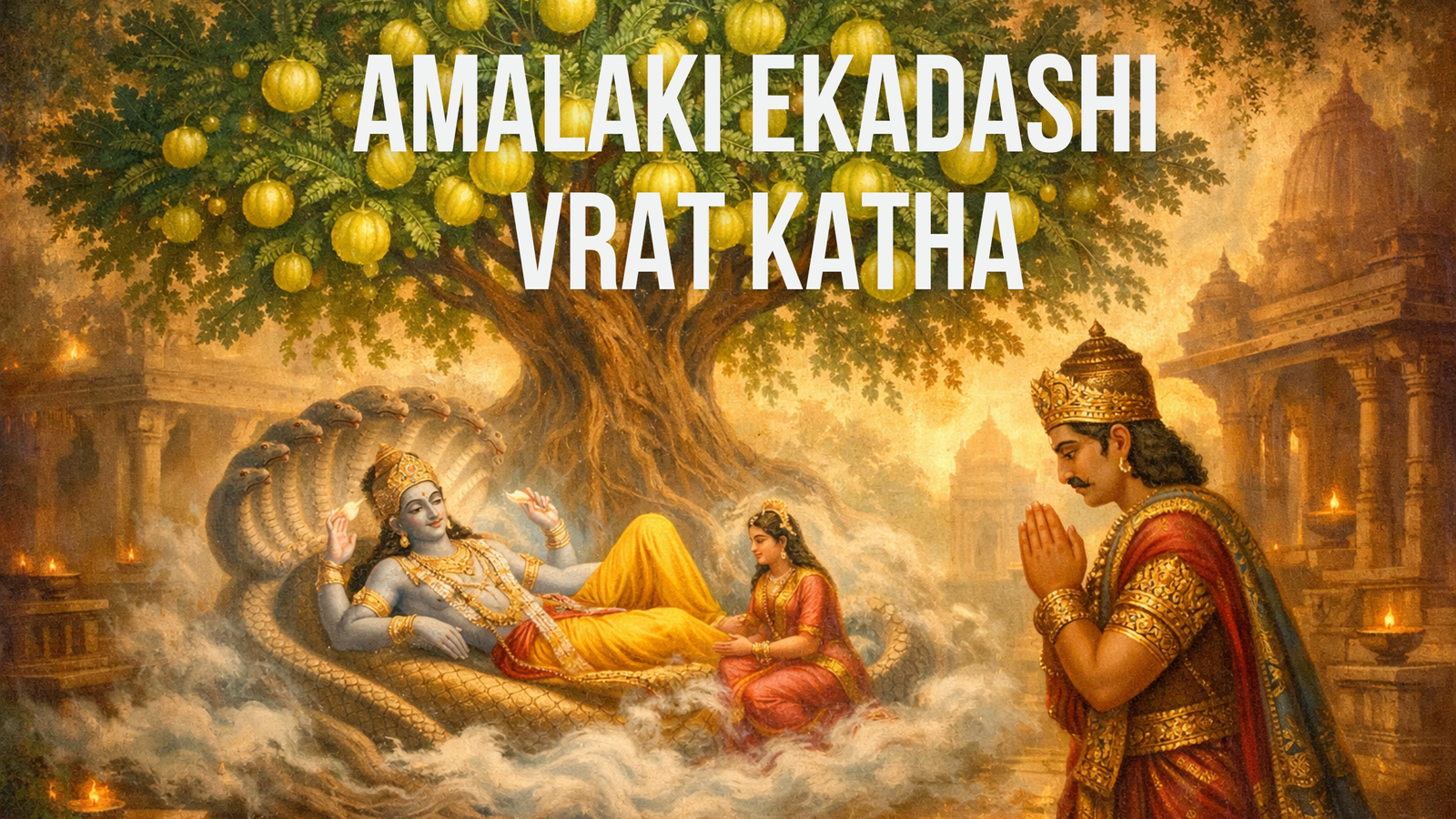
The word “Amalaki” refers to the Amla fruit, or the Indian Gooseberry, a tree considered immensely sacred in Sanatana Dharma. It is believed to have originated from the very being of Lord Vishnu, and to worship this tree on this day is to worship the Lord himself. The fast of Amalaki Ekadashi is considered one of the most supreme, capable of dissolving all sins and ultimately leading a soul to liberation (moksha). Its virtue is said to be equal to the merit of donating a thousand cows.
To truly understand its power, let us journey back in time and listen to the sacred story, the Amalaki Ekadashi Vrat Katha, as it was told by the great sage Vashishtha to King Mandhata.
The Amalaki Ekadashi Vrat Katha
The great King Mandhata, his heart filled with devotion, once approached the wise Maharishi Vashishtha. “O great sage,” he said, “if you are pleased with me, please tell me of a sacred fast, one whose observance will bring ultimate benefit to my life and my soul.”
Maharishi Vashishtha, his eyes filled with kindness, replied, “O King! The fast of Amalaki Ekadashi is the best of all fasts. It destroys all sins and, in the end, grants salvation.”
Intrigued, the king asked, “O expert of the Vedas! How did this sacred fast come into being? What is the story behind its power?”
The Maharishi smiled and began to narrate the ancient tale.
The City of Vedic and the Devout King
“Listen carefully, O King,” said Vashishtha. “In ancient times, there was a beautiful city named Vedic. It was a place of immense peace and prosperity, where people of all four varnas—Brahmin, Kshatriya, Vaishya, and Shudra—lived in perfect harmony. The sacred chants of the Vedas echoed through its streets, and there was no sinner, atheist, or evildoer to be found.
This divine city was ruled by a Chandravanshi king named Chaitraratha. He was a deeply learned and righteous ruler. In his kingdom, no one was poor or miserly. All his subjects, from the youngest child to the oldest elder, were devotees of Lord Vishnu and observed the Ekadashi fast with unwavering faith.
One year, as the month of Phalguna arrived, so did the sacred Amalaki Ekadashi. The entire kingdom, led by King Chaitraratha, observed the fast with great joy. The king, along with his people, went to the temple. There, they installed a sacred pot (Kalasha) and began to worship the Dhatri (Amla tree) with incense, lamps, divine food offerings, and a golden umbrella.
Together, they prayed with one voice: ‘O Dhatri! You are the very form of Brahma. You were born from Lord Brahma himself and are the destroyer of all sins. Salutations to you. Please accept our humble offerings. You were honored by Lord Ramchandra, and so we pray to you, please take away all our sins.’
The Unknowing Devotee
That night, the king and all his people kept a vigil (jagarana), staying awake in the temple, singing hymns and listening to stories of the Lord.
By chance, a bird hunter, a man who had lived a life of sin and violence to feed his family, stumbled upon the temple. He was exhausted, hungry, and thirsty. Seeking shelter, he sat in a quiet corner of the temple. Though he did not intend to, he sat through the entire night, listening to the divine stories and the Ekadashi Mahatmya being recited. He, too, observed the vigil, unknowingly participating in the sacred fast.
In the morning, when the devotees returned to their homes, the hunter also went to his and ate his meal. Some time later, the hunter passed away.
Due to his life of violence, he was destined for hell. However, because of the immense merit he had unknowingly gained by observing the Amalaki Ekadashi fast and vigil, a different fate awaited him.
A Royal Rebirth
The hunter was reborn as the son of the great King Viduratha and was named Vasuratha. As he grew, he became a mighty and righteous ruler, commanding a vast army and ruling over ten thousand villages.
He was as radiant as the sun, as brilliant as the moon, as brave as Lord Vishnu, and as forgiving as the Earth herself. He was a truthful, courageous, and devout follower of Lord Vishnu, treating all his subjects with love and respect. Giving charity was his daily ritual.
One day, while on a hunt, King Vasuratha lost his way in the deep forest. Tired, he fell asleep under a tree. Soon, a group of hill bandits discovered the lone king. Shouting ‘Kill him, kill him!’, they rushed towards him.
“This evil king has banished our families!” they cried. “We must take our revenge now!”
They began to strike the sleeping king with their sharp weapons. But a miracle occurred. Every weapon that touched the king’s body was instantly destroyed, feeling to him like a shower of flowers. Soon, by the will of the Lord, the bandits’ own weapons turned against them, and they all fell unconscious.
At that moment, a divine and beautiful Goddess emerged from the king’s own body. Adorned with beautiful clothes and jewels, her eyebrows were furrowed with divine anger. Flames of fury shot from her eyes. In an instant, this divine form, like Time itself, destroyed all the bandits.
When the king awoke, he was bewildered to see the dead bandits surrounding him. “Who has killed them?” he wondered. “Who is my great well-wisher in this desolate forest?”
As he pondered this, a voice from the sky, an Akashvani, spoke: “O King! Who else but Lord Vishnu can protect you in this world?”
Hearing this divine voice, the king was overwhelmed with devotion. He bowed to Lord Vishnu, returned to his city, and ruled with even greater faith for the rest of his days.”
Maharishi Vashishtha concluded, “O King! All of this was the effect of the Amalaki Ekadashi fast. A person who observes even one Amalaki Ekadashi with faith becomes successful in all their endeavors and, in the end, attains the supreme abode of Vaikuntha Dhama.”
FAQs
The primary benefit of the Amalaki Ekadashi fast is the complete destruction of one’s sins and the attainment of moksha (liberation). It is believed to grant immense spiritual merit, success in all worldly endeavors, and the ultimate grace and protection of Lord Vishnu.
The Amla, or Amalaki/Dhatri, tree is considered sacred because it is believed to have originated from Lord Vishnu himself. Worshipping the tree on this specific Ekadashi is considered equivalent to worshipping the Lord directly, and it is a central part of the day’s rituals.
While observing the fast with devotion is the most important aspect, listening to or reading the Vrat Katha is a highly recommended part of the ritual. The story (Katha) helps to focus the mind on the glory of the Lord and reinforces the faith and intention behind the fast, thereby amplifying its spiritual benefits.
The story of the hunter illustrates the immense, unconditional grace of Lord Vishnu and the purifying power of devotion, even when it is performed unknowingly. It shows that coming into contact with a sacred act, like the Ekadashi fast and vigil, can erase lifetimes of negative karma and elevate a soul to a state of righteousness and divine protection.