The Story of Khatu Shyam Ji: A Tale of Supreme Sacrifice
In the heart of Rajasthan, where faith echoes in every grain of sand, lies the sacred temple of Khatu Shyam Ji. Every day, thousands of voices unite in a single, powerful chant: “Shyam Baba ki Jai!” But who is Khatu Shyam Ji, and why is he revered as the ultimate support for those who feel lost? The answer lies in a timeless tale of immense power, profound wisdom, and the ultimate sacrifice—the story of a great warrior named Barbarik.
The Birth of a Mighty Warrior
Long ago, during the epic era of the Mahabharata, a child of incredible destiny was born. He was Barbarik, the son of the mighty Ghatotkacha and the grandson of the Pandava prince, Bhima. From his very childhood, Barbarik was a prodigy. Blessed with the strength of his forefathers and guided by divine sages, he mastered the arts of warfare.
Lord Shiva himself bestowed upon him a powerful boon: three infallible arrows. These were no ordinary arrows; they held the power to end any war in a minute.
- The first arrow could mark everything Barbarik wished to destroy.
- The second arrow could mark everything he wished to spare.
- The third arrow would then unleash its power, destroying everything marked by the first.
With these three arrows, Barbarik was invincible. He was a warrior who could conquer the world, yet his heart was humble and devoted to Dharma (righteousness).
The Call to the Great War
As the drums of the great Mahabharata war began to beat, Barbarik prepared to join the battle. He made a solemn promise to his mother: he would fight for the side that was weaker, the side that was losing. With this noble intention, mounted on his legendary blue horse, he set off for the battlefield of Kurukshetra.
However, this noble promise held a great paradox. If he joined the weaker side, his immense power would instantly make it the stronger one. He would then be bound by his vow to switch and fight for the other side. This would create an endless cycle, trapping the war in a stalemate where he would be the only one left standing.
The Divine Encounter with Lord Krishna
Lord Krishna, the divine orchestrator of the Mahabharata, knew of Barbarik’s vow and his incredible power. To protect the balance of Dharma, he intercepted the young warrior on his way to the battlefield, disguised as a simple Brahmin.
“Who are you, O mighty warrior, and where are you headed?” Krishna asked gently.
Barbarik respectfully introduced himself and explained his vow to support the weaker side. Krishna, with a knowing smile, pointed out the flaw in his promise. “If you keep switching sides,” he explained, “won’t you be the only one left in the end?” Barbarik, a man of great wisdom, immediately understood the dilemma.
To test his power, Krishna challenged him. “With a single arrow,” he said, “can you pierce every leaf on that great Peepal tree?”
Barbarik accepted. He closed his eyes, took aim, and released his first arrow. In a flash, it soared through the air, piercing every single leaf on the tree. It even circled around Krishna’s foot to pierce a leaf he had cleverly hidden beneath it. Krishna was astounded. He knew that Barbarik’s power was absolute.
The Supreme Sacrifice
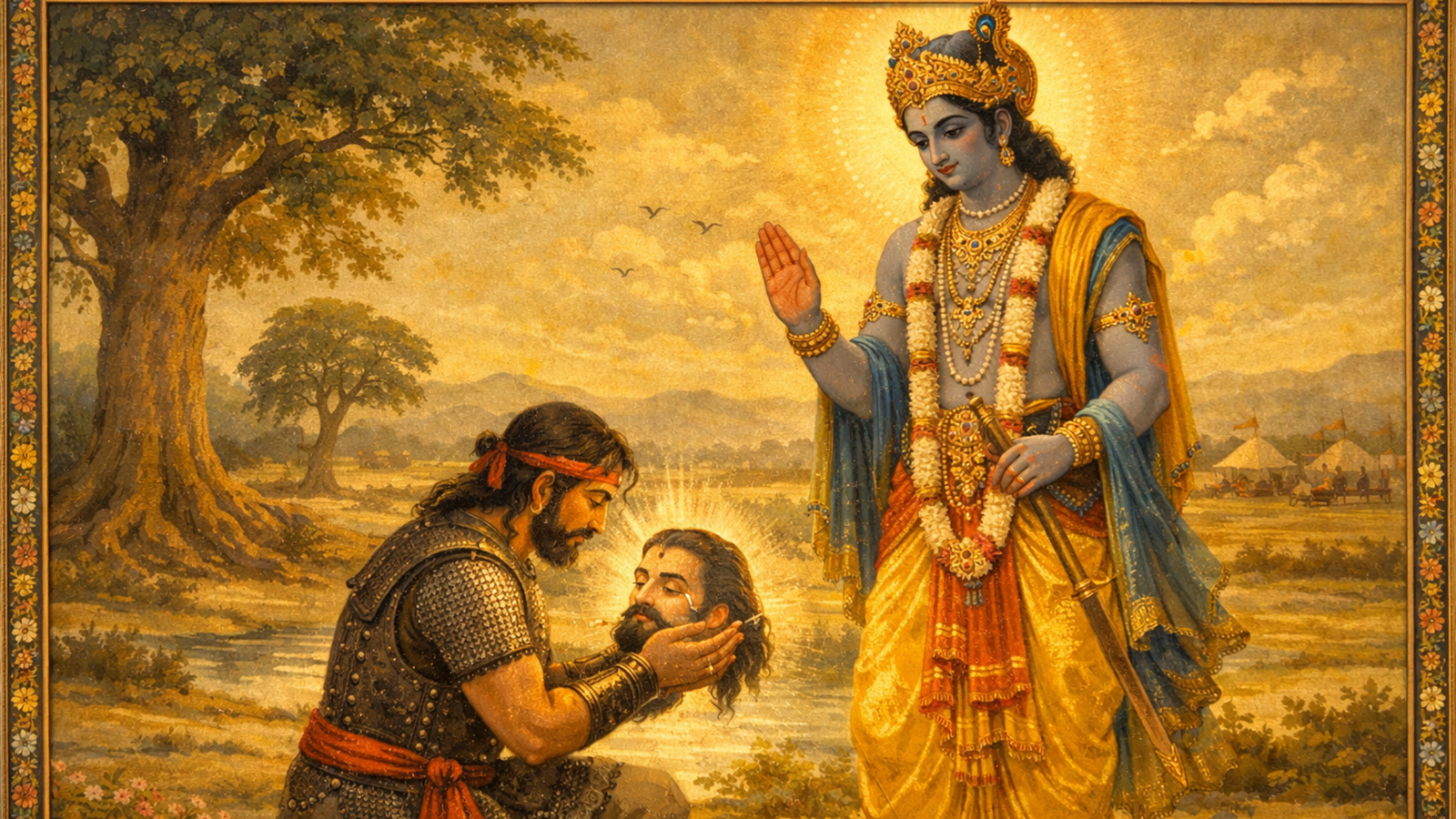
Revealing his divine form, Krishna explained the greater complexities of Dharma. He told Barbarik that for the good of the world and for the war to reach its righteous conclusion, a great sacrifice was needed. As his guru, he asked Barbarik for the ultimate Guru Dakshina: his head.
Another warrior might have hesitated, but Barbarik’s devotion was pure. Without a flicker of doubt, he bowed his head and said, “My Lord, it is my greatest honor.” He had only one request: to be able to witness the entire war.
Deeply moved by this supreme act of surrender, Krishna granted him a magnificent boon. “In the Kali Yuga,” he declared, “you will be worshipped by my own name, Shyam. Whoever remembers you with a pure heart, their troubles will be taken away, and their wishes shall be fulfilled.”
Krishna then placed Barbarik’s head atop a hill overlooking the Kurukshetra battlefield. From there, the great warrior witnessed every moment of the epic war.
The Birth of Khatu Shyam Ji
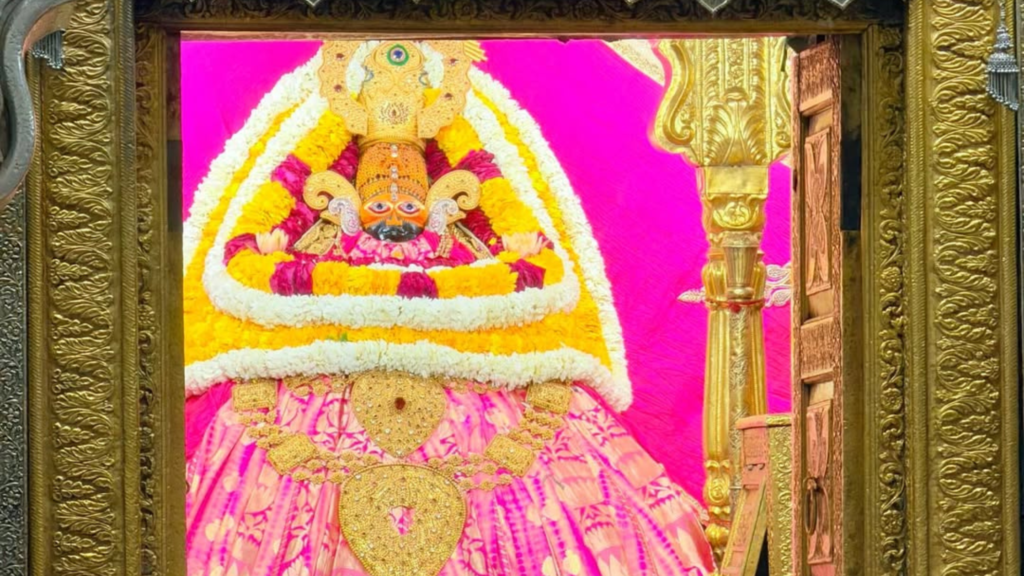
Centuries passed, and the sacred head lay buried in the soil of Rajasthan. One day, a cow belonging to a local villager began to spontaneously pour her milk over a particular spot of earth every single day. Curious, the villagers dug up the spot and unearthed a divine, glowing head.
The sacred head was enshrined in a magnificent temple in the town of Khatu, which we know today as the Khatu Shyam Ji Mandir. Here, Barbarik is worshipped as Shyam Baba, the loving and compassionate form of Lord Krishna in our age. He is lovingly called by many names:
- Haare ka Sahara (The Support of the Defeated)
- Morvi Nandan (The Son of Moorvi)
- Sheesh ke Daani (The Giver of the Head)
The story of Khatu Shyam Ji is a powerful lesson in devotion. It teaches us that true strength lies not in power, but in surrender. It reminds us that when we offer our ego at the feet of the divine, we receive a grace that is eternal.
So, the next time you chant “Shyam Baba ki Jai!”, remember the great warrior who gave everything for Dharma, and know that you are calling upon a love that is always there to support you, especially when you feel defeated.
FAQs
In the Mahabharata, Khatu Shyam Ji is the warrior Barbarik, the grandson of the Pandava Bhima. He sacrificed his head to Lord Krishna before the war began and was blessed by Krishna to be worshipped in the Kali Yuga by the name Shyam.
He is called “Haare ka Sahara” because of his promise to always support the weaker side. Devotees believe that in the Kali Yuga, he provides strength, hope, and support to anyone who feels lost, defeated, or is facing immense hardship in their life. Praying to him with a pure heart is believed to provide divine assistance.
The three infallible arrows were a boon from Lord Shiva that made Barbarik invincible. The first arrow could mark all his targets, the second could mark what to save, and the third would destroy all the marked targets. This symbolized his absolute power, which he ultimately sacrificed for the greater good of Dharma.
After the Mahabharata, Barbarik’s head was buried in the land of Khatu in Rajasthan. Centuries later, it was discovered after a cow began miraculously pouring her milk over the spot. The divine head was then enshrined in a temple by the local king, which is now the world-famous Khatu Shyam Ji Mandir.