
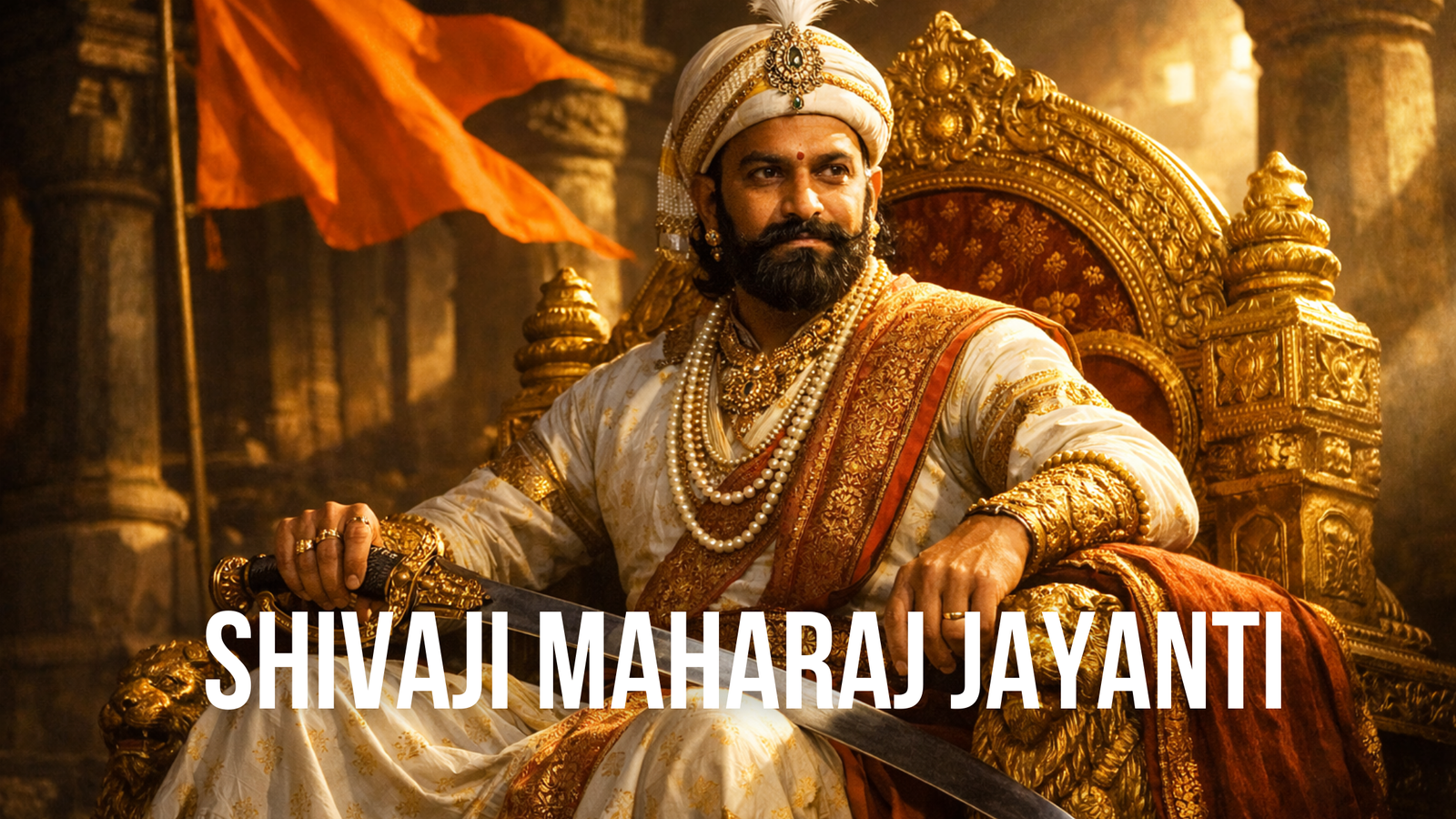
Shivaji Maharaj Jayanti: The Legacy of Chhatrapati Shivaji Maharaj, the King Who Forged an Empire
Every year on February 19th, the air in Maharashtra and across India resonates with a powerful chant: “Jai Bhavani, Jai Shivaji!” This is Shivaji Maharaj Jayanti, a day celebrating the birth of not just a king, but an idea—the idea of self-rule, of unwavering courage, and of a kingdom built on justice and righteousness.
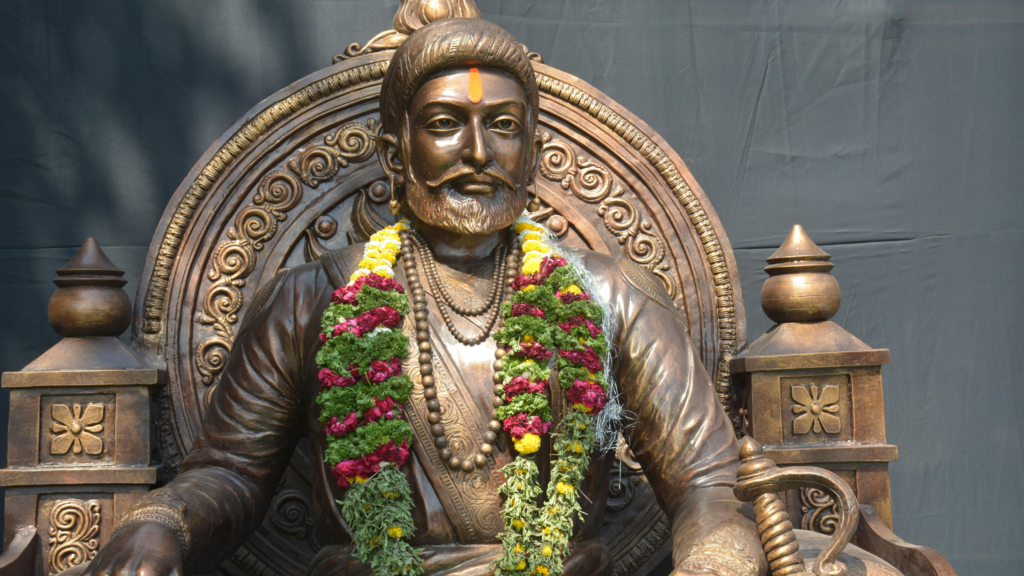
Chhatrapati Shivaji Maharaj (1630–1680) was more than a ruler; he was a force of nature. Born the son of a Maratha noble, he rose to challenge the might of the Mughal and Sultanate empires, carving out a realm that would become the formidable Maratha Empire. His life is a masterclass in strategy, governance, and the indomitable spirit of Hindavi Swarajya (self-rule of Hindu people). On this auspicious day, we journey back in time to honor the legacy of this mountain-rat, this visionary king, this Chhatrapati.
The Making of a King: Early Life and Influences
On February 19, 1630, in the rugged hill-fort of Shivneri, a child named Shivaji Bhonsle was born to Shahaji Bhosle and the deeply devout Jijabai. While his father Shahaji was a brilliant general serving the Deccan Sultanates, it was his mother, Jijabai, who became the primary architect of Shivaji’s character.
Raised under her watchful eye and the mentorship of his guardian, Dadoji Konddeo, the young Shivaji was immersed in tales of the Ramayana and Mahabharata. He learned swordsmanship, horse riding, and archery, but more importantly, he learned the principles of Dharma. As a boy, he explored the winding paths of the Sahyadri mountains, befriending the local Maval warriors and understanding the land that would one day become his greatest strategic asset. It was here, amidst these hills, that the dream of Swarajya took root in his heart.
The Warrior’s Art: Guerrilla Warfare and a Web of Forts
Shivaji Maharaj’s military genius was legendary. Facing vast, heavily armed imperial armies, he did not fight on their terms. He rewrote the rules of war. His primary tactic was “Ganimi Kava”—a sophisticated form of guerrilla warfare.
Using his light, swift cavalry and the hardy Maval infantry who knew the hills like the back of their hand, he would launch lightning-fast surprise attacks and execute strategic retreats into the impenetrable Ghats. He was a master of psychological warfare, earning the taunt “Mountain Rat” from his enemies, a name that concealed their deep-seated fear and respect.
Forts were the backbone of his kingdom. Capturing or building over 300 of them, he created a defensive web that was nearly impossible to breach. From his capital at Raigad to the naval bastions of Sindhudurg and Vijaydurg, each fort was a symbol of Maratha resilience.
Key Conquests: Forging an Empire
Shivaji’s journey to Swarajya began at the tender age of 16 when he captured his first fort.
- Torna Fort (1646): His very first conquest, which provided the treasury to fund his ambitious military campaigns.
- The Battle of Pratapgad (1659): A legendary encounter where he defeated the treacherous and imposing Bijapuri general, Afzal Khan, in a duel, turning the tide of the war.
- The Siege of Panhala (1660): A masterful escape that showcased his strategic brilliance and courage under pressure.
- The Recapture of Sinhagad (1670): An epic and costly victory immortalized by his words on losing his brave commander, Tanaji Malusare: “Gad aala, pan sinha gela” (The fort is won, but the lion is lost).
- The Surat Raids (1664, 1670): Daring raids on the wealthy Mughal port that funded the establishment of a powerful Maratha navy, earning him the title “Father of the Indian Navy.”
A Kingdom of Justice: The Ashta Pradhan Council
Shivaji Maharaj was not just a warrior; he was a visionary administrator. His goal was a kingdom that was efficient, just, and served its people. The cornerstone of his administration was the Ashta Pradhan—a council of eight ministers, each with a defined role, from the Peshwa (Prime Minister) to the Senapati (Commander-in-Chief).
He abolished the exploitative Jagirdari system, paying his officials in cash to curb corruption. He introduced a fair revenue system, the Ryotwari, where farmers paid a fixed part of their produce directly to the state. His spies kept him informed, his forts served as grain stores during famine, and his laws were meant to protect the common man.
A Ruler for All: A Legacy of Religious Tolerance
In an age of religious persecution, Shivaji Maharaj stood as a beacon of tolerance. Though a devout Hindu dedicated to protecting Swadharma, his policies were remarkably inclusive.
- He guaranteed religious freedom for all faiths.
- He appointed Muslims to high-ranking positions in his army and navy based on merit.
- He gave strict orders to his army to respect women, holy books like the Quran, and all places of worship during their campaigns.
- He famously condemned Aurangzeb’s Jizya tax on non-Muslims, championing the cause of equality.
His kingdom was a true Swarajya, a place where all subjects could live with dignity and freedom.
The Coronation and an Eternal Legacy
On June 6, 1674, at Raigad Fort, Shivaji Maharaj was crowned Chhatrapati (Sovereign Monarch). The ceremony, performed by the great scholar Gaga Bhatta, was a formal declaration of Maratha independence and the birth of a new Hindu empire.
Shivaji Maharaj’s life came to an end on April 3, 1680, but his legacy is eternal. He is remembered as an icon of resistance, a master strategist, a just ruler, and the king who dared to dream of freedom and made it a reality. On Shivaji Maharaj Jayanti, we don’t just celebrate a birth date; we celebrate the birth of an era and the timeless spirit of courage that continues to inspire millions.
FAQs
Shivaji Maharaj Jayanti is celebrated on February 19th to commemorate the birth of Chhatrapati Shivaji Maharaj, who was born on this day in 1630 at the Shivneri Fort in Maharashtra. It is a day of great pride and celebration, marked by processions, cultural events, and treks to his forts.
“Hindavi Swarajya” was the vision of Chhatrapati Shivaji Maharaj. It translates to “self-rule of the people” but is often understood as Hindu self-rule. It was a principle of establishing a kingdom that was free from foreign domination (Mughal and Sultanate), governed by principles of justice, tolerance, and righteousness, where its people could practice their culture and religion freely.
The Ashta Pradhan was the administrative council created by Shivaji Maharaj, consisting of eight ministers. Each minister had a specific portfolio, such as finance, foreign affairs, and justice. This system created a decentralized and efficient cabinet form of government, ensuring accountability and smooth functioning of the empire.
Shivaji Maharaj is called the “Father of the Indian Navy” because he was one of the first Indian rulers to recognize the strategic importance of a strong navy for protecting the coastline and trade routes. He built a formidable fleet of ships and established secure naval bases like Sindhudurg and Vijaydurg to challenge the naval power of the Siddis, Portuguese, and English on the Konkan coast.