जयपुर के पाँच छुपे हुए मंदिर
Five Sacred Spaces · Hidden in Plain Sight · The Pink City’s Best Kept Secrets
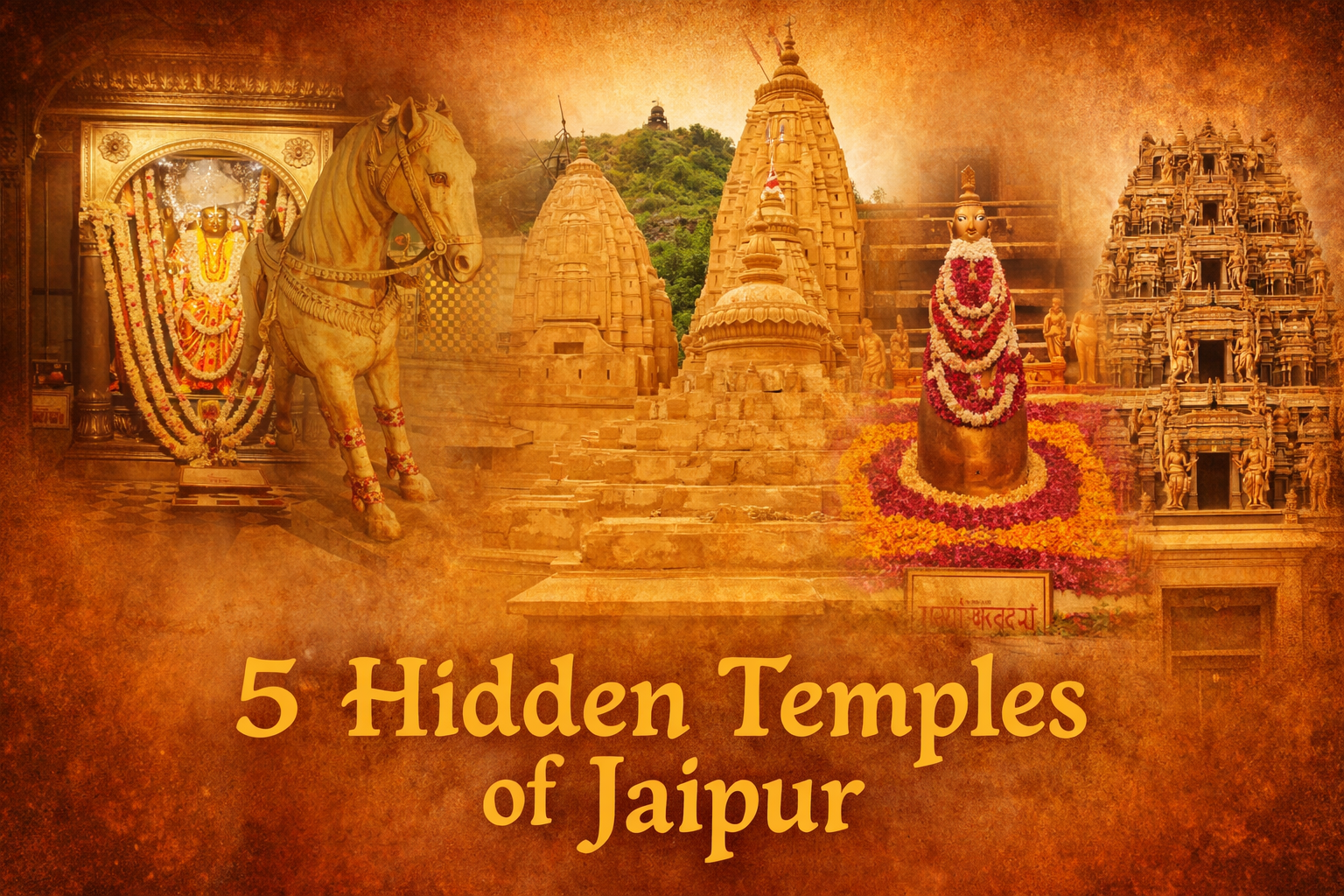
Every visitor to Jaipur sees the same temples. Birla Mandir gleams white on its little hill. Govind Dev Ji fills with thousands of devotees at each of its eight daily aartis. Moti Dungri sits compact and tidy above its traffic roundabout. These are fine temples — genuinely beautiful, genuinely sacred. But they are known. They are photographed. They appear in every travel guide, every Instagram reel, every “top things to do in Jaipur” list. The Jaipur we are taking you to today is different. This is the Jaipur of lanes so narrow you have to turn sideways to pass through them. Of a Shivling found buried twenty-two feet underground by a curious king. Of a shrine built for a god who has not yet arrived. Of a Dravidian gopuram rising, inexplicably and magnificently, from the middle of a Rajasthani neighbourhood. These five temples are not hidden because they are unimportant. They are hidden because the world’s attention is elsewhere — and they have been quietly going about their sacred business for centuries without needing it. Here is where to go when you want the real Jaipur.
01 · Ambikeshwar Mahadev Temple, Amer
The temple that gave Amer its name — and holds a Shivling buried twenty-two feet underground Stand at the foot of the Amer Fort and watch the tourists. Every single one of them is looking up — at the fort, at the battlements, at the impossible scale of the Kachhwaha achievement rising from the Aravalli ridge. Not one in a hundred looks across the lane to where a quieter building sits, its floor sunk below road level, its Nagara-style shikhara painted the warm ochre of old Rajasthan. This is Ambikeshwar Mahadev Temple. And it was here before the fort. Before the city. Possibly before the Kachhwaha clan itself.
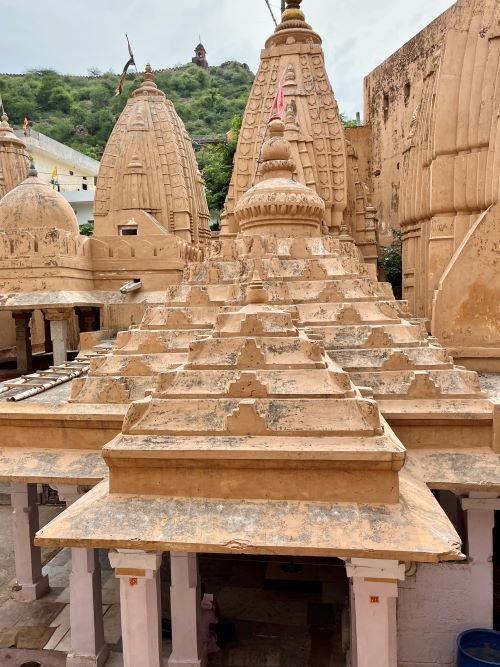
The story of how it was found is one of the most beautiful in Rajasthani lore. A king — variously identified as the Meena chief Ambikesh or the Kachhwaha ruler Kakil Dev — heard a strange report from his herdsmen. One particular cow, out of the whole herd, would walk to a specific spot in the forest every single day and release her milk directly onto the ground, as though offering it to something unseen. The curious king ordered that spot excavated. His men dug down. And down. Twenty-two feet below the surface of the earth, they found a Shivling — a natural, self-manifested one, a swayambhu — pulsing quietly in the dark soil as though it had been waiting. The king built a temple around it. The entire floor of the sanctum was built at the level of the Shivling, which means it sits twenty-two feet below the road outside. Even today, to see the Shivling, you peer down through a circular opening in the floor, into a kind of holy well. The stone is very old. Its surface is smooth from centuries of water offerings. The sanctum is held up by fourteen intricately carved pillars, and the whole chamber has the dim, cool quality of a place that has been protected from ordinary time. The miracle that happens every monsoon has never been fully explained. When the rains come and the nearby Panna Meena Ka Kund fills to overflowing, water begins to rise in the sanctum from below. Not from the kund flowing in. From underground, as though the earth itself is making an offering to the Shivling. The water submerges the linga completely. When the monsoon ends, it recedes. This has been happening, according to the temple’s priests, for as long as anyone can remember. There is one more layer to this story. According to some traditions, this is the place where Krishna’s first haircut — his mundan ceremony — was performed. The area was known as Ambika Van, the forest of Ambika. Over centuries, Ambika Van became Amer. The world-famous fort above is named, indirectly, for this temple below. The Kachhwaha rulers understood this. They built their capital in the spiritual shadow of Ambikeshwar Mahadev. The fort came later. The Shivling was always first.
Location
Amer Sagar Road, Amer town · Just across from Panna Meena Ka Kund · Walk down from Amer Fort’s rear exit
Best Time to Visit
Early morning, any day · Sawan Mondays for the submerged Shivling experience (Aug–Sep)
Do Not Miss
The recessed Shivling viewable only through a circular opening in the floor · The 14 carved pillars · The painted exterior wall showing a Maharaja’s army procession
The Whispering Bharat Verdict
The most historically layered temple in the entire Jaipur region. The Amer Fort gets all the attention. This temple deserves half of it.
02 · Kalki Mandir, Sirah Deori Bazaar
The only temple in India dedicated to a god who has not yet arrived You could walk past Kalki Mandir a hundred times and never notice it. It sits behind a row of noble mansions in the Sirah Deori Bazaar — directly opposite the eastern gate of the City Palace, 200 metres from Hawa Mahal — and yet it remains almost entirely invisible to the thousands of tourists who pass through this area every single day. Even many Jaipur residents have never been inside. This is, quite simply, one of the most theologically extraordinary temples in India. Kalki Mandir was built by Maharaja Sawai Jai Singh II, the founder of Jaipur, around 1727 to 1739. Jai Singh was a remarkable man — the same king who built the Jantar Mantar observatories, who performed the Ashwamedha Yajna when no other Hindu ruler dared, who was as much astronomer and Vedic scholar as military commander. And in the full possession of his Vedic knowledge, he built a temple to a god who does not yet exist. Kalki is the tenth and final avatar of Lord Vishnu. He has not come yet. He will come, according to the Puranas, at the very end of Kali Yuga — riding a white horse named Devadatta, carrying a blazing sword, to cleanse the world of accumulated evil and usher in a new Satya Yuga. The entire universe is still waiting for him. But Jai Singh decided not to wait to build his temple.
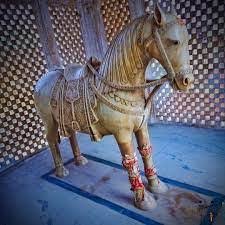
Step inside and the strangeness deepens. The garbhagriha holds idols of Lord Kalki seated alongside Goddess Lakshmi — a king yet to be crowned, seated with a queen, in a temple waiting for its deity to arrive. In the courtyard, a canopied kiosk houses a white marble statue of Devadatta — Kalki’s horse, carved from a single block of marble. The horse faces the temple, as though waiting for his rider. The rear left leg of the statue bears a crack. Local legend says this is a wound. When the wound heals completely, it will mean Kalki has arrived and Kali Yuga has ended. The architecture is unique among Jaipur’s temples. Two shikharas rise above the structure — no other Hindu temple of this era has two domes. The temple sits on a high plinth, accessed by a ramp rather than steps — because the horse must be able to climb up when the time comes. Every architectural decision is a preparation for an arrival that has not happened yet. Historians also note that Jai Singh may have built this temple partly in memory of his grandson Kalik Singh, who died in childhood. Grief and theology becoming the same act of creation. A grandfather building a temple to eternity in memory of a child he could not save.
“A king built a home for a god who has not yet arrived, with a horse waiting in the courtyard and a wound that will heal when the world is finally ready.”
— The Whispering Bharat description of Kalki Mandir
Location
Sirah Deori Bazaar, Badi Chaupar · Opposite the eastern gate of City Palace · ~200m from Hawa Mahal · Look for the ramp entrance hidden behind the street buildings
Timings
6:00 AM – 10:00 AM · Evening hours variable — check with temple · Maintained by Devasthan Vibhag
Do Not Miss
The white marble horse Devadatta in the courtyard kiosk — examine the crack on the rear left leg · The two shikharas visible from outside · The Kalki-Lakshmi idol in the garbhagriha
The Whispering Bharat Verdict
200 metres from Hawa Mahal. Visited by almost nobody. This is the most extraordinary theological story in all of Jaipur’s religious landscape.
03 · Jharkhand Mahadev Temple, Prempura
The temple with a South Indian gopuram in the heart of Rajasthan — and a tree that grew inside its sanctum When you turn the corner into the street at Prempura, Vaishali Nagar, you see something that the architecture around it has given absolutely no warning of. Rising above the ordinary geometry of the Jaipur neighbourhood is a gopuram — a South Indian temple tower, with the distinctive stacked tiers, the rows of carved figures, the characteristic moustaches on the Rudragana guardian deities above the main entrance. The building looks like it was picked up from Tamil Nadu and set down, intact and magnificent, in the middle of Rajasthan.
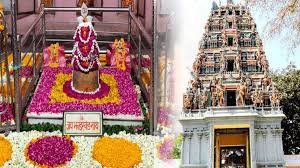
The story of why a Dravidian gopuram exists in the Pink City begins with a trust chairman named Jai Prakash Somani who loved travelling to South India. In the year 2000, when the old shrine at this site was due for restoration — it had been a modest Shiva temple since 1918, a single small room with a Shivling in a forest that gave the site its name (*jharkhand* meaning land of dense forest and bush) — he had a vision. He called a team of traditional architects, sthapatis, from the South. The chief architect, S. Natarajan, designed the new temple according to the complete rules of Dravidian Devalaya Vastu: the square chatursara plan, the correct cardinal alignment using Suddha Prache for liberation, the gopuram with its distinctly mustachioed Rudraganas, every proportion drawn from the ancient Manasara text. Three hundred skilled workers came from South India to build it. They worked with the specific stone blocks and carving traditions of the Dravidian school. The result is architecturally perfect — and completely out of place in the way that only genuinely interesting things ever are.
But the true magic of Jharkhand Mahadev Temple is what was preserved inside when the new structure was built. During construction, a tree was found growing naturally in the space between the main gate and the sanctum. Rather than remove it, the builders designed around it. The tree remains today, growing between the gopuram and the garbhagriha, as though it were always part of the plan. The sanctum itself is North Indian in design — a North Indian inner shrine clothed in a South Indian outer shell, with a living tree in between. Every architectural tradition on this subcontinent, in one building. The temple’s name also carries a small piece of etymology worth knowing. *Jharkhand* does not refer to the state of Jharkhand in eastern India. It is an older Rajasthani compound: *jhad* meaning bush or undergrowth, and *khand* meaning region or territory. This was the place of the forest. The Shivling that a devotee named Baba Gobindnath found here while in meditation was surrounded by dense jungle on all sides. That jungle is long gone — the city has swallowed it — but the name remains.
Location
Queens Road, Vaishali Nagar, Prempura · Jaipur 302021 · Contact: 0141-2350589
Best Time to Visit
Early morning daily · Sawan Mondays — extraordinary crowd energy for panchamrit abhishek · Mahashivratri for the largest celebration
Do Not Miss
The mustachioed Rudragana figures above the gopuram entrance · The living tree growing between gate and sanctum · The contrast between Dravidian exterior and North Indian interior
The Whispering Bharat Verdict
The architectural story here is as compelling as any fort or palace in Jaipur. The gopuram alone is worth the auto-rickshaw fare.
04 · Kala Mahadev Temple, Kanak Valley
Built with Tantric rituals by Maharaja Man Singh, open to the sky on all four sides Kanak Valley sits at the base of the Nahargarh ridge — a green, quietly beautiful stretch of Aravalli foothills that most Jaipur visitors see only as a backdrop to photographs. The Kanak Vrindavan garden here is on the tourist map. The Kala Mahadev Temple, a few minutes’ walk deeper into the valley, is not. This is the only openly Tantric-origin temple in Jaipur. Maharaja Man Singh — the great general of Emperor Akbar’s court, the king who built more temples across the subcontinent than perhaps any ruler of his era — commissioned Kala Mahadev following Tantric ritual protocols rather than the more common Agamic or Vaishnavite traditions.
The word Kala attached to Mahadev is not incidental. In Sanskrit, *Kala* carries multiple meanings simultaneously — time, death, darkness, the colour black. Kala Mahadev is Shiva in his most primal, most time-swallowing aspect. This is not the accessible, benevolent Shiva of household worship. This is the Shiva who stands at the burning ground, who wears serpents, who dances on the corpse of Muyalaka to remind the universe of its own impermanence. The architectural choice reflects this. The temple is open from all four sides — no walls enclosing the sanctum, no sheltered interior. Sky above, Aravalli around, the Shivling at the centre receiving whatever light, rain, or wind the day offers. This openness is itself a Tantric statement: Shiva in his Kala aspect belongs to no enclosed space. He is larger than any building. In the immediate surroundings are statues of Nandi, Goddess Parvati, Lord Ganesha, and Kartikeya. The Kanak Valley itself is quiet beyond the tourist season — a winding valley path, seasonal waterfalls during monsoon, and the sense that you have genuinely left the city behind even though Nahargarh Fort is visible on the ridge above. Go on a weekday, in the morning, and you may be the only person there for twenty minutes at a stretch. That is a very rare experience in Jaipur.
Location
Kanak Valley, near Kanak Vrindavan Garden · At the foothills of Nahargarh · 7 km from old city
Best Time to Visit
Early morning for solitude · Monsoon for waterfalls in the valley behind · Mahashivratri for the most charged energy
Do Not Miss
The four-sided open structure — no walls — framing Shiva against the Aravalli sky · The complete silence on a weekday morning · The valley walk toward the Nahargarh foothills
The Whispering Bharat Verdict
The most atmospheric temple on this list. Combine with Kanak Vrindavan for a full morning in the valley. No tourists. All peace.
05 · Kale Hanuman Ji Temple, Chandi Ki Taksal
A thousand-year-old black idol of Hanuman Ji, in the lane where Jaipur’s kings once minted silver coins. The lane is called Chandi Ki Taksal — literally, the mint of silver. This was where the royal mint of Jaipur once operated, where the coins of the Kachhwaha kingdom were struck from silver brought up from the mines of Rajasthan. The Maharajas’ treasury workers walked this lane. The silver press ran in one of these buildings. And at the end of it, almost hidden by the buildings pressing in from both sides, stands a temple that has been here for a thousand years and whose idol is unlike any other Hanuman Ji in the city. Kale Hanuman Ji. The Black Hanuman Ji. In almost every Hindu temple across North India, Hanuman Ji’s idol is red — vermilion red, the colour of devotion and strength. The redness itself is part of the worship; devotees bring sindoor to apply, continuing the colour that tradition began. But at this temple in Chandi Ki Taksal, the idol is black. It has always been black. And the reason connects this seemingly small neighbourhood temple directly to the Tantric tradition. Black Hanuman Ji idols, in Vedic tradition, are associated with Tantric consecration — with a mode of worship that emphasises Hanuman Ji’s fierce, protective, evil-averting aspects rather than his more commonly invoked role as the loyal devotee of Rama.
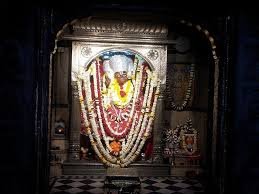
The Kale Hanuman Ji temple is considered to be around a thousand years old, predating the founding of Jaipur itself by at least seven centuries. Which means this temple was already ancient when Maharaja Sawai Jai Singh II laid out his grid city around it. Locals come here on Tuesdays and Saturdays — Hanuman Ji’s sacred days. They come especially to protect newborns from the evil eye, a tradition so old that nobody can say when it began. They come when they are afraid of something. The local belief is straightforward and complete: what you bring to Kale Hanuman Ji in genuine fear or genuine need, you do not leave carrying. The god takes it from you. The lane itself is worth walking slowly even before you reach the temple. The buildings still carry traces of their old function — carved stone doorways, faded merchant insignia, the shadows of the old imperial economy. At the end of this lane of history, the black idol waits in the dim interior as it has always waited, receiving what the city brings to it.
Location
Chandi Ki Taksal lane, near Ram Prakash Cinema, Hawa Mahal Road · Old City, Brahampuri · Walkable from Hawa Mahal
Best Time to Visit
Tuesday and Saturday mornings for peak devotion · Early weekday mornings for quiet · Walk the Chandi Ki Taksal lane slowly both ways
Do Not Miss
The black idol itself — compare it mentally to every red Hanuman you have seen elsewhere · The carvings on the lane’s old doorways · The atmosphere of an unchanged thousand-year neighbourhood
The Whispering Bharat Verdict
The lane of the royal mint. A black Hanuman at the end of it. This is the kind of Jaipur most people never find. Walk here slowly.
How to Do All Five in One Day
These temples are spread across Jaipur, but with reasonable planning, a single long day can cover all of them — and it makes a much more honest itinerary than a third trip to the same fort.
One Day · Five Hidden Temples · Suggested Route
- 6:30 AMAmbikeshwar Mahadev, Amer — Arrive at dawn before the Amer Fort crowds. The morning light on the painted exterior wall is extraordinary. Ask the priest about the monsoon flooding.
- 8:30 AMKalki Mandir, Old City — Drive from Amer (25 min). Enter before the morning hours close at 10 AM. Find the ramp entrance behind the buildings on Sirah Deori Bazaar. Study the horse’s left rear leg.
- 10:30 AMKale Hanuman Ji, Chandi Ki Taksal — A 10-minute walk from Kalki Mandir. Walk the full length of the mint lane before entering the temple.
- 12:30 PMLunch break at a local thali restaurant in the old city. Order the full Rajasthani thali. Rest during the hottest hour.
- 2:30 PMKala Mahadev, Kanak Valley — Drive to Kanak Vrindavan (15 min from old city). Walk into the valley toward the open-sided temple. Stay for at least 30 minutes in the quiet.
- 4:30 PMJharkhand Mahadev, Prempura — Drive to Vaishali Nagar (20 min). The evening light on the gopuram is the best of the day. Walk around the full exterior before going inside. Find the tree between the gate and the sanctum.
A Last Thought Before You Go
The temples most people visit in Jaipur are grand precisely because they were meant to be seen. They were built for display, for power, for the communication of royal devotion at a scale that even strangers could not miss. There is nothing wrong with that tradition. Some of those temples are genuinely magnificent. But the five temples on this list were built for different reasons. A king excavating a cow’s mysterious offering and finding the divine twenty-two feet underground. A Vedic scholar building a home for a god he knew would not arrive in his lifetime. A trust chairman who loved South Indian architecture and had the vision and resources to bring it north. A warrior-king commissioning a Shiva temple in the Tantric mode, open to all four winds. An unnamed devotee carving a black Hanuman into a thousand-year-old idol in a lane that used to mint silver. These are temples built from specific human stories. Not from royal ego but from genuine encounter — with myth, with grief, with devotion that couldn’t find expression in the ordinary forms. They have been waiting. They are not hard to find once you know they’re there.
❋Have you visited any of these temples? Did a priest share a story we haven’t told here? Did you find a sixth hidden temple that belongs on this list? Write to us — every lane in Jaipur’s old city is a conversation waiting to happen, and we are always listening.