
Surya Namaskar at Sunrise : The Ancient Practice and Its Forgotten Purpose
सूर्य नमस्कार · 12 Poses · 12 Mantras · One Complete Offering to the Source of All Life
| What it is | A sequence of 12 poses, 12 breaths, and 12 mantras performed as a moving act of worship to Surya — the Sun — the Vedic deity of consciousness, vitality, and cosmic intelligence. |
| Best Time | Brahma Muhurta to sunrise — ideally between 5:00 AM and 6:30 AM. The practice is meant to greet the first light, not follow it. |
| Direction | Face East — toward the rising sun. This is not convention; it is the alignment of the physical body with the direction of solar prana entering the world. |
| How Many Rounds | 1 round = 12 poses on the right leg + 12 poses on the left = 24 movements total. Begin with 4 rounds. Build to 12 over weeks. |
| Classical Source | Vedic tradition of Surya worship · Aditya Hridayam (Ramayana, Yuddha Kanda) · Rig Veda Surya hymns · Yoga Makaranda (T. Krishnamacharya, 1934) |
| Pancha Kosha Effect | Acts on all five sheaths of the self: Annamaya (body), Pranamaya (breath), Manomaya (mind), Vijnanamaya (intellect), Anandamaya (bliss) |
| The 12 Sun Names | Mitra · Ravi · Surya · Bhanu · Khaga · Pushan · Hiranyagarbha · Marichi · Aditya · Savitri · Arka · Bhaskara |
| The 6 Bija Mantras | Hraam · Hreem · Hroom · Hraim · Hroum · Hraha — each used twice across the 12 poses to complete the full solar cycle |
Before the gym. Before the protein shake and the fitness app and the twenty-minute HIIT routine. Before all of it — Bharat was doing this. Rising in the dark, walking to the open courtyard or the river bank or the field outside the village, facing East, pressing the palms together, and beginning. Twelve poses. Twelve breaths. Twelve names of the god who was, at that very moment, rising above the horizon to begin his own journey across the sky.
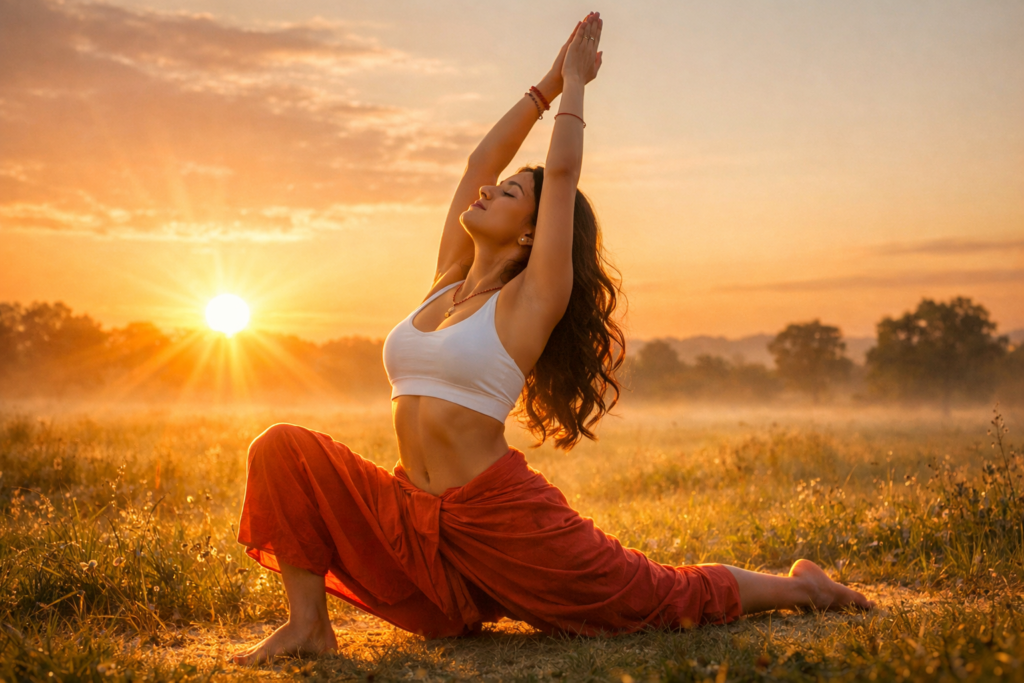
The modern world knows Surya Namaskar as a warm-up. A yoga sequence. Something you do before the real workout begins or at the opening of a yoga class. And it is these things — it is an extraordinarily efficient physical practice that works every major muscle group, regulates the breath, stimulates every organ, and can be completed in twelve minutes if that is all you have. But to call it a warm-up and stop there is like calling the Ganga a water source. Technically accurate. Spiritually impoverished.
Surya Namaskar is a prayer that happens to be a perfect physical practice. Or a perfect physical practice that happens to be a prayer. The two are so completely intertwined in the original conception that separating them leaves you with something less than either. The body that does Surya Namaskar without the mantras is exercising. The voice that chants the Surya mantras without the poses is reciting. The person who does both together — at sunrise, facing East, with the intention of offering the first act of their day to the source of all life — is doing something that Bharat has understood for five thousand years and that the modern world is only beginning, in its fragmented way, to recover.
This is the complete guide. The forgotten purpose. The twelve poses with correct form and breath. The twelve mantras with their meanings. The Vedic science of sunrise. And the understanding of what changes — in the body, in the mind, in the day itself — when you rise before the sun and meet it coming.
The Forgotten Purpose — What Surya Namaskar Actually Is
The name holds the answer. Surya: the Sun — not the astronomical object, but Surya the deity, the cosmic intelligence that the Vedas describe as Pratyaksha Brahman — the only form of the absolute divine that is directly visible to the human eye. Namaskar: salutation, greeting, prostration — from the root namas, to bow, and kar, to do. Together: the act of bowing to the sun. A daily, moving, breathing prostration to the most visible face of the divine.
In the Vedic understanding, the sun is not simply a star. It is the source of all prana — the life-force that animates every living being on earth. The Rig Veda’s Surya hymns describe him as the eye of Mitra and Varuna, the soul of all that moves and does not move, the light that removes darkness from both the sky and the heart. The Upanishads call him Aditya — the son of Aditi, the infinite — the bounded manifestation of that which has no boundary.
“Aditya Hridayam Punyam, Sarva Shatru Vinashanam — the sacred practice of Aditya Hridayam destroys all enemies. This is what sage Agastya taught Lord Rama on the battlefield of Lanka, before his final encounter with Ravana. The first and most ancient instruction on Surya worship was given on a battlefield, to a warrior who needed strength.”
— Ramayana, Yuddha Kanda
The Ramayana moment is worth sitting with. Rama — the embodiment of dharma, the seventh avatar of Vishnu — is exhausted on the battlefield at Lanka. Ravana seems undefeatable. The sage Agastya appears and gives him not a weapon, not a strategy, but a prayer: the Aditya Hridayam — the heart of Aditya. A hymn to the twelve forms of the Sun. Rama chants it three times, feels the energy return to his body, and defeats Ravana.
The instruction is precise: worship the Sun before the battle. Not after. Not when you are full of strength. When you are most depleted — that is when the Surya practice does its deepest work.
Surya Namaskar emerged from this tradition of Surya worship — the physical encoding of the same devotion that Agastya taught Rama, made into a sequence that a body could enact rather than merely a voice could chant. Each of the twelve poses corresponds to one of the twelve Adityas — the twelve solar deities of the Vedic pantheon, each representing one month of the solar year, one zodiacal phase, one aspect of the sun’s character as it moves through the year. To perform all twelve is to honour the complete solar cycle in a single morning practice.
This is what was forgotten when Surya Namaskar was reduced to a warm-up. Not the poses. Not even the breath. The knowledge that the person doing it is not exercising — they are participating. In the sunrise. In the cosmic intelligence that makes the earth habitable and the day possible. In the same act that sages, warriors, and farmers performed for thousands of years before the first gym was built.
The Science of Sunrise — What the Body Receives at This Hour
The Vedic insistence on performing Surya Namaskar at sunrise is not ritual for ritual’s sake. It is extraordinarily precise — and the precision is confirmed by both ancient Ayurvedic science and modern physiology, arriving at the same conclusions from different directions.
Brahma Muhurta — The Hour Before Dawn
Ayurveda divides the day into three-hour periods governed by the three doshas. The hours from 6 to 10 AM — both morning and evening — are Kapha time: heavy, slow, cool. The hours from 10 AM to 2 PM and 10 PM to 2 AM are Pitta time: sharp, hot, active. But the hours from 2 to 6 AM — the two hours before dawn — are Vata time: light, clear, spacious, moving.
Within Vata time, there is a specific window called Brahma Muhurta — the auspicious hour of Brahma — which falls approximately ninety minutes before sunrise. The classical texts describe this window as the most sattvic period of the entire day: the time when tamas (heaviness, inertia) has not yet fully released its grip on the world, but Rajas (activity) has already begun to stir, and Sattva (clarity, lightness, luminosity) is at its peak.
A person who is awake and active during Brahma Muhurta is moving with the day’s clearest energy rather than against it. The mind is naturally more focused, the breath is naturally more even, and the body’s channels are most open and receptive. The Charaka Samhita says: the person who rises at Brahma Muhurta and performs their sadhana will be blessed with beauty, strength, wisdom, and long life. This is not poetry. It is Ayurvedic prescription.
What Sunrise Light Does to the Body
The first light of the sun — the soft, low-angle light of the thirty minutes around sunrise — carries a specific spectrum that differs fundamentally from mid-morning light. It is rich in red and infrared wavelengths and relatively low in the blue light that dominates the midday spectrum. This sunrise light does several things that no supplement or practice can fully replicate.
It triggers the release of serotonin — the brain’s primary mood-stabilising neurotransmitter — and begins resetting the circadian rhythm that governs every system in the body: sleep, digestion, immunity, hormonal function, and cognitive clarity. The eyes — specifically the intrinsically photosensitive retinal ganglion cells — contain receptors that respond exclusively to natural light, signalling the suprachiasmatic nucleus of the brain to begin the day’s biological cascade. This cascade, initiated by sunrise light, cannot be triggered by artificial light at any intensity.
Ayurveda called this Suryasevana — the service of the sun — and prescribed it as a daily necessity rather than an optional wellness practice. The Ashtanga Hridayam specifically states that a person who avoids Suryasevana will develop weakness of the eyes, skin diseases, and diminished vitality. Modern research on circadian rhythm disruption — consistently linked to depression, metabolic disorder, cardiovascular disease, and immune dysfunction — is essentially confirming what the Ashtanga Hridayam already knew.
The Direction — Why East
Facing East during Surya Namaskar is not symbolic orientation. The rising sun in the East is the actual solar event being honoured — and facing it directly means the body receives the first light of the day on the face, the eyes, and the chest simultaneously. The Vedic reasoning is both energetic and physiological: prana enters the world from the East with the rising sun, and the body that faces this direction at this moment receives the maximum benefit of that incoming life-force.
The additional Vedic teaching is that the East corresponds to the direction of new beginnings, of consciousness rising — the same movement as the sun itself. To face East in the morning is to align your body with the direction of awakening. In the Vastu Shastra, the tradition of sacred spatial arrangement, the East is always the direction of the sun, of Indra the king of gods, of light and knowledge entering the home. Surya Namaskar at sunrise, facing East, puts the practitioner at the precise intersection of the right time, the right direction, and the right practice.
The 12 Poses — Complete Guide with Form, Breath & Drishti
One round of Surya Namaskar consists of 12 poses performed first with the right leg leading (poses 4 and 9) and then repeated with the left leg leading. Together these two halves make one complete round — 24 movements, 24 breaths, the complete solar cycle. What follows is the classical Bihar School of Yoga sequence — the most widely used and most complete traditional version.
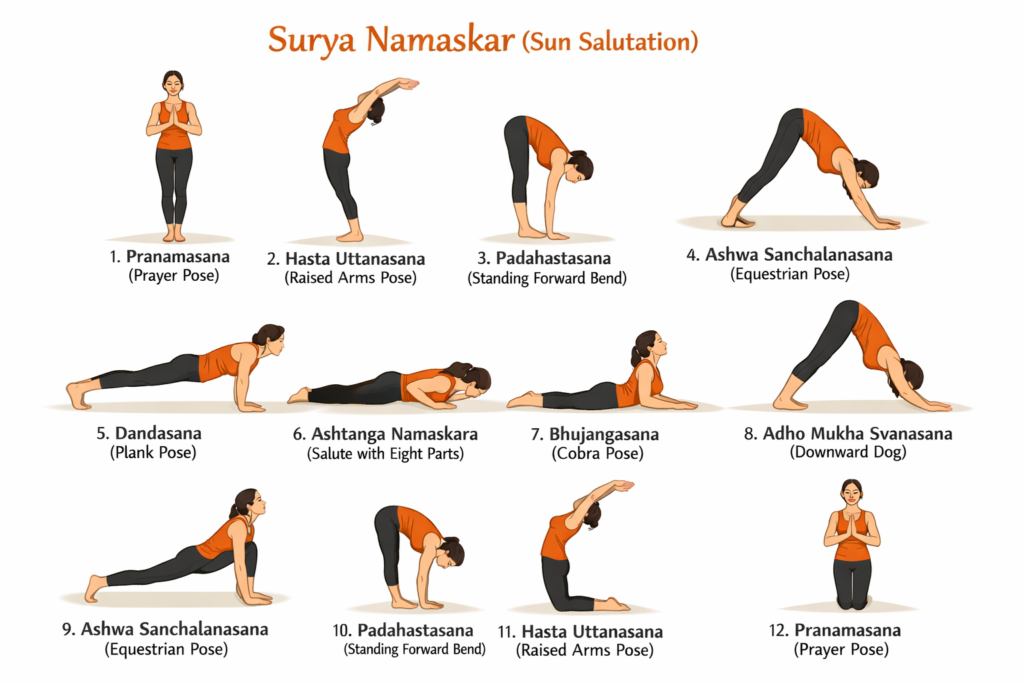
Three things matter equally in every pose: the physical alignment, the breath, and the Drishti (the gaze point). All three together create the meditative flow that separates Surya Namaskar from exercise. When your gaze wanders, your mind wanders. When your breath loses its rhythm, the prana loses its direction. Hold all three and the practice becomes something that acts on all five koshas simultaneously.
| 01 Pranamasana · Prayer Pose · Breath: Exhale | |
| Eye Gaze (Drishti) | Tip of the nose or closed eyes |
| Body | Stand at the front edge of your mat. Feet together, weight equally distributed. Spine tall, shoulders relaxed and dropped away from ears. Bring palms together at the heart centre (Anahata). Thumbs touching the sternum. Elbows level with the floor. |
| Benefit | Opens the heart centre. Grounds the body. Creates the intention of the practice — this is the Namaskar, the bow, from which everything flows. Regulates the breath before movement begins. |
| Common Mistake | Raised or hunched shoulders. Weight falling to one foot. Palms pressed together so hard the wrists ache. Soften the hands — the greeting is not a grip. |
| 02 Hasta Uttanasana · Raised Arms Pose · Breath: Inhale | |
| Eye Gaze (Drishti) | Thumbs — follow the hands as they rise |
| Body | From Pranamasana, inhale and sweep the arms up and overhead in a wide arc. Palms face each other or press together above the head. Gently arch the upper back — the backbend is in the chest and upper spine, not the lower back. Biceps frame the ears. Lengthen the whole front body. |
| Benefit | Expands the lungs fully — the first complete inhale of the practice. Stretches the abdominal organs that have been compressed through sleep. Stimulates the digestive system. Awakens Anahata and Vishuddha chakras. |
| Common Mistake | Crunching the lower back in the arch. Dropping the head back so far the neck compresses. The backbend is gentle and expansive — imagine the front of the body opening like a door, not the back collapsing. |
| 03 Hasta Padasana · Hand to Foot Pose (Standing Forward Bend) · Breath: Exhale | |
| Eye Gaze (Drishti) | Knees — keep the gaze soft and inward |
| Body | From Hasta Uttanasana, exhale and fold forward from the hips — not the waist. Lead with the chest, keep the spine long for as long as possible before releasing. Hands reach to the floor beside the feet. If hamstrings are tight, bend the knees generously. Head hangs heavy. |
| Benefit | Stretches the entire posterior chain — hamstrings, calves, lower back. Reverses blood flow toward the brain, stimulating the nervous system. Compresses and massages the abdominal organs. Relieves anxiety and quiets mental noise. |
| Common Mistake | Rounding immediately from the waist. The fold begins at the hip crease — imagine the torso as a drawer sliding down over the thighs. Bent knees are correct; a rounded spine in a straight-leg fold is not. |
| 04 Ashwa Sanchalanasana · Equestrian Pose (Low Lunge) · Breath: Inhale | |
| Eye Gaze (Drishti) | Up — between the eyebrows (Ajna chakra) |
| Body | From Hasta Padasana, inhale and step the right leg back into a long lunge. Right knee on the floor, top of the right foot flat. Left knee directly above left ankle. Fingertips on the floor beside the left foot. Lift the chest and gaze upward. The spine curves gently into a backbend from the thoracic region. |
| Benefit | Opens the hip flexors — among the most chronically tight muscles in sedentary modern life. Stimulates the Manipura (solar plexus) chakra. The upward gaze and chest lift mimic the rising sun — this pose is the physical embodiment of the dawn. |
| Common Mistake | Letting the front knee collapse inward over the foot. The knee tracks directly over the second toe. The back hip tends to drop — actively lift it to feel the full hip flexor stretch. |
| 05 Dandasana · Plank Pose · Breath: Exhale or breath retained | |
| Eye Gaze (Drishti) | Floor — slightly ahead of the hands |
| Body | From Ashwa Sanchalanasana, exhale and step the left leg back to join the right. Body forms one long diagonal line from the crown of the head to the heels. Arms straight, wrists directly below shoulders. Core engaged. Hips neither raised nor sagging. The body is a plank — held with breath, not effort. |
| Benefit | Builds core, arm, and shoulder strength. Teaches the body to create integrity — to hold a straight line without compensation. Regulates the nervous system through the sustained breath hold. This is the pose of steadiness — Sthira in Sanskrit. |
| Common Mistake | The hips rising into a mountain (that is the next pose) or sagging toward the floor. The gaze dropping too far forward, which over-extends the neck. Keep everything parallel — check that both heels push equally toward the back of the room. |
| 06 Ashtanga Namaskara · Eight-Limb Salutation · Breath: Exhale fully — breath held out | |
| Eye Gaze (Drishti) | Floor directly between the hands |
| Body | From Dandasana, lower simultaneously: knees, chest, and chin to the floor — in that order. Hips remain elevated. Eight points touch the earth: toes (2), knees (2), palms (2), chest (1), chin (1). This is the Sashtanga Pranam — the prostration with eight limbs. The complete bow. |
| Benefit | The full prostration — the body’s total surrender to the earth and to the sun. Strengthens the triceps and pectoral muscles. Prepares the spine for the backbend of Bhujangasana. The breath held out in this moment is the moment of complete emptiness — before the inhale of Cobra, like the sky before dawn. |
| Common Mistake | Letting the hips drop to the floor — this collapses the pose into a lying position. The hips stay up, forming a gentle peak. The sequence is knees first, then chest, then chin — not all together, and never nose or forehead to the floor. |
| 07 Bhujangasana · Cobra Pose · Breath: Inhale | |
| Eye Gaze (Drishti) | Upward and slightly forward — toward the horizon |
| Body | From Ashtanga Namaskara, slide forward and press the palms into the earth as you inhale and lift the chest. Elbows remain slightly bent — this is a low Cobra, not Upward Dog. The navel may or may not leave the floor depending on spinal flexibility. Shoulders draw back and down. Crown of the head reaches toward the horizon. |
| Benefit | Opens the entire chest and lungs — the deepest inhale of the practice. Strengthens the spinal extensors. Massages the kidneys and adrenal glands. The upward gaze activates the pituitary and pineal glands. This is the sun at its zenith — the moment of full light. |
| Common Mistake | Straightening the arms completely, which compresses the lumbar spine rather than lengthening it. The elbows stay soft. The lift comes from the back muscles, not from pushing with the arms — imagine the chest being pulled forward and up by a string from the sternum. |
| 08 Adho Mukha Svanasana · Downward Facing Dog · Breath: Exhale | |
| Eye Gaze (Drishti) | Navel — the gaze pulls the abdomen in and activates the core |
| Body | From Bhujangasana, exhale, tuck the toes, and push the hips up and back into an inverted V. Hands shoulder-width apart, feet hip-width apart. Spine long — think of creating length in the back rather than pushing the heels to the floor. Head hangs between the upper arms, ears level with the biceps. |
| Benefit | An inversion that reverses the blood flow toward the brain and refreshes the nervous system. Stretches the full posterior chain. Strengthens the arms, shoulders, and core simultaneously. The sustained exhale in this pose activates the parasympathetic nervous system — the body’s rest-and-restore mode. |
| Common Mistake | Rounding the upper back to force the heels toward the floor. The heels lifting is completely acceptable — what matters is spinal length. Bent knees with a long spine are always better than straight knees with a rounded back. |
| 09 Ashwa Sanchalanasana · Equestrian Pose (Low Lunge — Left Leg) · Breath: Inhale | |
| Eye Gaze (Drishti) | Up — between the eyebrows (Ajna chakra) |
| Body | From Adho Mukha Svanasana, inhale and step the left foot forward between the hands. Right knee lowers to the floor. Chest lifts, gaze rises. This is the mirror of Pose 4 — the same pose, the other leg. The sun is now descending. |
| Benefit | All the benefits of Pose 4, now on the opposite side. The symmetry of Surya Namaskar — right leg leads on the first half, left leg leads on the second — is not aesthetic. It ensures that both sides of the body, both hemispheres of the brain, receive equal activation. |
| Common Mistake | Same as Pose 4 — front knee tracking the second toe, back hip lifted, chest genuinely opening rather than just tilting the chin up. The gaze at the third eye point (Ajna) held steadily. |
| 10 Hasta Padasana · Hand to Foot Pose · Breath: Exhale | |
| Eye Gaze (Drishti) | Knees — the same soft, inward gaze as Pose 3 |
| Body | From the low lunge, exhale and step the right foot forward to join the left. Both feet together, hands on the floor. The standing forward bend again — the body folding back toward the earth as the sun begins its descent. This is the exact mirror of Pose 3. |
| Benefit | All the benefits of Pose 3 — the posterior chain stretch, the cranial blood flow, the abdominal compression — but now carrying the heat and activation generated by the full sequence. The body is open in ways it was not when the practice began. |
| Common Mistake | Rushing through this pose to get to the standing position. The exhalation here should be complete — let the body fold a little deeper than it did at Pose 3, because the tissues are warmer now. |
| 11 Hasta Uttanasana · Raised Arms Pose · Breath: Inhale | |
| Eye Gaze (Drishti) | Thumbs — follow the hands as they sweep upward |
| Body | From Hasta Padasana, inhale and sweep the arms out and up in a wide arc, reversing the movement of Pose 2. The chest lifts, the spine lengthens and arches gently. The same pose as Pose 2 — but after everything the body has done, the chest opens differently now. The inhale is fuller. The backbend is deeper. |
| Benefit | The ascent — the sun completing its arc, returning toward the zenith. All the benefits of Pose 2, amplified by the heat and openness of the full sequence. The lungs expand into a space they could not fully access at the beginning. |
| Common Mistake | Same as Pose 2 — the backbend is in the chest and upper spine, not the lower back. The arms frame the ears, the gaze follows the thumbs. |
| 12 Pranamasana · Prayer Pose · Breath: Exhale | |
| Eye Gaze (Drishti) | Closed eyes — or the tip of the nose |
| Body | From Hasta Uttanasana, exhale and bring the palms together at the heart centre. Return to exactly where you began. The same pose. The same hands. The same standing body. But not the same person who began. |
| Benefit | The completion. The cycle closes. The sun has risen and set in twelve movements. The breath returns to stillness. The heart centre closes around whatever the practice has opened. This final Pranamasana is the most important moment — do not rush it. Stand here for three complete breaths before beginning the next round. |
| Common Mistake | Treating this as a formality — the real end of the round. This is the moment of integration, the pause in which the body absorbs what has just happened. The practitioner who lingers here receives more than the one who immediately launches into the next round. |
The 12 Surya Mantras — One Name of the Sun per Pose
The mantra tradition of Surya Namaskar is described in both the Rig Veda and the Sivananda Yoga tradition. Each mantra has four components: the universal sound Om · a Bija (seed) mantra · one of the twelve names of Surya · the salutation Namaha. The six Bija mantras — Hraam, Hreem, Hroom, Hraim, Hroum, Hraha — are chanted twice across the twelve poses, completing the full sonic cycle of the sun.
Chant the mantra as you enter each pose — not before, not after. The sound and the movement are one act. If you are new to chanting, whisper the mantra internally with full attention. The effect is the same. The classical texts say the mantra should be felt in the body, not performed for the ear.
ॐ ह्रां मित्राय नमः
Om Hraam Mitrayai Namah
Surya as: Mitra — Friend of All
Pose 1: Pranamasana. The sun as the universal friend — the one who gives light and warmth equally to all without discrimination. Begin the practice by greeting the sun as you would greet the most generous friend you have ever had.
ॐ ह्रीं रवये नमः
Om Hreem Ravaye Namah
Surya as: Ravi — The Radiant, The Shining One
Pose 2: Hasta Uttanasana. As the arms sweep up and the body opens, salute the sun’s radiance. Ravi: the one who shines. The arms reaching overhead are the body’s own attempt at radiance — reaching toward the light as a plant reaches toward the sun.
ॐ ह्रूं सूर्याय नमः
Om Hroom Suryaya Namah
Surya as: Surya — The Supreme Light, Inducer of Activity
Pose 3: Hasta Padasana. As the body folds forward and the blood moves toward the brain, salute Surya the activator — the force that sets all life in motion. The forward fold is surrender; the mantra is the acknowledgement of what we surrender to.
ॐ ह्रैं भानवे नमः
Om Hraim Bhanave Namah
Surya as: Bhanu — The Brilliant, The Bestower of Beauty
Pose 4: Ashwa Sanchalanasana. In the low lunge, the body opens toward the sky as Bhanu — the sun as giver of radiance and beauty — is invoked. The upward gaze in this pose is not just a physical direction; it is the recognition that beauty descends from above.
ॐ ह्रौं खगाय नमः
Om Hroum Khagaya Namah
Surya as: Khaga — The One Who Moves Through the Sky
Pose 5: Dandasana. In the plank, the body holds steady as the sky-traveller is invoked. Khaga: the sun as the great moving intelligence crossing the sky every day without fail, without rest, without detour. The steadiness of the plank is an echo of the sun’s own constancy.
ॐ ह्रः पूष्णे नमः
Om Hraha Pushne Namah
Surya as: Pushan — The Nourisher, The Sustainer of Life
Pose 6: Ashtanga Namaskara. In the complete eight-limb prostration, the body offers itself entirely to Pushan — the sun as the cosmic nourisher, the one who feeds all life. This is the moment of absolute surrender in the entire sequence. The prostration IS the mantra.
ॐ ह्रां हिरण्यगर्भाय नमः
Om Hraam Hiranyagarbhaya Namah
Surya as: Hiranyagarbha — The Golden Womb, Creator of the Universe
Pose 7: Bhujangasana. As the cobra rises and the chest opens to its fullest, Hiranyagarbha — the golden egg from which the universe was born — is invoked. The chest opening in Cobra is the body’s enactment of cosmic creation: something emerging from compression into light.
ॐ ह्रीं मरीचये नमः
Om Hreem Marichaye Namah
Surya as: Marichi — The Ray of Light, Dispeller of Illusion
Pose 8: Adho Mukha Svanasana. In the inversion of Downward Dog, Marichi — the ray of light that cuts through illusion — is invoked. The inversion reverses ordinary perspective: the world seen upside down is a reminder that what we think is real is often a construction. Marichi dissolves the mirage.
ॐ ह्रूं आदित्याय नमः
Om Hroom Adityaya Namah
Surya as: Aditya — Son of Aditi, the Infinite Cosmic Mother
Pose 9: Ashwa Sanchalanasana (left leg). As the left leg steps forward and the body opens again toward the sky, Aditya — the son of the infinite — is invoked. Everything on earth has been created by the cosmic mother. The sun is her most visible son. To salute Aditya is to salute creation itself.
ॐ ह्रैं सावित्रे नमः
Om Hraim Savitre Namah
Surya as: Savitri — The Stimulating Power Before Sunrise
Pose 10: Hasta Padasana. In the return to the forward fold, Savitri — the sun in its pre-dawn, stimulating form — is invoked. Savitri is the sun before it is seen: the light that begins to work on the world before the horizon reveals it. The Gayatri Mantra — the most sacred of all Vedic mantras — is a Savitri mantra. You are chanting the energy behind the Gayatri.
ॐ ह्रौं अर्काय नमः
Om Hroum Arkaya Namah
Surya as: Arka — The Energy Worthy of Praise and Worship
Pose 11: Hasta Uttanasana. As the arms sweep upward again and the chest opens, Arka — the sun as the object of all praise — is invoked. The pose is praise made physical: the arms reaching toward the source of all light. Arka is why temples were built to face East.
ॐ ह्रः भास्कराय नमः
Om Hraha Bhaskaraya Namah
Surya as: Bhaskara — The One Who Leads to Enlightenment
Pose 12: Pranamasana. In the final prayer pose, Bhaskara — the sun as the path to enlightenment itself — is invoked. Bhas: light. Kara: maker. The one who makes light. The one who makes you able to see. As the palms return to the heart and the breath settles, you are saluting the source of all clarity — outer and inner.
What Surya Namaskar at Sunrise Does — The Complete Effect
The classical texts describe Surya Namaskar as acting on all five Pancha Koshas — the five sheaths of the self — simultaneously. Modern physiology, without using this framework, has essentially confirmed it through research on the practice’s effects on every major system of the body. Here is what happens, sheath by sheath.
| Annamaya Kosha (Physical Body) | Activates all 12 major muscle groups · Lubricates every major joint · Stimulates digestive organs through compression and extension · Improves circulation to the heart, brain, and extremities · Regulates the respiratory system · In 12 rounds: equivalent cardiovascular benefit to 30 minutes of moderate exercise |
| Pranamaya Kosha (Breath / Energy Body) | The alternating inhale-exhale pattern of the 12 poses expands and contracts the lungs in a precise sequence that maximises oxygen exchange · Activates both nadis (Ida and Pingala — the lunar and solar channels) equally · Raises Kundalini energy from Muladhara toward Sahasrara · At sunrise, the body receives the maximum prana available in the day |
| Manomaya Kosha (Mind Body) | The combination of movement, breath, mantra, and Drishti creates a moving meditation that quiets the default mode network of the brain — the mental chatter · Cortisol (stress hormone) levels decrease measurably after 12 rounds · Serotonin and dopamine release increases · Anxiety and depression symptoms reduce with consistent daily practice |
| Vijnanamaya Kosha (Wisdom / Intellect Body) | The twelve names of the sun in the mantras carry twelve distinct teachings about the nature of reality — each name a different facet of cosmic intelligence. To chant them daily is to slowly absorb these teachings into the understanding, not as concepts but as felt knowledge embedded in the body through repetition |
| Anandamaya Kosha (Bliss Body) | The practitioner who performs Surya Namaskar with full attention — body, breath, and mantra aligned — regularly reports an experience that Ayurveda calls Ananda: the bliss that arises when all five sheaths are simultaneously activated and the sense of separation between the self and the cosmos momentarily dissolves. This is the forgotten purpose made experiential. |
| Circadian Rhythm Reset | Sunrise light received during the practice synchronises the body’s master biological clock — regulating sleep quality, metabolic function, immune response, and hormonal balance for the entire day that follows |
| Vitamin D Synthesis | Even ten minutes of morning sun exposure during Surya Namaskar initiates the body’s Vitamin D production cascade — a process that cannot be replicated by artificial light or supplements with the same efficiency |
| Spinal Health | The alternating backbends and forward folds of the sequence provide spinal traction and compression that nourishes the intervertebral discs — structures that receive their nutrients through movement, not blood supply. Daily Surya Namaskar is one of the most effective practices for long-term spinal health known to any tradition |
How to Actually Begin — An Honest Starter’s Guide
The most common reason people do not begin Surya Namaskar is not lack of knowledge. It is the gap between knowing and doing that feels insurmountable at five in the morning when the bed is warm and the floor is cold. Here is the honest guide to crossing that gap.
Week 1 — Just Show Up
Set your alarm for thirty minutes before your city’s sunrise time. Place your yoga mat the night before. When the alarm sounds, rise without negotiating with yourself — do not lie back down, do not check your phone. Walk to the mat. Face East. Perform three rounds of Surya Namaskar slowly, without mantras, simply following the breath. That is all. Three rounds, correctly, with full breath. Takes twelve minutes. Return inside.
Do not try to do twelve rounds on Day 1. The body that is not used to this practice will tell you the next morning in the hamstrings and the shoulders and the hip flexors. Respect this conversation.
Week 2 — Add the Mantras
By the second week, the sequence is becoming familiar enough that the mind is not occupied entirely with remembering what comes next. Now add the mantras — begin with just chanting Om at each pose, and gradually introduce the full mantra as the practice deepens. Internal chanting is fully valid and carries the same effect as spoken chanting.
Week 3 Onward — Build to 12 Rounds
Add two rounds per week. By the end of the first month you will be performing twelve rounds — twenty-four complete movements — in approximately twenty to twenty-five minutes. This is the traditional daily minimum for the full benefit. At twelve rounds, the cardiovascular, meditative, and energetic effects of the practice reach their full expression.
| Before Practice | Empty or near-empty stomach. A glass of warm water with lemon is ideal. Minimum two hours after any meal. |
| After Practice | Shavasana (corpse pose) for five minutes minimum — lie flat on your back, arms at sides, complete stillness. This is where the body integrates what the practice has activated. Do not skip it. |
| What to Wear | Comfortable clothes that do not restrict movement. Bare feet on a non-slip mat or clean earth. This is a Vedic practice — the connection between bare feet and the ground is not incidental. |
| Rain & Winter | The classical texts do not grant exemption for weather. If outdoor practice is genuinely not possible, perform it facing an East-facing window through which you can see the light changing. The sunrise still reaches you. |
| Menstruation | The classical Ayurvedic position is rest during the first two days. From Day 3 onward, a gentle practice — fewer rounds, no inversions — is considered appropriate. Listen to your body. |
| Children | Surya Namaskar is considered ideal for children from age five onward. The mantras, taught young, become embedded in a way that nothing else quite achieves. They become the prayer the grown child still knows. |
The Practice at the Edge of Day
There is a specific quality to the world at sunrise that exists at no other time. It is the quality of the possible — the sense that the day has not yet made its decisions, that anything could still happen, that the light arriving is genuinely new rather than a continuation of yesterday’s. Every civilisation that has ever existed has marked this moment as sacred. The difference is that Bharat gave it a practice — a set of twelve movements, twelve breaths, twelve names — that makes the marking physical, daily, and complete.
The person who stands on their mat at 5:45 AM, facing East, pressing their palms together as the first pink enters the sky, and begins — that person is doing what their great-grandmother did. What her great-grandmother did. What a Vedic sage described in a hymn that is older than any building standing anywhere on earth today. The practice has not changed because it does not need to change. The sun rises in the same direction. The body opens the same way. The twelve names carry the same meaning.
What changes, with every sunrise practice, is the person. Incrementally, cumulatively, and in ways that are genuinely difficult to put into words but that everyone who has maintained the practice for more than a month will recognise: a clarity that is there before the mind has had its first thought. A steadiness that came from somewhere before the first task of the day arrived. A relationship with the morning that feels less like enduring it and more like receiving something from it.
This is what the forgotten purpose, recovered, actually feels like. Not mystical. Not dramatic. Simply the experience of beginning the day as Bharat has always known the day should begin — in conversation with the sun, in movement, in the full presence of a body that has been asked to be awake before the world demands it.
ॐ ह्रां ह्रीं ह्रूं ह्रैं ह्रौं ह्रः
The six Bija mantras of Surya — the complete solar sound.
आदित्यस्य नमस्कारान् ये कुर्वन्ति दिने दिने
Aadityasya Namaskaran Ye Kurvanti Dine Dine
Those who salute the Sun every day —
Ayuh Prajnam Balam Varchah, Tejo Varchah Cha Vindati
— they attain long life, wisdom, strength, vitality, and radiance.
— Aditya Purana
🌿 Do you practice Surya Namaskar? Did someone in your family teach you — a grandfather at the well, a grandmother before the morning puja — in a way that no yoga app ever has? Write to us. The oral tradition of this practice is as ancient as the practice itself, and every version of it that is remembered is a version that is not lost.