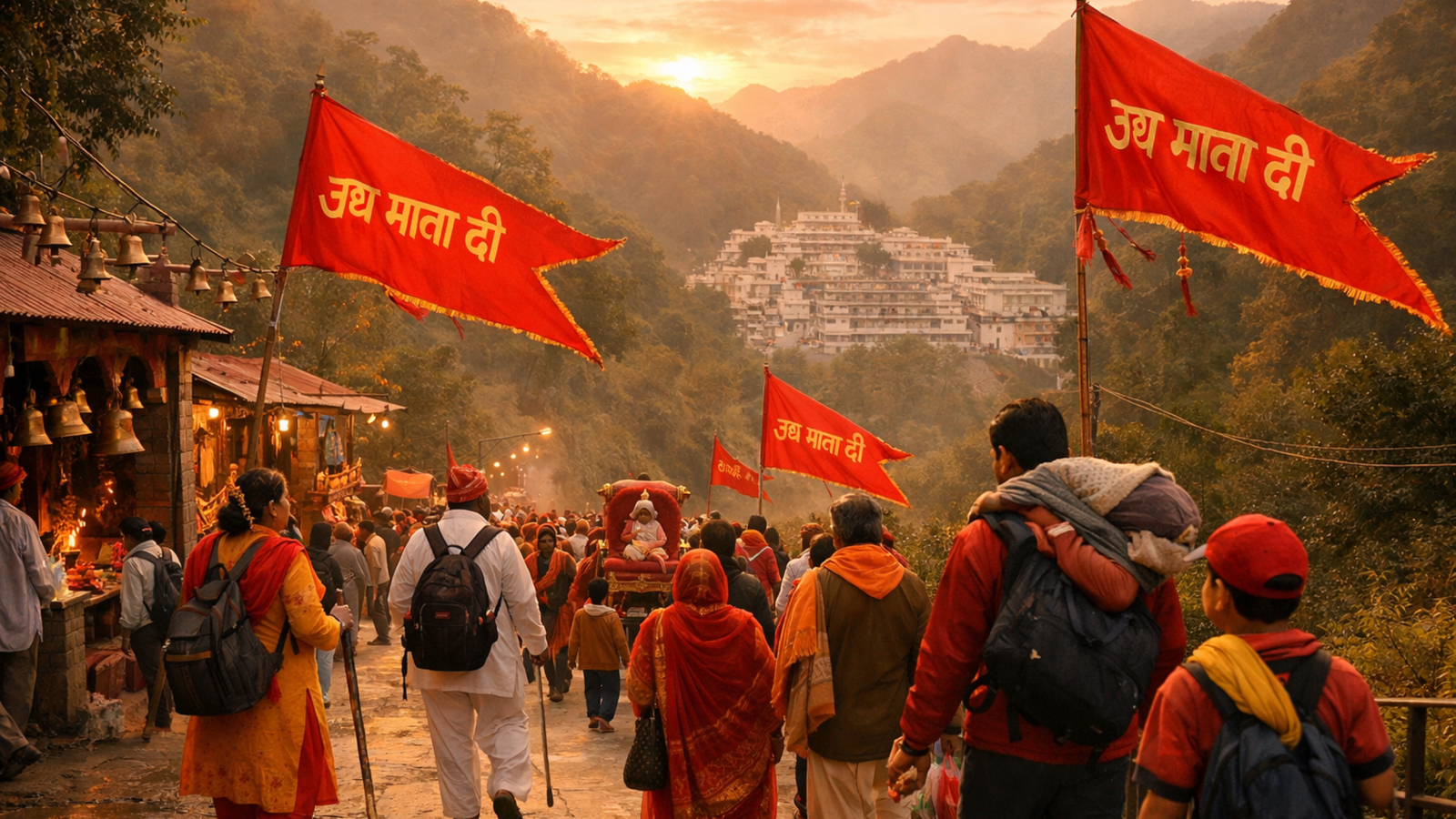
Vaishno Devi During Navratri: What No Travel Blog Tells You
Every travel blog about Vaishno Devi tells you the same things. Book early. Carry ID. Wear comfortable shoes. Start at dawn. Visit Bhairon Temple after darshan. These things are true, and also completely insufficient if you are going during Chaitra Navratri — because Navratri at Vaishno Devi is not a variation of the normal yatra experience. It is a different experience entirely, with its own crowds, its own energy, its own specific challenges and its own specific grace. Over 2.4 lakh devotees visited the shrine in just the initial days of Chaitra Navratri 2026. On the peak day, over 30,000 pilgrims departed from Katra in a single day. Registration was temporarily suspended on the night of March 21 due to the overwhelming number of devotees — it resumed at 4 AM on March 22. This is the Vaishno Devi that no travel blog prepared you for. This article will.
Why Chaitra Navratri Is Different from Any Other Time of Year
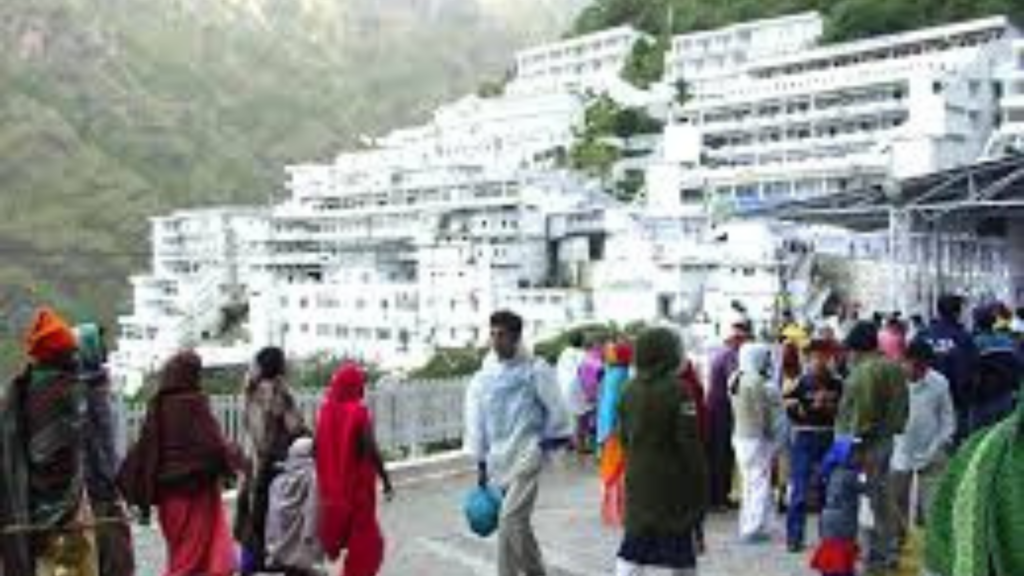
There is a reason that many pilgrims specifically choose Chaitra Navratri for the yatra, believing that prayers offered during these nine days are especially blessed by Maa Vaishno Devi. The energy on the mountain during these nine days is qualitatively different from anything you will experience in the off-season. The entire Trikuta range vibrates with the sound of “Jai Mata Di” echoing from thousands of pilgrims simultaneously — from the valley floor all the way up to the Bhawan at 5,200 feet. It is overwhelming, and it is beautiful, and it demands respect. But it also demands preparation that goes far beyond what most guides provide. Here is the truth about Chaitra Navratri on the mountain.
| 2.4L+ Devotees in first days | 30,000 Per day at peak | 13 km Katra to Bhawan | 5,200ft Bhawan altitude | 9 Sacred nights | Mar 19 Navratri begins 2026 |
The Thing Nobody Tells You About Registration During Navratri
All pilgrims must register online before starting the yatra. This is standard advice — what is not standard is what happens to that registration system during Navratri. Registration was temporarily suspended on the night of March 21 due to heavy inflow of devotees. Despite this suspension, the pilgrimage itself continued throughout the night. What this means in practice: if you arrive at Katra without a pre-registered yatra slip during Navratri, you may find the system closed. The physical counters in Katra will have queues several hours long. And the online portal — your best option — books out days in advance for popular Navratri dates. The rule for Navratri: Register online at the official SMVDSB website (maavaishnodevi.org) at least 72 hours before your planned departure from Katra. Do not rely on same-day registration. Do not trust any agent, tout, or unofficial service claiming they can book for you. Always use the official Shrine Board site — the only guaranteed source. One more thing about registration that genuinely surprises first-time Navratri visitors: your registration slip has a time window. You are expected to begin your yatra within that window. During peak Navratri days when 30,000 people are on the mountain, the Shrine Board may control entry at Darshani Darwaza to maintain safe crowd density on the track. If you miss your window, you rejoin a queue. Plan accordingly.
The Three Routes — and Which One to Take During Navratri
Most pilgrims know there is a route from Katra to Bhawan. Most do not know there are now three distinct routes, each with very different characteristics — and during Navratri, this choice matters enormously.
Route 1 — The Old Track (Darshani Darwaza via Ban Ganga, Charan Paduka, Ardhkuwari): This track begins from Darshani Darwaza and covers Ban Ganga, Charan Paduka, Ardhkuwari, Himkoti, and Sanjichhat before reaching Bhawan. This is the traditional route and the one most pilgrims take. During Navratri it is also the most congested — ponies, palkis, battery cars, and tens of thousands of pilgrims all using the same path. Expect significant slowdowns, especially between Banganga and Ardhkuwari.
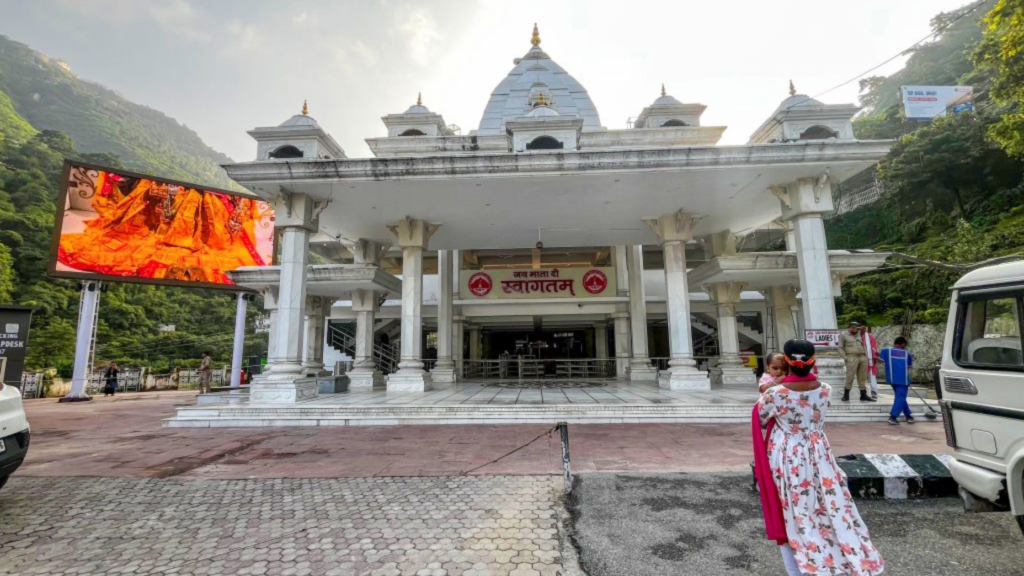
Route 2 — The Middle Track (Indraprastha Bypass): This route also starts from Darshani Darwaza and covers Ban Ganga and Charan Paduka, but begins just below Ardhkuwari near Indraprastha viewpoint. It is about 500 metres shorter than the old route and ponies are not allowed, making it significantly wider and less congested. This is the best choice for fit walkers during Navratri — fewer animals means faster, cleaner movement.
Route 3 — Tarakote Marg (Newest): The newest track starts from Tarakote and doesn’t allow ponies and palkis. With a comfortable gradient and a ramp-type design, it offers scenic views and is linked to the Banganga-Ardhkuwari track near Gulshan Langar. During Navratri this route sees the least foot traffic of the three and is the best choice if you value a more meditative, quieter ascent.
🏔️ Navratri Route Strategy: Take Tarakote Marg up, and the Old Track down. You get the quieter, less congested ascent when you need energy, and the more vibrant, traditional descent when the crowds feel less overwhelming. This combination is used by experienced repeat pilgrims.
The Night Trek — The Navratri Secret That Transforms the Experience
This is what no travel blog tells you. The best times to start the trek are either 3–4 AM — reaching Bhawan by sunrise with fewer crowds — or 8–9 PM for a night trek with cooler temperatures and beautiful starlit paths. Night treks offer a special spiritual atmosphere with chants echoing through mountains. During Navratri, starting at 2–3 AM is not just a crowd-management strategy — it is a completely different spiritual experience. The path is lit by a river of diyas and phone torches. The sound of “Jai Mata Di” rises from pilgrims you cannot see, voices from above and below in the dark. The temperature in mid-March at this altitude is cool but not cold — perhaps 12–15°C — ideal for trekking. By the time the sun rises over the Trikuta range, you are already at Ardhkuwari or beyond, watching the first light hit the mountains from halfway up. The darshan queue at the Bhawan at 5–6 AM is a fraction of what it becomes by 10 AM. Conversely, if you start at 9 PM and trek through the night, you arrive at Bhawan in the early hours when the Shrine Board runs its special Atka Aarti — the night aarti that most visitors never experience because they arrive during daylight hours. The spiritual atmosphere during Atka Aarti surpasses regular darshan exponentially.
“One does not go to Mata Vaishno Devi by choice. One goes by her calling. When you feel pulled — by a dream, by a restlessness, by something that will not leave you alone — that is the invitation.”— The oldest belief of Vaishno Devi yatra tradition
Ardhkuwari — The Stop Most Navratri Pilgrims Rush Past
In the urgency of reaching the Bhawan, most pilgrims treat Ardhkuwari as a rest stop — a place to eat something, use the facilities, and continue. During Navratri this is a mistake. Ardhkuwari is the cave where Mata Vaishno Devi meditated for nine months, evading Bhairon Nath. The cave is shaped like a womb — it is called Garbh Joon, meaning “a womb.” It is fifteen feet long and devotees have to crawl on their knees to reach the other side. Think about what this means in the context of Navratri, the festival of the Goddess. You are celebrating nine nights of Shakti. And here, halfway up the mountain, is the cave where that same Shakti sat in complete stillness for nine months — the same span as human gestation, the same span as a pregnancy. The cave is shaped like a womb. The Goddess who is being worshipped across all of India for nine sacred nights meditated here for nine sacred months. Passing through Garbh Joon on a Navratri pilgrimage is not a tourist detour. It is the most symbolically resonant moment of the entire journey. You will need to buy a ticket online and offline to visit Ardhkuwari Gufa. Book this when you book your yatra registration. Do not leave it to chance during Navratri — the queue for Garbh Joon darshan can stretch several hours on peak days.
The Complete Route — Katra to Bhawan
| Katra (Base) | Register here. Hotel check-in. Geeta Mandir for opening prayer. Begin yatra from Darshani Darwaza or Tarakote Marg. |
| Ban Ganga · 1.5 km | The sacred stream where Mata is said to have shot an arrow into the earth to create water. Holy dip or face wash. First real stop. |
| Charan Paduka · 3 km | The rock bearing the Goddess’s footprints. Pause here and do not rush. This is the first threshold. |
| Ardhkuwari · 6 km | Do not skip. Book Garbh Joon darshan ticket in advance. If exhausted, rest here overnight — Shrine Board accommodation available. Battery cars onward from here. |
| Himkoti · 8.5 km | The best viewpoint on the entire route — panoramic valley views. Not religious, but worth 15 minutes. The Trikuta range from here is extraordinary. |
| Sanjichhat · 11 km | Helipad. Last major rest point before Bhawan. Deposit non-essential luggage here if you haven’t already. |
| Bhawan · 13 km | Deposit all bags, shoes, phone and leather items at Cloak Room (Counter 1–2, further from Bhawan entrance, shorter queue). Bathing ghat before darshan. The three Pindis: Maha Kali, Maha Lakshmi, Maha Saraswati. |
| Bhairon Temple · 1.5 km up | The yatra is incomplete without this. Steep climb but short. Ropeway available. The boon Mata gave Bhairon Nath — that no yatra is complete without visiting him — is one of the most profound stories on this mountain. |
The Original Cave — The Darshan Most Pilgrims Never Know Exists
This is the most important thing in this article. Most pilgrims who go to Vaishno Devi — including many who have been multiple times — do their darshan at the new marble-floored Bhawan complex. Clean, accessible, devotion intact. What they do not know is that the original natural cave, unchanged for millennia, occasionally reopens. The historic natural holy cave at Vaishno Devi shrine was reopened during January–February 2026 when pilgrim footfall is comparatively lower. This provides a rare opportunity to experience darshan in the cave’s original ancient form — as during the rest of the year, pilgrims use the newly constructed sanctum sanctorum due to heavy crowds. The original holy cave is approximately 98 feet long and is characterised by a narrow, watery pathway.
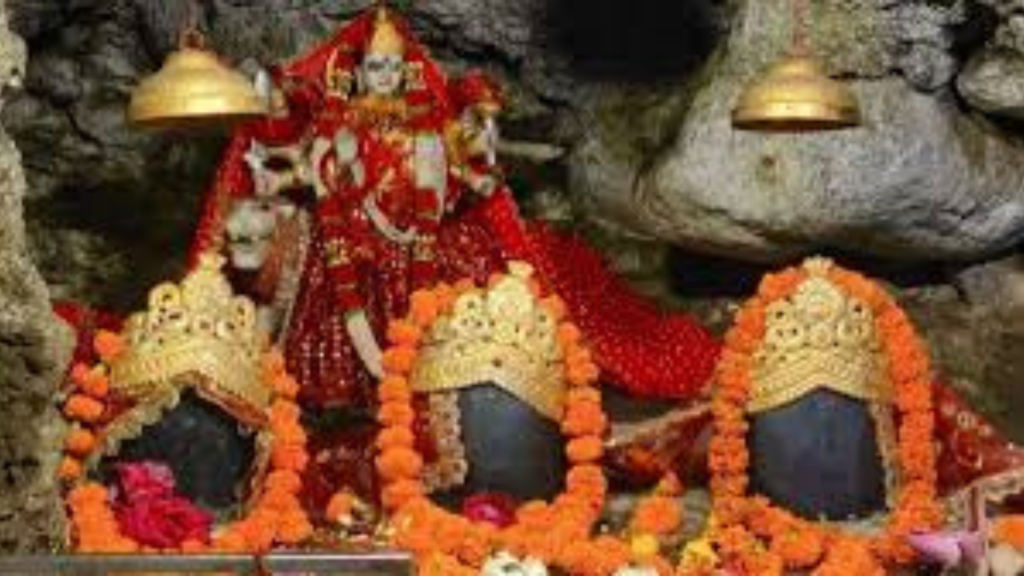
Pilgrims wade through an ankle- to calf-deep stream of clear water known as Charan Ganga, traditionally believed to flow from near the holy Pindis. Further inside the cave, past rock formations identified by devotees as Shesh Nag and natural shapes resembling a conch, discus, mace, and lotus, the passage culminates at a platform housing the three holy Pindis — natural, rounded stone formations revered as manifestations of Maha Kali, Maha Lakshmi, and Maha Saraswati. The Pindis are naturally formed under the natural cave. Earlier people used to crawl into the cave for darshan — it is now closed for safety during heavy crowds and opens annually only in January and February. This means the original cave darshan is not available during Navratri. But knowing it exists changes your relationship to the Bhawan darshan. Because of the large number of visitors, artificial tunnels have been constructed alongside the original cave to facilitate darshan of the Pindis. What you are passing through in the new sanctum is a modern accommodation to the ancient reality. The Pindis are the same. The water flowing near them is the same. The stone formations inside are the same. They have been there since before recorded history. Devotees believe approximately 330 million gods and goddesses have worshipped within this holy cave and have left symbolic marks on its walls. Stand before the three Pindis with this knowledge. You are not in a temple. You are in a mountain.
The Cloak Room Mistake That Costs People Their Darshan
This is a practical detail that ruins thousands of Navratri visits every year and almost nobody warns about it in advance. At the Bhawan, you must deposit all your belongings — bags, phones, shoes, leather items — before darshan. There are two cloak room counters. One cloak room is around 100 metres from the Bhawan and is less crowded. The other is just outside the Bhawan entrance and is very much crowded — you will waste 1–2–3 hours depending on the rush. During Navratri, the difference between these two counters is not 1–2 hours. It can be the difference between reaching darshan and missing it entirely because the aarti gates closed. Every year, pilgrims who did everything right — registered, trekked, arrived at the Bhawan — miss their darshan window because they used the wrong cloak room counter. Use Counter 1–2, approximately 100 metres before the Bhawan entrance. Always.
What to Do on Each of the Nine Days — If You Can Stay
Most pilgrims come for a single darshan and return. But if you can arrange to stay in Katra for the full nine days of Navratri — or even three to four days — here is how to think about the different days:
Day 1 — Pratipada (March 19): The Ghatasthapana day. The mountain is at its fullest and most electric as hundreds of thousands of pilgrims all begin their yatra simultaneously. Do not go up on this day unless you have the stamina for extraordinary crowds. Better to arrive in Katra, visit the Navdurga Mandir at the base, rest, and begin your ascent on the night of Day 1 for a Day 2 arrival at Bhawan.
Days 2–5 — The steady middle: Crowds are still enormous but the peak of Day 1 has eased slightly. This is when the mountain has a rhythm to it — the continuous chant of “Jai Mata Di” rising and falling, the path lit by diyas at night, the smell of incense at every wayside shrine. These are the days to trek slowly and absorb everything.
Days 7–8 — Saptami and Ashtami (March 25–26): The most intense spiritual days. Maha Ashtami is Durga Ashtami — the day Sandhi Puja happens at temples across India, the day of the goddess at her most powerful. At Vaishno Devi, this means even larger crowds, even more fervent prayer. Devotees from Haryana, Punjab, Delhi, Rajasthan and every corner of India are there specifically for these days. If your darshan falls on Ashtami, you will wait longer — but the energy in that waiting queue, the singing and chanting around you, is itself a form of the goddess’s presence.
Day 9 — Ram Navami (March 27): The last day of Navratri coincides with Ram Navami in 2026 — an extraordinarily rare alignment. Darshan on this day carries a specific completeness: you are in the presence of Shakti on the day Dharma was born. Many pilgrims specifically aim for this day as their darshan day for exactly this reason.
The Whispering Bharat Navratri Yatra Plan
- Book online registration at maavaishnodevi.org at least 72 hours before your planned departure from Katra. Also book Ardhkuwari Garbh Joon entry ticket.
- Arrive in Katra one day before your planned trek day. Rest. Eat lightly. Visit Geeta Mandir. Do not attempt the trek on the same day you travel to Katra.
- Begin your trek at 2–3 AM via Tarakote Marg. Reach Ardhkuwari by 5–6 AM. Do Garbh Joon darshan at Ardhkuwari. Rest. Continue to Bhawan — arrive by 9–10 AM before the main crowd surge.
- At Bhawan, use Cloak Room Counter 1–2 (100m before the main entrance). Not the counter at the entrance.
- After darshan, do not skip Bhairon Temple. Take the ropeway up. Come down on foot for the descent views. This completes the yatra.
- Return via the Old Track — in daylight on the descent, the valley views from the traditional route are extraordinary.
What the Mountain Actually Asks of You
There is a belief, held by every regular pilgrim on this mountain, that has no equivalent in any other pilgrimage tradition in India. For generations, devotees have believed that one does not go to Mata Vaishno Devi by choice but by her invitation. This belief, rooted in legend and personal experience, makes the pilgrimage deeply emotional and spiritually fulfilling. What this means in practice — not as theology but as experience — is that the yatra asks something of you before it gives anything back. It asks you to be patient in extraordinary queues. It asks you to be kind to the strangers around you who are pushing and tired and equally devoted. It asks you to keep chanting when your legs hurt. It asks you to begin at 2 AM when every comfort-instinct says to wait until sunrise. The physical challenges of the 13 km uphill trek symbolise overcoming obstacles and ego, while reaching the holy cave represents spiritual fulfilment, divine grace, and ultimate surrender to the divine mother. The Navratri version of this symbolism is amplified by the nine days of Shakti worship happening simultaneously across the entire country. You are not trekking alone. You are trekking as part of a nation in prayer — as one strand in a river of devotion that has been flowing up this mountain, without interruption, for longer than any written record can trace. The Trikuta hills have been echoing with “Jai Mata Di” since before Jammu was a city, since before the Shrine Board existed, since long before anyone thought to write a travel guide. That continuity is what the mountain offers. If you go prepared for the crowds, the cold, the queues and the cloak rooms — you will receive it.
❋Chaitra Navratri 2026 runs from March 19 to March 27. May the Mother call you at the right time. And when she does — may you go prepared.
Jai Mata Di.