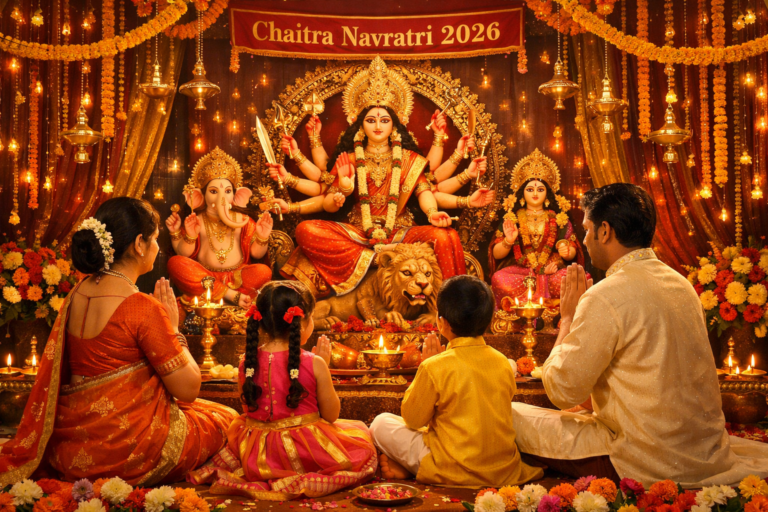
Kanjak Puja 2026 : Why We Feed Little Girls and What the Science Behind It Says
कन्या पूजन · Ashtami: March 26 · Navami: March 27, 2026 · Girls aged 2–10 as Living Navdurga
| Kanya Puja 2026 | Ashtami — Thursday, March 26, 2026 (primary day) · Navami — Friday, March 27, 2026 (alternate/additional day). Both days are auspicious. Most families observe on Ashtami. |
| Ashtami Muhurat | Complete before 11:48 AM on March 26, when Navami Tithi begins. Morning hours — after sunrise and after the morning Mahagauri puja — are ideal. |
| Navami Muhurat | March 27, 2026, from 6:18 AM until 10:06 AM (when Navami Tithi ends). Keep the puja complete before 10:06 AM. |
| Who Are the Kanya | Girls between 2 and 10 years of age who have not yet attained puberty. Nine girls ideally, representing the nine Navdurga. Five or seven are accepted if nine are not available. One young boy — Batuk Bhairav / Langur — is traditionally included. |
| Classical Source | Devi Bhagavata Purana · Kalika Purana · Skanda Purana (Prabhas Khand, Dwarka Mahatmya) · Marked as mandatory — the Navratri vrat is considered incomplete without Kanya Puja. |
| The Shloka | बालिकाः पूजिता यत्र तत्र रमन्ते देवताः — Bālikāḥ pūjitā yatra tatra ramante devatāḥ. ‘Where young girls are worshipped, there the gods reside happily.’ |
| The Prasad | Sooji halwa · Puri · Kala chana (black chickpeas) · Kheer · Fruits. The three-part halwa-puri-chana combination is the non-negotiable core. |
| The Gifts | Red chunri (dupatta) · Bangles · Bindi · Cash (dakshina) · New clothes · Small toys or school items. The gift must be given with the feeling of giving to the goddess. |
At some point on the morning of March 26 or 27, 2026, in tens of millions of homes across North India, something will happen that has no equivalent in any other religious tradition on earth. A woman — having fasted for nine days, having performed puja every morning before dawn, having kept the Akhand Diya burning through each night — will wash the feet of a child.
Not her own child. Not a child she necessarily knows. A child from the neighbourhood, perhaps. A child of her domestic worker, perhaps. A child she has invited specifically because this child is between two and ten years old, has not yet attained puberty, and carries within her, according to nine days of Vedic tradition and several thousand years of Shakta theology, the living presence of the goddess she has been worshipping.
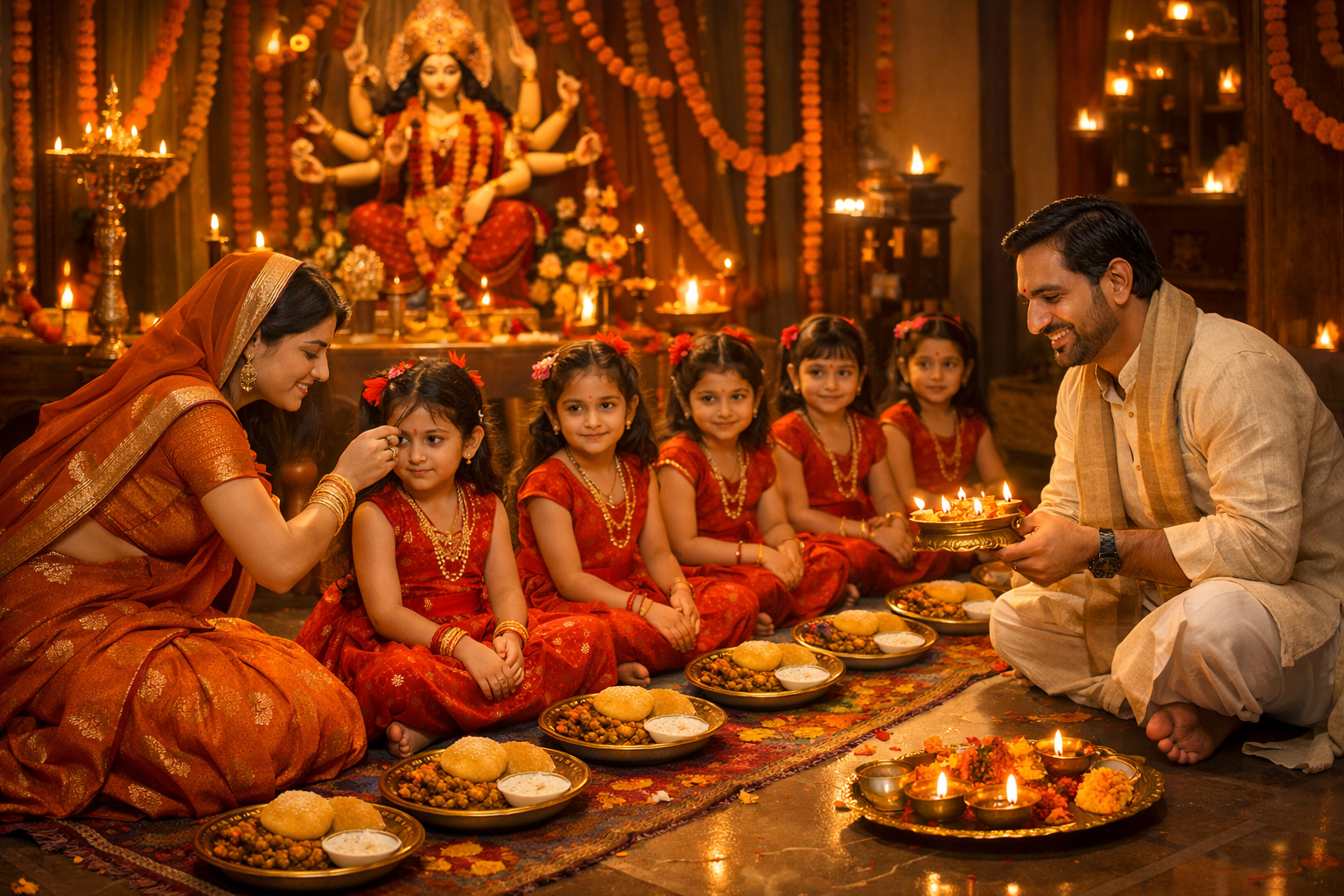
She will wash those feet. She will apply kumkum tilak to the child’s forehead — the same tilak she applies each morning to the deity’s image. She will tie a red sacred thread on the child’s wrist. She will seat her on a clean asana as though seating a queen. She will perform aarti to the child. And then she will serve her — with her own hands, with the same devotion she would serve any deity — the halwa, puri, and chana that she has cooked that morning.
And then she will touch the child’s feet and ask for her blessing.
This is Kanjak Puja. Kanya Pujan. The worship of the living goddess. The single most theologically radical act in all of Hinduism’s ritual calendar — the moment when the abstract theology of the divine feminine descends from the altar into the world and sits in front of you in a red dress, eating halwa with both hands, completely unaware that she is a goddess.
Kanya Puja 2026 — The Dates, Explained Clearly
Kanya Puja is performed on Ashtami, Navami, or both days of Navratri. In 2026, the dates are as follows:
| Ashtami (Day 8) | Thursday, March 26, 2026 — dedicated to Maa Mahagauri. The most widely observed day for Kanya Puja, especially in Punjab, Haryana, Delhi, and UP. Complete the puja before 11:48 AM, when Navami Tithi begins. |
| Navami (Day 9) | Friday, March 27, 2026 — dedicated to Maa Siddhidatri and also Ram Navami. Kanya Puja before 10:06 AM (when Navami Tithi ends). Families who observe Kanya Puja only on Navami perform it in the early morning before Ram Navami rites. |
| Both Days | Many families perform Kanya Puja on both Ashtami and Navami — eight girls on Ashtami (representing the first eight Navdurga) and nine girls on Navami (all nine). This is considered the most complete observance. |
| If Neither Works | Kanya Puja can technically be performed on any of the nine days. The Devi Bhagavata Purana suggests that in ancient practice, one girl was invited on Day 1 and one added each day, reaching nine on Day 9. Most families now concentrate on Day 8 or 9 for practical reasons. |
| Morning vs Evening | Ashtami morning is strongly preferred — ideally after the morning puja and before noon. The Sandhi Puja window (11:24 AM – 12:12 PM) should not be interrupted. Plan to complete Kanya Puja before the Sandhi window. |
The Theology — Why a Child Is the Goddess
The classical Sanskrit texts are direct about this — not metaphorical, not symbolic, not approximating. The Skanda Purana states it as a fact: where young girls are worshipped, the gods are happy. The Devi Bhagavata Purana records that even Indra — the king of the gods — performed Kanya Puja on the instruction of Brahma, and it was through this act of worshipping young girls with food and reverence that Goddess Durga blessed him. The text is not encouraging a metaphor. It is recording a theology.
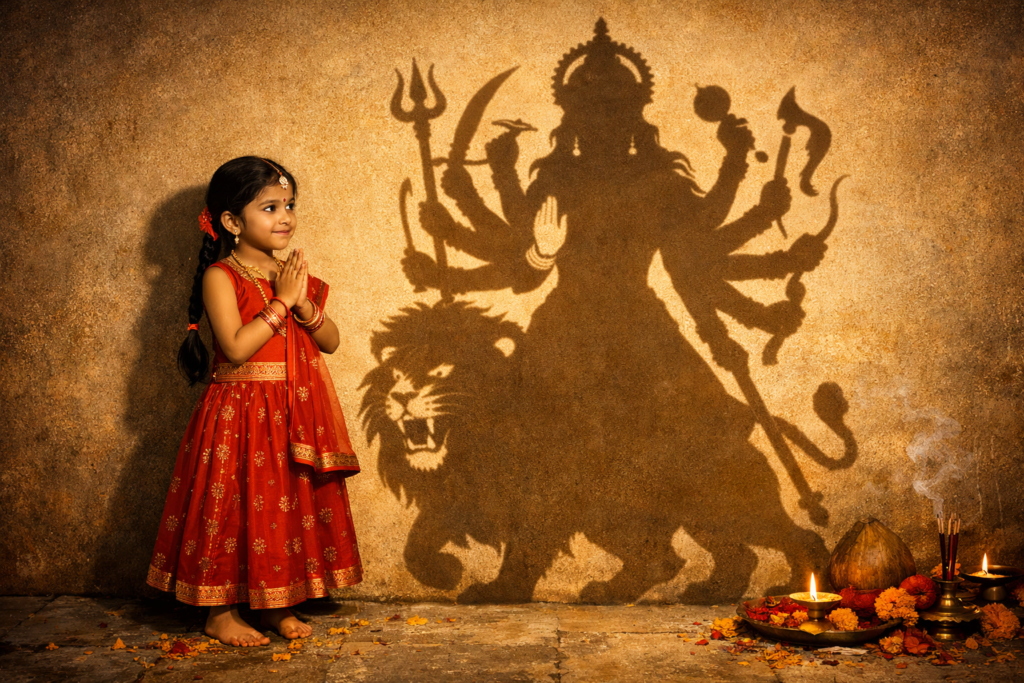
The theology begins with the Shakta understanding of where the divine feminine energy is most concentrated and most pure. In the Shakta Tantric tradition, Shakti — the primordial divine energy — is present in all beings but most completely accessible in those whose consciousness has not yet been shaped by desire, fear, anger, and the accumulated samskaras (impressions) of worldly experience. A young girl between two and ten, who has not yet encountered the world’s full weight, who has not yet been told that she is less than she is, who carries her joy and her anger and her love in full and uncalculated expression — she is, in Shakta theology, the closest available human being to the pure form of Shakti.
“स्त्रियः समस्ता सकला जगत्सु — All the women of the world are forms of You, O Devi.”
— Devi Mahatmya, Chapter 11 — the fundamental theological statement that underlies Kanya Puja
The Devi Mahatmya — the 700 verses of the Markandeya Purana that form the scriptural foundation of Durga worship — contains one statement that encapsulates the entire theology: Striyah Samastastava Devi Bhedah — all the women in the world are forms of You, O Goddess. Not symbols. Not metaphors. Not representations. Forms. The same energy that is worshipped in the temple image is present in the living woman — and most completely, most accessibly, in the young girl who has not yet learned to suppress it.
This is why the Kanya is not merely representing Mahagauri or Siddhidatri on Ashtami or Navami. She is Mahagauri. She is Siddhidatri. The act of washing her feet is not symbolic foot-washing. It is the same act as bathing the deity’s feet during Panchamrit abhishek. The bowing to receive her blessing is not courtesy. It is the prostration of the devotee before the goddess who is present, in this moment, in a child’s body in your own home.
The radical nature of this theology cannot be overstated in the context of Bharat’s social history — and its present. In a civilisation that has, at various points in its history, struggled to translate its deep theological reverence for the feminine into consistent social respect for actual women and girls, Kanya Puja stands as an annual, undeniable, enacted reminder: the girl in front of you is the goddess. Treat her accordingly. Not just on Ashtami. But because of what Ashtami has just taught you.
Why Only Before Puberty — The Precise Reasoning
The age restriction — girls between two and ten, specifically before puberty — is not arbitrary tradition. It comes from a precise Tantric observation about the quality of Shakti in a being who has not yet encountered the hormonal and psychological transformation that puberty brings.
In Tantric pharmacology and the philosophy of subtle energy, pre-pubescent girls carry a form of Shakti that is classified as Nishkala — undivided, complete, not yet specialised into the functions of fertility, desire, and creation that puberty initiates. This Nishkala Shakti is the same quality as the Shakti worshipped in the abstract, formless aspects of the goddess. After puberty, Shakti becomes Sakala — divided, fertile, specialised, creative in the biological sense. Both are sacred. But for the specific purpose of Kanya Puja — the worship of Shakti in its most complete and undivided form — only the Nishkala qualifies.
The lower bound of two years is equally considered: a girl younger than two has not yet developed the individual consciousness — the distinct personhood — that makes her a complete embodiment of the goddess rather than simply a being in formation. The window of two to ten is the window in which Nishkala Shakti is at its fullest expression in a fully individuated, fully conscious human being.
The Nine Girls — Who They Are and Which Goddess Each Carries
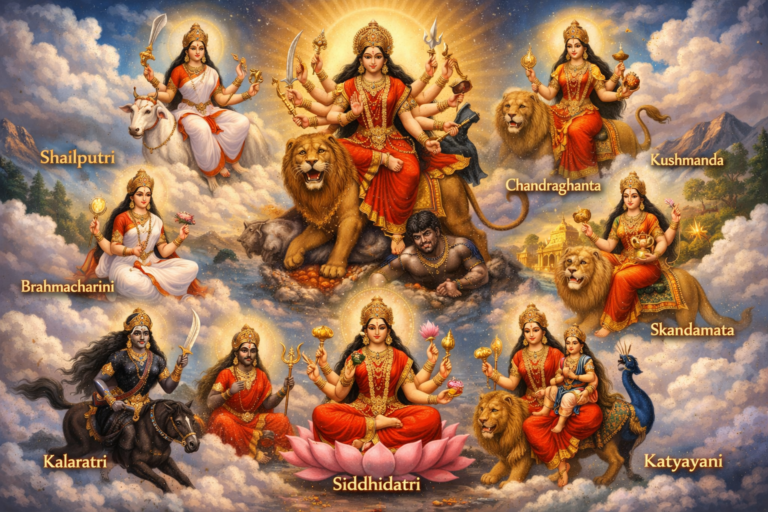
The nine girls invited for Kanya Puja are not interchangeable. Each age from two to ten carries a specific Sanskrit name, represents a specific form of the Navdurga, and bestows a specific blessing on the household that receives her. This is the classical system as described in the Kalika Purana and the Devi Bhagavata Purana.
| Age | Name (Sanskrit) | Navdurga Form | Blessing Bestowed | Represents |
| 2 yrs | Kumarika | Maa Shailputri | Prosperity, health, fulfilment of desires | The rooted mountain — new to the world, completely unafraid of it |
| 3 yrs | Trimurti | Maa Brahmacharini | Wealth, dharma, liberation (moksha) | The three faces of creation — Brahma, Vishnu, Mahesh in feminine form |
| 4 yrs | Kalyani | Maa Chandraghanta | Auspiciousness, happiness, family welfare | The auspicious one — brings the energy of Mangal into every space she enters |
| 5 yrs | Rohini | Maa Kushmanda | Health, disease-free life, bodily strength | The rising one — Rohini nakshatra, the moon’s most beloved station, is associated with abundance |
| 6 yrs | Kali | Maa Skandamata | Victory over enemies, removal of obstacles, courage | Not the terrible Kali of destruction but the fierce, protective Kali who destroys what threatens the child |
| 7 yrs | Chandika | Maa Katyayani | Victory, sovereignty, fearlessness | The most fierce Chandika — the war goddess at the height of her power, the destroyer of Mahishasura |
| 8 yrs | Shambhavi | Maa Kalaratri | Peace, spiritual knowledge, liberation from fear | Shiva’s consort — the universe’s most essential balancing energy, fierce and completely compassionate |
| 9 yrs | Durga | Maa Mahagauri | All sins forgiven, difficult tasks accomplished | Durga in her complete form — nine in one, all the forms of the goddess gathered in a single child |
| 10 yrs | Subhadra | Maa Siddhidatri | All desires fulfilled, all siddhis granted | The auspicious one standing at the threshold of the world — the girl about to become. The most complete form. |
When nine girls of exactly these ages are not available — which is more often than not in a modern urban household — the tradition allows for any nine girls between two and ten, or five or seven if nine cannot be arranged. The theological intention remains the same. What the specific ages add, when available, is the completeness of the offering: all nine Navdurga present simultaneously in your home, each in her specific human form.
The one boy who accompanies the nine girls — called Batuk Bhairav in most traditions, Langur in Punjab and Haryana — represents either Lord Hanuman (the protector) or Kal Bhairav (the fierce guardian form of Shiva). His presence maintains the cosmic balance: the divine feminine worshipped alongside the divine masculine in his protective role. He is seated alongside the girls, given the same tilak, the same food, the same reverence.
The Complete Kanya Puja Vidhi — Step by Step
The Kanya Puja ritual has a specific sequence that should be followed with care. Below is the complete traditional vidhi as observed across North India, with practical notes for the modern household.
Preparation — The Evening Before
The preparation for Kanya Puja begins the evening before. The home is thoroughly cleaned — not as a chore but as the preparation of a sacred space. The puja room is arranged with the Navratri altar still intact: the Kalash, the Akhand Diya, the idol or image of the Goddess. A low wooden platform (chowki) is cleaned and covered with a fresh red or yellow cloth — this is where the Kanyas will sit.
The invitation. In many communities, the families of the girls are personally visited or called the evening before. Kanya Puja is not the same when the girls are rushed in at the last moment and hurried out. The invitation should convey that these children are being welcomed as guests of the highest order — because they are.
The Morning of Kanya Puja
Rise before sunrise. Bathe. Perform the morning Navratri puja to Maa Mahagauri (on Ashtami) or Maa Siddhidatri (on Navami) before the girls arrive. The bhog — halwa, puri, kala chana, and any additional items — must be freshly prepared after the morning bath, in a state of ritual purity, without tasting while cooking. The first offering of the prepared food goes to the deity on the altar. Only after this offering are the girls seated and fed.
| Step 1 — Welcome | Receive the girls at the door with folded hands. Say: ‘Devi Swarupa Kumari, padharo.’ Welcome them as you would welcome the goddess herself — not as children visiting your home but as the deity answering your invitation. |
| Step 2 — Seating | Seat all nine girls (and the boy) on the chowki, on individual asanas (small cloth squares) placed side by side. No girl sits on the bare floor. The seat itself is an act of honour. |
| Step 3 — Paad Puja | Take a copper or brass plate. Fill it with warm, clean water. Take each child’s feet and wash them gently — both feet, thoroughly. Dry with a clean cloth. This is Paad Puja: the worship of the feet of the goddess. Do not rush this. Do not treat it as hygiene. It is worship. |
| Step 4 — Tilak | Apply kumkum tilak on each girl’s forehead — the same vermilion you apply to the deity’s image each morning. Then apply akshat (unbroken rice grains) over the kumkum. Say the name of the Navdurga form she represents as you apply the tilak. |
| Step 5 — Mauli | Tie a red sacred thread (Mauli / Kalava) around each girl’s right wrist. On the boy’s right wrist as well. The thread marks them as participants in the divine ceremony and carries the household’s protection with it when they leave. |
| Step 6 — Flowers | Offer fresh flowers at the feet of the seated girls. Fold hands and offer the Navdurga panchang pranaam — the complete five-point salutation to all nine forms. |
| Step 7 — Aarti | Perform full aarti to the seated girls with a ghee lamp, ringing a bell, incense lit. Chant: Jai Ambe Gauri or any Durga aarti of your family’s tradition. The girls receive the aarti as the deity receives it. |
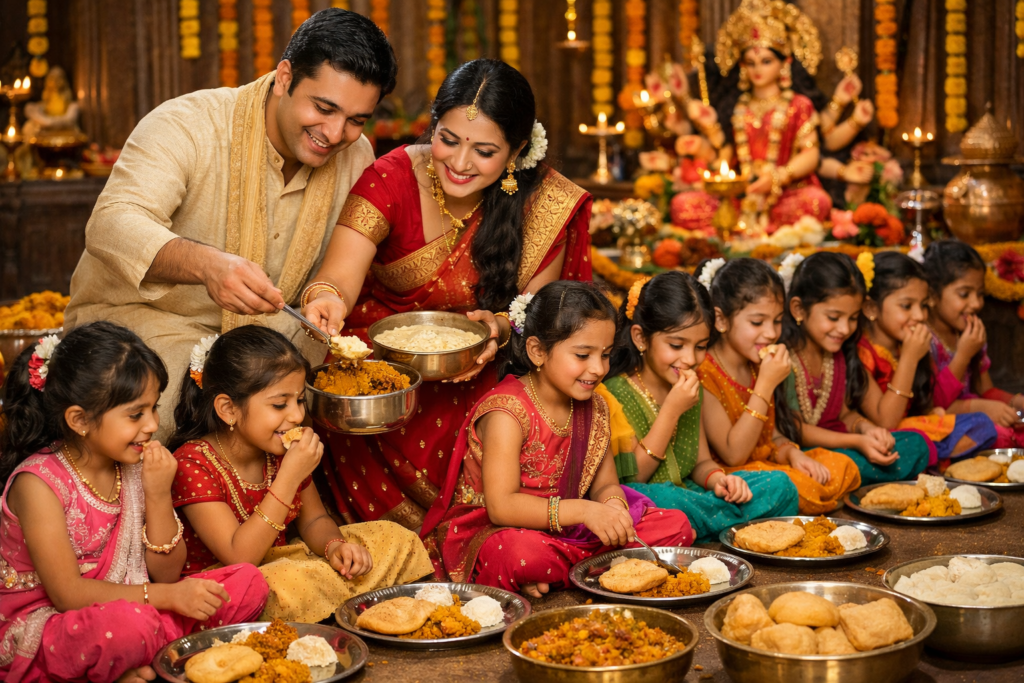
| Step 8 — Bhog | Serve the halwa, puri, and kala chana on individual plates — not in a shared platter. Include kheer and fruits if prepared. Serve with your own hands. Sit and wait while they eat. Do not eat before they have eaten. Do not hurry them. |
| Step 9 — Gifts | After the meal, present each girl with the chunri (red dupatta), bangles, bindi, and dakshina (cash) or a small gift of clothes or school items. Present these gifts as offerings — the way a devotee brings a gift to a temple — not as payment for attending. |
| Step 10 — Pranam | Fold your hands and touch the feet of each girl. Ask for her blessing — genuinely, not as a formality. She is the goddess. Her blessing is as real as any blessing you have asked for in nine days of puja. Receive it accordingly. |
| Step 11 — Send Off | Accompany the girls to the door. Wish them and their families well. Do not forget that what just happened in your home was not a social event. The goddess came. And she left satisfied. That is everything. |
Halwa, Puri, Chana — The Science in the Sacred Plate
Of all the questions Kanya Puja raises, the one most worth exploring is the one most rarely asked: why these three foods? Why has every generation, in every home, across every community that observes this ritual, served exactly halwa, puri, and kala chana? The tradition gives a theological answer: this is the Bhog of the goddess, and feeding the Kanya these foods is equivalent to offering naivedyam at the altar. But Ayurveda and nutritional science add a second answer that is equally compelling: this specific combination is precisely what a growing girl’s body needs in spring.
| Dish | What It Is | Ayurvedic Science | What It Means |
| Sooji Halwa (Semolina pudding) | Semolina (sooji/rava) cooked in generous ghee, sweetened with sugar or jaggery, flavoured with cardamom, garnished with raisins and cashews. Served warm, directly from the pan. | Ayurvedically: Sooji is Laghu (light) and Grahi (absorptive) — easy to digest but sustaining. Ghee is Ojas-building: it increases the vital essence in the body, supports the nervous system, improves the absorption of fat-soluble vitamins (A, D, E, K), and is specifically prescribed for growing children. The sugar provides immediate glucose energy. Cardamom is digestive. The raisins provide iron. Nutritionally: halwa made with ghee provides calories, B vitamins, iron, and the healthy fats essential for brain development and hormonal health in pre-pubescent girls. | Sweetness as blessing. The first food of the goddess’s plate is sweet — because the prayer for the household is for sweetness. Halwa is also, in North Indian tradition, the food of new beginnings — cooked when a new business starts, a new house is entered, a new life begins. On Kanya Puja, the household is beginning its new year with this sweetness offered to the goddess in a child’s form. |
| Puri (Deep-fried wheat bread) | Small, round wheat dough discs deep-fried in ghee or oil until puffed golden. Served immediately, while still hot and inflated. Slightly salted with sendha namak. | Ayurvedically: Wheat is Guru (heavy) and Snigdha (unctuous) — qualities that are beneficial for growing children who need sustained energy. The deep-frying in clean oil or ghee makes puri more calorie-dense than roti, appropriate for children who may not eat large quantities but need significant caloric density. The inflation of the puri when properly fried indicates that the dough has been prepared correctly and the oil temperature is right — overcooked or flat puris are Tamasic by traditional assessment. Nutritionally: complex carbohydrates for sustained energy, B vitamins, iron, and zinc in the wheat germ. | Fullness and completeness. The puffed puri — filled with hot air, round, golden, complete — is the symbol of the full stomach, the satisfied body, the household that has enough. Feeding the goddess puri is the prayer that the household will always have enough bread. |
| Kala Chana (Black chickpeas) | Whole black chickpeas soaked overnight, cooked until tender, then tempered in ghee with cumin, black pepper, and sendha namak. Dry preparation, not curried. Sometimes a small piece of coconut is added. | Ayurvedically: Black chickpeas are Tikta (slightly bitter), Kashaya (astringent), and Laghu (light) — the bitter and astringent tastes are the two most Kapha-pacifying tastes, directly appropriate for the spring season of Kanya Puja. They are also high in iron, protein, and fibre. For girls between two and ten — a period of significant physical and neurological development — the protein in kala chana is particularly valuable. Iron deficiency is one of the most common nutritional deficiencies in Indian children and girls specifically. Black chickpeas contain significantly higher iron than the white variant. The combination of iron in the chana, fat-soluble vitamin absorption from the ghee in halwa, and carbohydrates in the puri makes the Kanjak meal nutritionally more complete than most meals a child in this age group would eat. Vitamin C from lemon (sometimes added) increases iron absorption by up to three times. | Strength and resilience. Chana is the food of the body that endures — the fuel of the person who will carry something heavy over a long distance. Feeding the goddess chana is the prayer for the strength to face whatever the year contains. It is also the most sattvic of the three components, the most nutritionally serious. The prasad is not only devotionally complete — it is physically complete. |
| Kheer (Rice pudding) | Slow-cooked rice pudding with full-fat milk, sugar, saffron, cardamom, and garnished with pistachios and almonds. The traditional conclusion to the Kanjak plate. | Ayurvedically: Kheer is the most Ojas-building food in the entire Ayurvedic pharmacopoeia — it nourishes the deepest tissue of the body, the reproductive tissue, and is specifically prescribed for children and women. Full-fat milk is rich in calcium critical for bone development in girls aged 2–10. The saffron has mild anti-depressant and immune-modulating properties. Almonds provide vitamin E and magnesium. The slow-cooked, concentrated milk protein is the most bioavailable dairy protein available. | Abundance, completeness, and the blessing of the goddess’s full grace. Kheer is the prasad of completion — served at the end of the Kanjak plate as the statement that the household has given everything it had, and the goddess has received it all. |
“The Kanjak Bhoj is not a meal that happens to have religious significance. It is a nutritional protocol that happens to be a sacred offering. The people who designed it understood both things simultaneously — and knew that the two were not in conflict.”
— Whispering Bharat
One more layer: the Kanjak Bhoj is traditionally the first proper meal that the fasting householder breaks on after nine days of Navratri vrat. Not only are the girls fed — the family eats alongside them, or immediately after them, breaking the long fast. The prasad of the Kanya is the first food of the new year’s body. The meal is simultaneously the goddess’s feast and the household’s celebration of survival and renewal.
Kanjak Puja Across the North — The Same Goddess, Different Celebrations
| Region | Local Name | The Distinctive Flavour | What Makes It Different |
| Punjab & Haryana | Kanjak or Kanjak Pujan | The most intensely communal version — entire neighbourhoods participate simultaneously | Punjab’s Kanjak is the most public and most festive version in the country. In the old cities of Amritsar, Ludhiana, Jalandhar, and Chandigarh’s surrounding areas, lanes close and become outdoor puja spaces on Ashtami morning. Neighbours coordinate — one household’s kitchen feeds the girls from three families’ lists. Dhol players sometimes accompany the girls from home to home. The gifts here are the most elaborate: new complete outfits, significant dakshina, sometimes jewellery. The cultural norm is absolute: no family in a Punjabi Hindu neighbourhood skips Kanjak without it being noticed and remarked upon. |
| Delhi & NCR | Kanjak or Kanya Puja | Urban adaptation — apartment buildings become neighbourhood puja circuits | Delhi’s Kanjak has adapted beautifully to apartment living. The girls move from flat to flat in the same building — floors become pilgrimage circuits. Many apartment societies organise community Kanjak in the common area: a single large puja, all the girls of the society invited, all the families contributing to the meal. This community format has become popular for its logistics but also for its feeling — the girls being welcomed by twenty families in sequence, the communal energy building with each threshold they cross. |
| Uttar Pradesh (Varanasi, Lucknow) | Kanya Puja or Kumari Puja | Most elaborate ritual protocols — Brahminic traditions followed most precisely | In the Brahminic households of Varanasi and Lucknow, the Kanya Puja is performed with the most complete classical vidhi — individual mantras recited for each of the nine age groups as they receive tilak, the specific Navdurga name spoken aloud for each girl, the Paad Puja performed with turmeric water rather than plain water. In Varanasi specifically, the girls from the same caste as the household are preferred (the girl from the Brahmin caste is considered to bring knowledge; from the Kshatriya caste, power; from the Vaishya caste, wealth) — an older form of the tradition preserved in the classical texts and still practised in some households. |
| Himachal Pradesh (Shimla, Kullu, Dharamshala) | Kanjak Puja or Kanya Puja | Mountain version — siddu and other local foods supplement the halwa-puri-chana | In Himachal Pradesh’s hill towns, the Kanjak plate is supplemented with local seasonal foods: siddu (a steamed wheat bread specific to Himachal), seasonal hill vegetables prepared dry, and local sweets. The red chunri given to the girls here is often a specific Himachali pattern — the traditional embroidered cloth of the region rather than the plain red of the plains. The Devi temples of Himachal — Chamundeshwari, Naina Devi, Chintpurni — organise community Kanya Puja at scale on Ashtami, drawing pilgrims who have come specifically for this purpose. |
| West Bengal (Kolkata) | Kumari Puja | The most formal and most elaborate temple tradition in the country — performed at Belur Math | West Bengal’s Kumari Puja is a completely different tradition in form but identical in theology. Performed on the Ashtami of Durga Puja (Shardiya Navratri in October), it reaches its most magnificent expression at the Belur Math — the headquarters of the Ramakrishna Mission on the banks of the Hooghly. Swami Vivekananda himself performed Kumari Puja for the first time at the Math in 1901 — worshipping a young Brahmin girl as the goddess with the full formal puja reserved for temple deities. Today, the Belur Math Kumari Puja draws thousands and is broadcast nationally. The girl chosen is bathed, clothed in red silk, adorned with gold, and worshipped as a complete deity for the duration of the ceremony. |
The Science — What Feeding Girls Actually Achieves
This is the section that most articles about Kanjak Puja do not write. Not because the information does not exist but because the tradition of treating the ritual and the science as separate domains — one for the devotee, one for the rationalist — has obscured something that the original designers of the practice understood as a single integrated truth.
What does it do to a girl, biologically, when she is regularly fed a nutritionally complete meal, welcomed with formal respect into a clean and beautiful space, offered clothing as gifts, touched on the forehead with the mark of divinity, and sent home with the unambiguous social signal that she is considered sacred?
The first answer is nutritional and straightforward: the halwa-puri-chana-kheer meal provides a significant nutritional input at a critical developmental window. Girls aged two to ten are in periods of rapid brain development, bone formation, and hormonal groundwork. Iron deficiency — specifically addressed by the kala chana component — affects cognitive development, immune function, and the neurological architecture that will shape adult mental health. The meal served at Kanjak Puja is, in the most practical terms, an annual guarantee of one nutritionally complete meal for girls who may otherwise lack regular access to adequate protein, iron, and healthy fats.
The second answer is psychological and less commonly discussed. The ritual of Kanya Puja sends a specific message to the girl receiving it — through the specific mechanism of the body being treated as sacred, the forehead receiving the mark given to deities, the feet being washed by the adults of the household who would ordinarily be considered her social superiors. That message is: you are valued. Not for what you can produce, not for who you will marry, not for the son you might eventually bear — but for what you are right now, in this body, at this age. You are the goddess.
The Ayurvedic tradition has always understood that psychological health and physical health are not separate systems. The stress hormones that chronic devaluation produces — in children who receive the social message that they are less than — have measurable physical consequences: suppressed immune function, disrupted growth hormone cycles, impaired cognitive development. The counter-message of Kanya Puja — delivered not as words but as ritual, as touch, as the bodily experience of being worshipped — is a specific intervention against this damage.
“The tradition did not create Kanya Puja because it understood neuroscience. It created Kanya Puja because it understood, through long, careful observation, that a civilisation which treats its girl children as sacred will be different — healthier, stronger, more just — than a civilisation that does not.”
— Whispering Bharat
The Ayurvedic concept of Ojas — the vital essence that governs immunity, resilience, and the quality of life — is strengthened by three things: proper nourishment, adequate rest, and being treated with dignity. Kanya Puja provides all three in a single morning. The food builds Ojas physically. The sleep-well-having-eaten builds it biologically. And the ritual of worship builds it psychologically — the child who has been received as sacred, even once a year, carries something of that sacred recognition forward. It does not dissolve when the red thread on her wrist fades.
This is what the science says. Which is, interestingly, exactly what the tradition has always said — in different language, for different reasons, arriving at the same conclusion: the girl you feed today is not diminished by the receiving. She is elevated. And you are changed by the giving. This is the chemistry of the ritual. Sacred and scientific at once, as Bharat’s best traditions always have been.
After the Girls Leave — What Kanya Puja Leaves Behind
When the last girl has been sent home — red chunri folded carefully, dakshina in her small fist, the coconut smell of the prasad still in the air — the household is not the same as when the morning began.
Something has shifted. The devotee who spent nine days asking the goddess for blessings — for health, for prosperity, for the protection of their family, for the removal of obstacles — has just received a direct reply. Not from the image in the altar. From the child who sat on the chowki and ate halwa with both hands and looked at you with the unself-conscious directness that only children and deities possess.
She gave you her blessing. You asked. She gave. That is the whole of it.
What the tradition asks in return is not complex. It does not require another ritual, another fast, another ceremony. It asks only for the consistency between the gesture of worship and the gesture of daily life. To have washed the feet of the goddess in a child’s body on Ashtami — and then to be unkind to the girl child in the lane, to pull a daughter out of school for a brother’s convenience, to consider a girl a burden rather than a Devi — is a contradiction that the tradition notices and names. The worship is incomplete without the life that follows it. Kanya Puja is not a day. It is a standard.
The Devi Bhagavata Purana is specific: the household that genuinely honours the girl child — not only on Ashtami but in the daily decisions of how daughters are raised, educated, and seen — is the household where the goddess resides permanently. Not as a guest on Navratri. As a resident.
That is the full meaning of Kanjak Puja. The puja ends. The meaning does not.
जय माता दी
Jai Mata Di — Victory to the Mother.
बालिकाः पूजिता यत्र तत्र रमन्ते देवताः
Where young girls are worshipped — there the gods reside happily.
🙏 How do you observe Kanjak Puja? Does your family have a specific tradition — a particular song sung while washing the girls’ feet, a specific way of tying the mauli, a recipe for the halwa passed down from a grandmother who never wrote it down? Write to us. Whispering Bharat was made for exactly these stories, and every one that is recorded is one that will not be lost.
| 🙏 If This Work Reached You — Consider Supporting It Whispering Bharat is built to carry the stories of real Bharat — the ones that stand nowhere in textbooks and nowhere in mainstream media but live in the memory of every family that lights a diya and washes a child’s feet. Every article is researched, written, and designed by hand. No sponsored content. No advertiser pressure. Just the real Bharat — written with full devotion, offered freely. |
| ☕ Buy Us a Chai — Support on Ko-fi Even the price of one chai keeps the stories coming. Every contribution goes directly into the research, writing, and building of Whispering Bharat. 👉 ko-fi.com/rudraveda |
| 🌐 Start Your Own Blog with Hostinger Inspired to share your own slice of Bharat? Whispering Bharat is built on Hostinger — affordable, fast, and easy. Use our link for a special discount. 👉 hostinger.com/in?REFERRALCODE=1ANKUR227 (Special discount for you — and you support Whispering Bharat at no extra cost.) |
| Thank you for reading. Thank you for caring about Bharat’s stories. The work continues because readers like you exist. 🙏 जय माता दी |