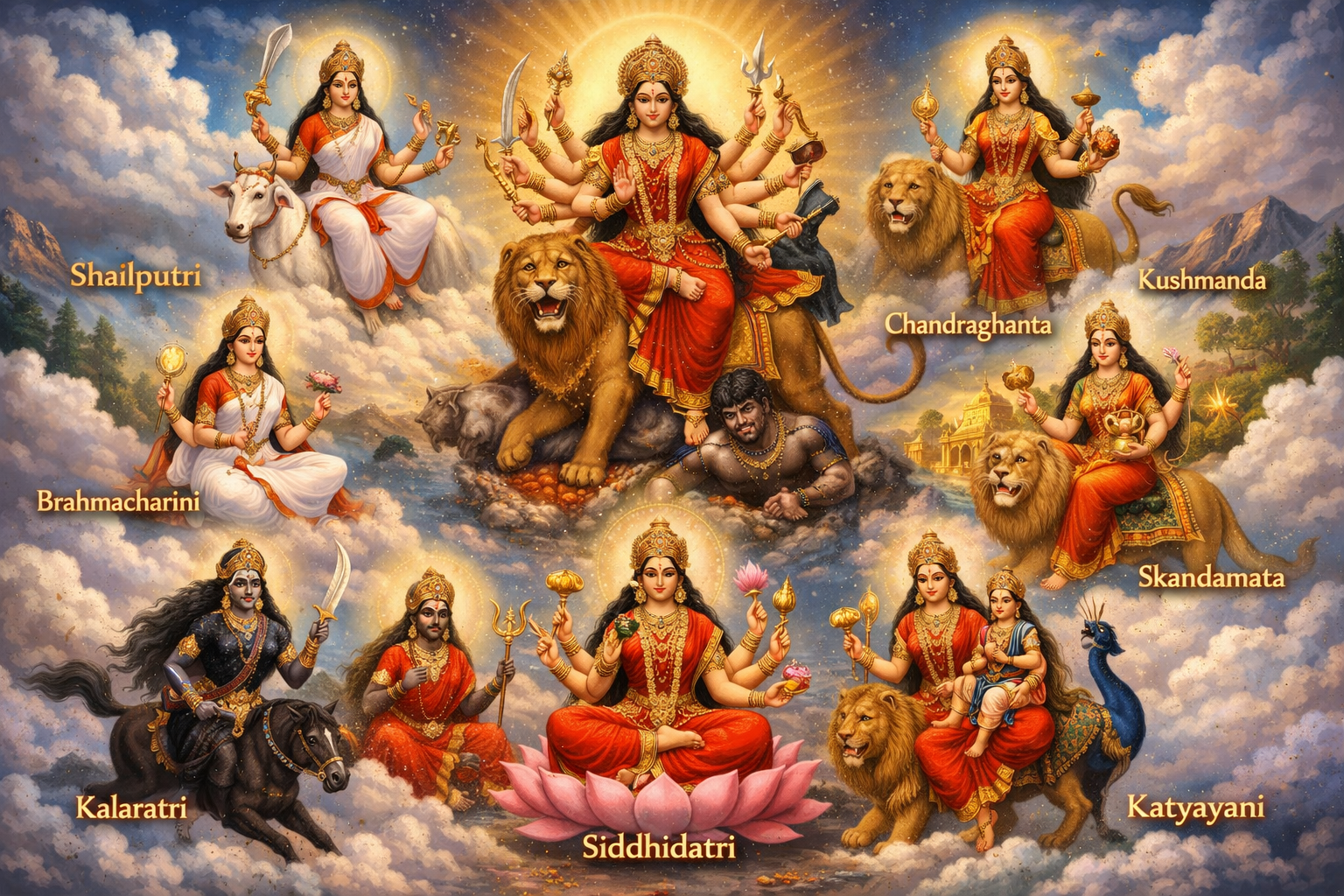
Maa Durga’s 9 Forms: The Complete Guide to Navdurga Before Navratri
नवदुर्गा · Nine Forms · One Supreme Shakti · Nine Nights of Devotion
| What is Navdurga | The nine divine forms of Maa Durga worshipped across nine nights of Navratri. Each form is a distinct aspect of the same supreme Shakti — Adi Parashakti. |
| Source Texts | Devi Mahatmya (Markandeya Purana) · Devi Bhagavata Purana · Shiva Purana · Skanda Purana |
| Chaitra Navratri | March 19–27, 2026 — Pratipada to Navami, Chaitra Shukla Paksha |
| Shardiya Navratri | October 11–19, 2026 — Ashwin Shukla Paksha (the larger, more celebrated Navratri) |
| Universal Mantra | ॐ ऐं ह्रीं क्लीं चामुण्डायै विच्चे — Om Aim Hreem Kleem Chamundaye Vichche |
| Durga Saptashati | 700 verses across 13 chapters of the Devi Mahatmya — the sacred scripture recited across all nine days |
| Kanya Puja | Performed on Ashtami or Navami — nine young girls worshipped as living forms of the nine Navdurga |
She is one. She has always been one. The Adi Parashakti — the primordial cosmic energy that preceded creation itself, the force from which Brahma, Vishnu, and Mahesh drew their own power, the shakti without which no god can act and no universe can turn. She has one name that contains all her names: Durga. And she has nine faces i.e., 9 roop of Maa Durga
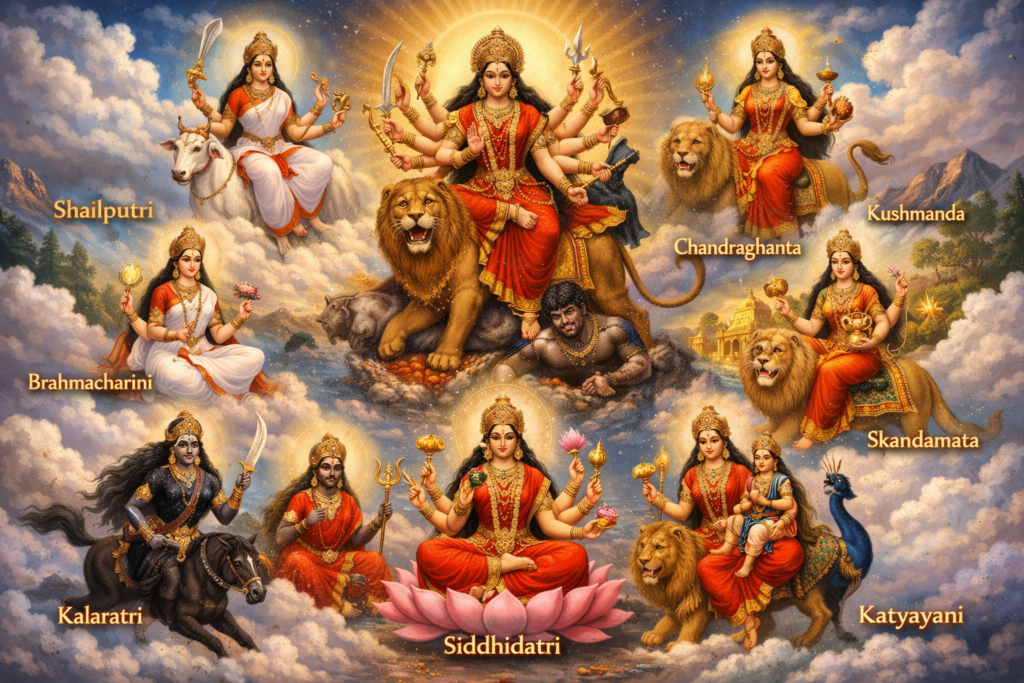
The nine faces are not separate goddesses. They are not even separate personalities, in the way that Western mythology imagines its pantheon — independent beings with independent wills who sometimes agree and sometimes conflict. The Navdurga are something more precise and more profound than that. They are aspects — the same energy seen from nine different angles, serving nine different purposes, inviting nine different forms of devotion from the human being who stands before the altar.
To know Maa Shailputri is to know the strength of the earth itself — the rooted, mountainous, immovable foundation. To know Maa Brahmacharini is to know the strength of sustained devotion — the years of penance that do not break. To know Maa Kalaratri is to know the strength of the night — the fearsome, necessary darkness that protects by destroying what should not remain. Nine names. Nine teachings. One mother.
The nine days of Navratri are an invitation to know her one face at a time — to sit with each aspect long enough to understand what it is asking of you, what it is capable of giving you, and how it lives not only in the heavens of myth but in the daily life of the person who lights the diya every morning and sits in her presence.
This is that guide. The story of each form, the mantra that calls her, the worship that honours her, and the blessing that comes when she is genuinely received.
Why Nine Forms — The Theology Behind Navdurga
The Devi Mahatmya — the Markandeya Purana’s extraordinary 700-verse account of the Goddess — describes the nine forms of Durga as the nine stages of her great battle against the demon Mahishasura and his forces. Each day of the war, she manifested in a different form, each suited to the specific challenge of that moment. The nine forms are therefore not arbitrary. They are the record of how the divine feminine fights — not with one fixed weapon but with whatever the battle requires.
But the theology goes deeper than the battle narrative. The Devi Bhagavata Purana offers a different lens: the nine forms correspond to the nine stages of the human spiritual journey — from the rooted innocence of birth (Shailputri) to the complete realisation of self as divine (Siddhidatri). To worship the Navdurga in order across nine days is to symbolically travel the entire arc of spiritual evolution in nine concentrated nights.
And the Tantric tradition adds a third dimension: the nine forms correspond to the nine energy centres of the subtle body — the chakras, from Muladhara at the base of the spine to Sahasrara at the crown. To worship each goddess is to awaken the corresponding chakra, clearing the channel through which Kundalini — the divine energy coiled at the base — rises toward enlightenment.
Three ways of understanding the same nine forms. The mythological, the spiritual, and the energetic. All three are true. All three are present in every Navratri puja, whether the devotee knows it consciously or not.
Ya Devi Sarvabhuteshu Shakti-Rupena Samsthita, Namastasyai Namastasyai Namastasyai Namo Namah.
— Devi Mahatmya — salutation to the goddess who is present in all beings in the form of Shakti. Bowed to her, bowed to her, bowed to her, again and again.
The Nine Forms — Story, Mantra & Puja
| 01 Navratri Day 1 — March 19, 2026 · Maa Shailputri माँ शैलपुत्री Navratri Colour: 🟡 Yellow — the colour of earth and prosperity · Vahana: Nandi the Bull · Arms: Two · Chakra: Muladhara (Root Chakra) | |
| Meaning | Shail = mountain · Putri = daughter. She is Parvati in her first form — the daughter of Himavan, king of the Himalayas. Also known as Sati Bhavani, Hemavati. |
| Appearance | Serene and powerful. White complexion. Rides the bull Nandi. Trishul in right hand representing past, present, future. Lotus in left hand representing purity. |
| Bhog (Prasad) | Cow’s ghee and white sweets — offered to her and given as prasad. Anointing the Shivling with ghee on this day is said to relieve pain and illness. |
The story of Shailputri begins before Parvati was Parvati. In her previous life, she was Sati — the daughter of Daksha Prajapati — who married Lord Shiva against her father’s wishes and later sacrificed herself in the sacred fire when Daksha insulted Shiva at a yajna. Grief-stricken, Shiva carried her body across the cosmos until Vishnu released it piece by piece with his Sudarshana Chakra. Each piece of Sati’s body that fell to earth became a Shakti Peetha — a seat of the goddess, a place of concentrated divine feminine energy.
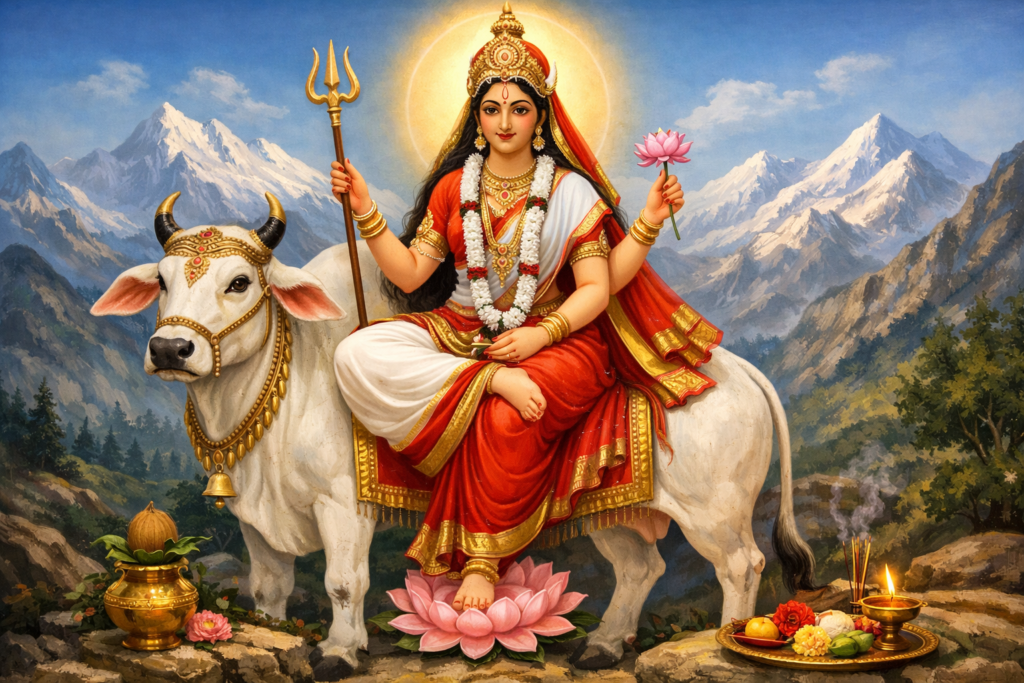
Sati was reborn as the daughter of Himavan — the personification of the Himalayas — and became Shailputri: the daughter of the mountain. She is the shakti that begins again after complete destruction. The grounding force after the absolute fall. She teaches that no fall is final, that the soul returns to earth after every death, and that every beginning carries within it the memory and the power of everything that came before.
Shailputri governs the Muladhara chakra — the root, the base, the foundation of all energy in the body. To worship her on the first day of Navratri is to begin the spiritual journey from the ground up. To ask: am I stable enough to rise?
ॐ देवी शैलपुत्र्यै नमः
Om Devi Shailputryai Namah
Salutation to Goddess Shailputri — recite 108 times with a japa mala
Vande Vaanchhit Laabhaay
Vande Vaanchhit Laabhaay, Chandrardhkritshekharaam. Vrisharudham Shooldharaam, Shailputreem Yashaswineem.
I bow to Shailputri — the glorious one, who wears the crescent moon, rides the bull, and carries the trishul — to receive from her all that I wish for.
Practical puja: Perform Ghatasthapana on this day. Offer yellow flowers, ghee, and white sweets to the idol. Light the Akhand Diya — the continuous lamp — which must burn through all nine nights. The ghee with which you anoint the Kalash on Day 1 is considered to carry her blessing of health and strength.
| 02 Navratri Day 2 — March 20, 2026 · Maa Brahmacharini माँ ब्रह्मचारिणी Navratri Colour: 🟢 Green — the colour of growth and hope · Vahana: None — she walks barefoot · Arms: Two · Chakra: Svadhishthana (Sacral Chakra) | |
| Meaning | Brahma = divine knowledge/penance · Charini = one who practises. She is the ascetic form of Parvati — the goddess of tapas (penance) and brahmacharya (disciplined spiritual practice). |
| Appearance | Simple, luminous, radiantly beautiful despite her austerities. White sari, bare feet. No ornaments. Only the mala of Rudraksha beads and the water pot — the two instruments of her devotion. |
| Bhog (Prasad) | Sugar (chini) and panchamrit — five sacred substances: milk, curd, honey, ghee, sugar. Offering sugar is said to bring longevity to the devotee’s family. |
The story of Brahmacharini is one of the most powerful in all of Hindu mythology — a story about what true devotion looks like when it is tested beyond any reasonable limit. After her birth as Parvati, she was determined to win Lord Shiva as her husband. But Shiva was the great ascetic — deep in samadhi, unmoved by anything in the world, certainly unmoved by the desires of a beautiful young woman.
And so Parvati chose to fight fire with fire. She went into the forest and began a penance so severe that even the gods were shaken by it. For three thousand years, she ate only fruit and leaves. Then for another three thousand, she ate only dry leaves. Then she stopped eating entirely — Aparna, the one who takes no leaves. She sat through monsoons without shelter, through summers in the open sun between four fires, through Himalayan winters with no clothing. For thousands of years. Without wavering.
The sage Narada visited her during the penance and tried to dissuade her. Shiva, he said, was an ascetic, a wanderer, a smear of ash and serpents — no fit husband for the daughter of a king. Parvati did not move. She said: I have decided. I will not undecide. And she continued her tapas.
Shiva, who had seen everything in the universe and been moved by none of it, was moved by this. He came to her disguised as a Brahmin and insulted himself in every possible way — trying to convince her to give up. She refused to hear a word against him. And Shiva, revealed, received her. Brahmacharini is the goddess who demonstrates that the things most worth having are the ones you are willing to sit with indefinitely, without guarantee of the outcome.
ॐ देवी ब्रह्मचारिण्यै नमः
Om Devi Brahmacharinyai Namah
Salutation to Goddess Brahmacharini — recite 108 times
Dadhana Kare Padmaabhyam Akshamala Kamandalu. Devi Praseed Mahi Maye Brahmacharini Nuttaye.
O Goddess Brahmacharini — holding in your lotus hands the rosary and the water pot — be pleased with me, and grant me your grace.
Practical puja: Offer sugar, panchamrit, and white flowers. If you are undertaking a vrat (fast) during Navratri, Brahmacharini’s day is the ideal day to deepen your commitment — to move from going through the motions to genuine tapas. She rewards those who show up with real intention, not just form.
| 03 Navratri Day 3 — March 21, 2026 · Maa Chandraghanta माँ चन्द्रघण्टा Navratri Colour: 🩶 Grey — the colour of strength and resolve · Vahana: Tiger · Arms: Ten · Chakra: Manipura (Solar Plexus Chakra) | |
| Meaning | Chandra = moon · Ghanta = bell. The half-moon on her forehead is shaped like a bell (ghanta). She is Parvati after her marriage to Shiva — the warrior queen adorned for battle. |
| Appearance | Ten arms. Golden complexion radiant as the sun. Three eyes. The half-moon adorns her forehead. Rides a tiger. Her form inspires simultaneous awe and calm — terrible to enemies, peaceful to devotees. |
| Bhog (Prasad) | Milk and kheer (rice pudding). Offering milk products on this day is said to bring relief from pain and suffering and to relieve the agonies of this life. |
Chandraghanta represents the moment of sacred transformation — the point at which Parvati the ascetic becomes Parvati the warrior queen. After her years of tapas and her marriage to Shiva, Parvati was ready to receive what the universe would throw at her. And the universe threw a great deal.
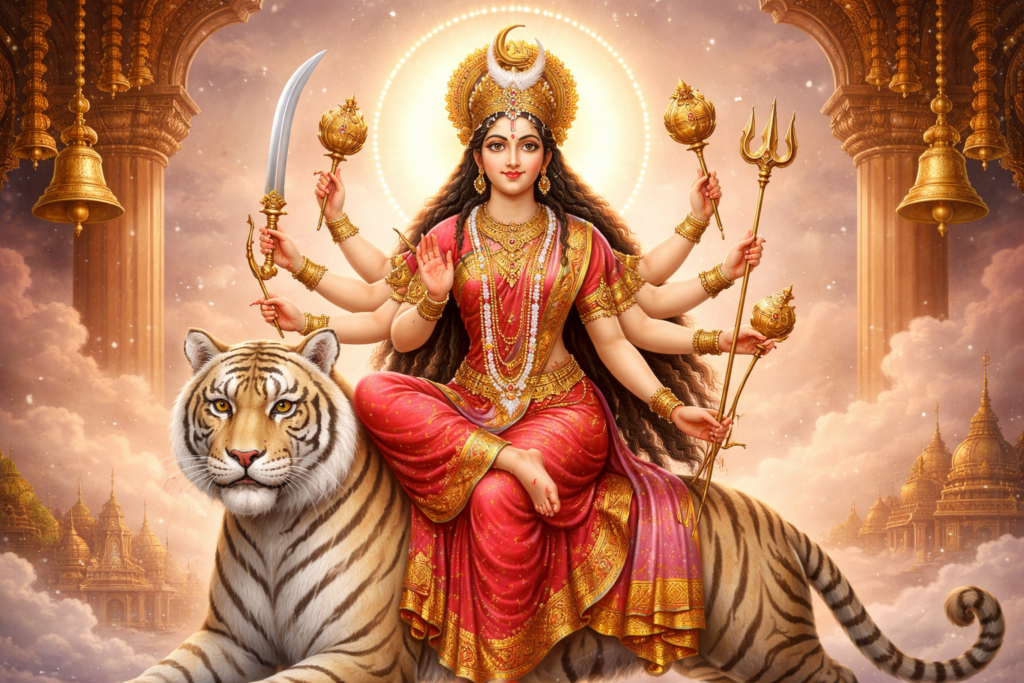
The half-moon on her forehead — shaped like the ghanta, the sacred bell — is the same crescent that Shiva himself wears. It connects her to her lord and marks her as his equal: not the worshipper now but the worshipped alongside him. The sound of the ghanta, the classical texts say, is itself a weapon — it drives away all evil forces, all dark energies, all demons that cannot bear the vibration of sacred sound. To chant her name is to ring that bell.
Chandraghanta governs the Manipura chakra — the solar plexus, the seat of personal power, confidence, and will. She is prayed to by those who face enemies, who need courage to confront what frightens them, who wish to move through life with the contained grace of a warrior who is always ready but never unnecessarily violent. She does not seek battle. But she does not avoid it when it is necessary.
ॐ देवी चन्द्रघण्टायै नमः
Om Devi Chandraghantayai Namah
Salutation to Goddess Chandraghanta — recite 108 times
Pindaj Pravaarudh Chandkopastrkairyuta. Prasadam Tanute Madhyam Chandraghanteti Vishrutaa.
She who rides the tiger and carries weapons in her hands, full of fierce energy — the celebrated Chandraghanta — bestow your grace upon me.
Practical puja: Offer milk, kheer, and grey or silver flowers (or white flowers as an alternative). Light jasmine incense — she particularly favours it. On this day, pray specifically for courage in whatever you have been avoiding. The warrior queen does not accept vague petitions — name what you are afraid of.
| 04 Navratri Day 4 — March 22, 2026 · Maa Kushmanda माँ कूष्माण्डा Navratri Colour: 🟠 Orange — the colour of fire and creativity · Vahana: Lion · Arms: Eight (Ashtabhuja) · Chakra: Anahata (Heart Chakra) | |
| Meaning | Ku = little · Ushma = warmth/energy · Anda = egg (cosmic). She who created the universe from the warmth of her divine smile. The creator of the cosmic egg. |
| Appearance | Eight arms — hence Ashtabhuja Devi. Radiant, bright, luminous complexion like the sun itself. Rides a lion. Her smile is said to contain the light of a thousand suns. |
| Bhog (Prasad) | Malpua — the golden fennel pancakes. Offering malpua to Kushmanda is said to bring intelligence, knowledge, and freedom from all troubles. |
Before time, before the universe, before light itself — there was only darkness. The endless void. And in that void, it is said, Adi Parashakti existed as pure potential. And she smiled. And from that smile — that single act of divine creative joy — light entered the darkness. The cosmic egg formed. And within it, the seeds of all creation.
Maa Kushmanda is that smile. She is the universe at the moment of its own beginning — the creative power that exists before anything has been created, that brings everything into being by an act not of work or will but of pure radiant joy. She is why creation happened at all: not from necessity, not from plan, but from the overflow of a divine happiness that could not contain itself.
She governs the Anahata chakra — the heart centre — which is why she is associated with creativity, abundance, and the feeling of genuine aliveness that comes when the heart is open. When she is worshipped with sincerity, the classical texts say, even the most diseased body is restored to health, because she is the original life-force from which all health flows. What she blesses is not just physical health but the deeper vitality — the desire to be alive, to create, to contribute.
ॐ देवी कूष्माण्डायै नमः
Om Devi Kushmandayai Namah
Salutation to Goddess Kushmanda — recite 108 times
Suraasampoorna Kalasham Rudhiraaplutamev Cha. Dadhaanaa Hastpadmaabhyaam Kushmanda Shubhdaastu Me.
Goddess Kushmanda — holding pots in her lotus hands, full of the nectar of life — be propitious and auspicious to me.
Practical puja: Offer malpua, orange flowers, and light a deepam with ghee. On this day, bring your creative intentions to the altar — what you wish to build, to create, to bring into the world. Kushmanda receives prayers for new beginnings, new projects, and the health to carry them through.
| 05 Navratri Day 5 — March 23, 2026 · Maa Skandamata माँ स्कन्दमाता Navratri Colour: ⬜ White — the colour of purity and peace · Vahana: Lion (also depicted on lotus) · Arms: Four · Chakra: Vishuddha (Throat Chakra) | |
| Meaning | Skanda = Lord Kartikeya (the war god, son of Shiva) · Mata = mother. She is the mother of Skanda — Kartikeya — who was appointed commander-in-chief of the divine army against the demons. |
| Appearance | Radiant, four-armed, seated on a lotus throne or riding a lion. Holds the infant Skanda in her upper right arm — the divine child who will grow into the general of gods. Her face is luminous with maternal love. |
| Bhog (Prasad) | Banana and fresh seasonal fruits. Offering banana to Skandamata is said to bring wisdom, enlightenment, and moksha — liberation from the cycle of birth and death. |
The story of Skandamata is inseparable from the story of her son — and the story of why that son was born. The demon Tarakasura had received a boon from Brahma: he could only be killed by the son of Shiva. Since Shiva was a deep ascetic with no interest in progeny, Tarakasura considered himself effectively immortal — no son of Shiva could exist if Shiva had renounced all worldly engagement.
Parvati’s tapas — her years of penance as Brahmacharini — resulted in her union with Shiva. And from that union came Skanda: Kartikeya, the war god, born specifically to end a demon’s certainty of his own invincibility. Skandamata is Parvati at the moment of her greatest accomplishment — not the moment she won Shiva, but the moment she produced the force that would protect the universe.
There is a tenderness in Skandamata that none of the other forms carry in quite the same way. She holds the infant Skanda — the future general of all the gods — in the arm of an ordinary mother. Before he is the divine warrior, he is her child. And she holds him the way any mother holds her child: completely, unhurriedly, with her full being. The Devi Bhagavata Purana says that by worshipping Skandamata, even a fool becomes an ocean of knowledge — because the same love that formed the war god can form wisdom in anyone who receives it.
ॐ देवी स्कन्दमातायै नमः
Om Devi Skandamatayai Namah
Salutation to Goddess Skandamata — recite 108 times
Simhaasangataa Nityam Padmaashrit Karadvayaa. Shubhadastu Sadaa Devi Skandamaata Yashaswinee.
Seated on the lion throne, hands resting on lotus flowers, the glorious Skandamata — be always auspicious to me.
Practical puja: Offer bananas, white flowers, and white cloth. Mothers pray particularly fervently to Skandamata for the health, intelligence, and protection of their children. She is also prayed to by those seeking children, and by students before examinations. On this day, write down what you wish to protect and nurture — and place it at her altar.
| 06 Navratri Day 6 — March 24, 2026 · Maa Katyayani माँ कात्यायनी Navratri Colour: 🔴 Red — the colour of fierce love and power · Vahana: Lion · Arms: Four · Chakra: Ajna (Third Eye Chakra) | |
| Meaning | Born in the ashram of sage Katyayan — who had prayed for the Goddess to be born as his daughter. She is the daughter of Katyayan, born from the combined divine rage of Brahma, Vishnu, and Mahesh to destroy Mahishasura. |
| Appearance | Radiant, four-armed, golden complexion. Rides a lion. Her sword blazes. Her mudras — one protective, one granting — tell the devotee she is simultaneously shield and gift. |
| Bhog (Prasad) | Old honey (purana madhu). Offering honey to Katyayani is said to fulfil wishes and bring beauty, grace, and the fulfilment of all marriage-related prayers. |
Maa Katyayani was born to fight. The demon Mahishasura — the buffalo demon — had been given an extraordinary boon by Brahma: no man, no god could kill him. He had assumed, with the confident stupidity of all such boons, that this made him invincible. He had not considered the possibility of a goddess.
When Mahishasura’s armies overran the heavens and drove the gods from their own realm, the combined fury of Brahma, Vishnu, and Mahesh took form as a blinding light — and from that light emerged Katyayani: armed with the weapons of every god, riding a lion, her face composed with the calm that only someone who knows they will win can carry into battle. She fought for nine days. On the tenth, she destroyed Mahishasura. That tenth day is Vijayadashami — the day of victory.
Katyayani is particularly worshipped by unmarried women seeking a loving and righteous husband. The Bhagavata Purana describes how the Gopis of Vrindavan — the companions of young Krishna — observed a month-long vrat to Katyayani, bathing in the Yamuna at dawn, fasting through the day, and praying with one specific request: grant us Krishna as our husband. She is the goddess of brave, intentional love — the love that knows what it wants and is willing to do the inner work to receive it.
ॐ देवी कात्यायन्यै नमः
Om Devi Katyayanyai Namah
Salutation to Goddess Katyayani — recite 108 times
Chandrahaasojjval Karaa Shaardoolvarvaahanaa. Katyayani Shubham Dadyaad Devi Daanavghatini.
Goddess Katyayani — who holds the blazing sword, rides the lion, and destroys the demons — be auspicious to me and give me your blessing.
Practical puja: Offer honey and red flowers — red hibiscus especially, which is her favourite. Unmarried women who observe the Katyayani vrat traditionally wake before sunrise, bathe, and pray with the specific intention of a loving life partner. Whisper the prayer clearly — Katyayani does not respond to vague requests. She is a warrior; she appreciates precision.
| 07 Navratri Day 7 — March 24–25, 2026 (Saptami) · Maa Kalaratri माँ कालरात्रि Navratri Colour: 🔵 Royal Blue — the colour of the infinite night sky · Vahana: Donkey · Arms: Four · Chakra: Sahasrara (Crown Chakra) | |
| Meaning | Kala = time, darkness, and death · Ratri = night. She is the darkest, most fearsome form of Durga — the one who destroys absolutely, who embodies the terrifying aspect of time that ends all things. |
| Appearance | Dark as a moonless night. Flowing unbound hair. Three blazing red eyes. Her breath is fire. She wears a garland of skulls. Rides a donkey. Terrifying to behold — and completely benevolent to her devotees. |
| Bhog (Prasad) | Jaggery (gur). Offering jaggery to Kalaratri is said to remove all sorrows and obstacles, and to free the devotee from all forms of black magic and dark energy. |
Maa Kalaratri is the most terrifying face of the goddess — and the most misunderstood. People approach her altar with fear, as though the darkness she embodies is something to be afraid of rather than something to be grateful for. This is the misunderstanding.
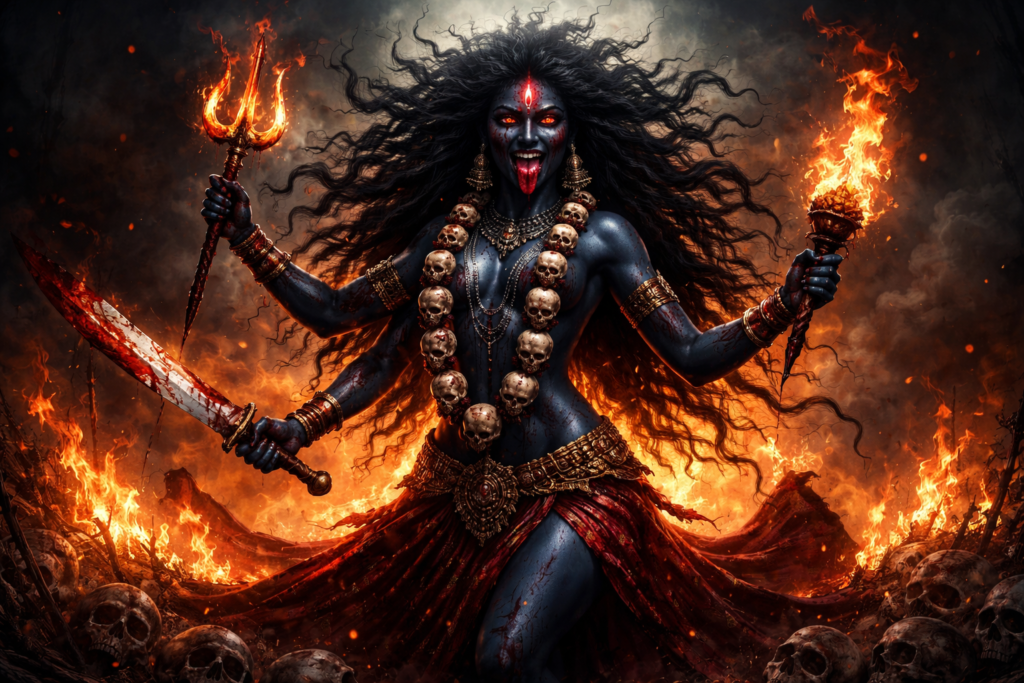
The story of her origin is this: during the great war with the demons Shumbha and Nishumbha, two particularly terrible demons named Chanda and Munda were sent to capture the goddess. When they arrived, such fierce anger arose in her that her face turned black as the darkest night — and from her forehead emerged Kalaratri: the goddess of absolute darkness, skeleton-thin, skull-garlanded, riding a donkey, breathing fire from flared nostrils, her three eyes blazing like the sun, moon, and fire. She destroyed Chanda and Munda utterly — which is why she is also called Chamunda.
Kalaratri represents something that is genuinely difficult to hold in the mind at once: she is the most frightening form of the goddess and simultaneously the most protective. Her darkness is not the darkness of evil — it is the darkness that swallows evil. She destroys fear by embodying it so completely that nothing remains to be afraid of. She is night itself — which is not the enemy of day but its necessary companion, the space in which all rest, all renewal, all transformation happens. Without her darkness, there is no morning.
Her other name is Shubhankari — the one who does good, the one who is auspicious. She is described in the Devi Mahatmya as abhayankari and shubhankari together — one who gives fearlessness and one who gives auspiciousness. These two qualities, in her, are the same thing: true fearlessness IS auspiciousness. When you are no longer afraid, everything becomes possible.
ॐ देवी कालरात्र्यै नमः
Om Devi Kalaratryai Namah
Salutation to Goddess Kalaratri — recite 108 times
Ekaveni Japakarnapoora Nagna Kharaasthitaa. Laamboshthi Karnikanaakarni Tailaabhyaktasharirinee.
She with the single braid, ornamented ears, naked form on the donkey — dark-complexioned, long-lipped, her body anointed with oil — to her I bow.
Practical puja: Offer jaggery, dark blue or black flowers, sesame oil lamps (not ghee — she is worshipped with sesame). On this day, bring what frightens you to her altar with complete honesty. Name it. Place it before her. Kalaratri’s blessing is not the removal of darkness — it is the courage to stop being afraid of it. She is prayed to for protection against all forms of negative energy, black magic, and evil influences.
| 08 Navratri Day 8 — March 26, 2026 (Durga Ashtami) · Maa Mahagauri माँ महागौरी Navratri Colour: 🩷 Pink — the colour of compassion and new beginnings · Vahana: Bull (White) · Arms: Four · Chakra: Anahata (Heart Chakra — renewed) | |
| Meaning | Maha = great · Gauri = extremely fair/white. She is the purest, most radiant form of Parvati — after her years of penance darkened her skin, Shiva bathed her with the Ganga’s waters and she emerged shining white as the moon. |
| Appearance | Perfectly white complexion. White clothes. White ornaments. Rides a white bull. She is purity made visible — every item of her iconography is white, carrying the teaching that purity of this kind is not passive but achieved through fire. |
| Bhog (Prasad) | Coconut and nariyal laddoo. Offering coconut to Mahagauri is said to wash away all past sins — of this life and previous lives — and bring the peace that comes only from genuine purification. |
The story of Mahagauri is the story of what comes after the penance is complete. Parvati had sat for thousands of years in the Himalayan forests, through summers and winters without shelter, eating nothing, thinking of nothing but Shiva. During those years, the elements did their work on her body — the sun darkened her skin, the wind dried her hair, the years wore at her beauty until what remained was pure devotion in a body that had given everything else away.
When Shiva finally came to her and they were united, he looked at her and felt a tenderness that no amount of divine power had ever produced in him. He bathed her in the holy water of the Ganga. And she emerged transformed — not restored to what she was, but elevated beyond it. Mahagauri: the great white one, radiant beyond the radiance of the moon, all impurity dissolved by the combination of her penance and his grace.
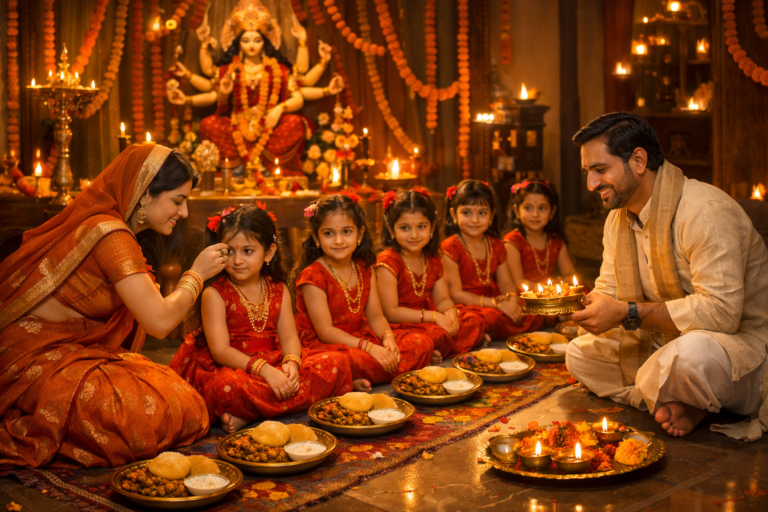
She is worshipped on the Ashtami — the eighth night — which is considered the most powerful single night of all Navratri. The Sandhi Puja on this evening (at the junction between Ashtami and Navami) is the peak sacred moment of the entire nine days. And Kanya Puja — the worship of nine young girls as living embodiments of the nine Navdurga — is performed on this day or the following morning. The girls who sit before you at Kanya Puja are, in the theology of this day, Mahagauri herself in miniature: pure, unformed by the world’s grime, carrying the goddess’s radiance in their unself-conscious eyes.
ॐ देवी महागौर्यै नमः
Om Devi Mahagauryai Namah
Salutation to Goddess Mahagauri — recite 108 times on Ashtami
Shwete Vrishesamaaroodhaa Shwetaambar Dharaa Shuchih. Mahaabaahu Shitikaanthaa Cha Mahaagandhaa Cha Gaurih.
The pure white goddess — seated on the white bull, dressed in white, with great arms and the fair complexion — Mahagauri, whose fragrance is divine.
Practical puja: This is the most important day of Navratri for individual worship. Offer coconut, white flowers, and white cloth. Perform Kanya Puja if possible — wash the feet of nine young girls, offer them halwa-puri-chana, give red chunri and a small gift, take their blessings by touching their feet. The Sandhi Puja window — 11:24 AM to 12:12 PM on March 26 — should be observed with 108 diyas lit simultaneously if possible. It is the most sacred 48 minutes of all nine days.
| 09 Navratri Day 9 — March 27, 2026 (Navami · Ram Navami) · Maa Siddhidatri माँ सिद्धिदात्री Navratri Colour: 🟣 Purple — the colour of wisdom and spiritual perfection · Vahana: Lion (also seated on lotus) · Arms: Four · Chakra: Sahasrara (Crown Chakra — fully awakened) | |
| Meaning | Siddhi = supernatural power or perfection · Datri = giver, bestower. She who grants all eight Siddhis. The highest, most complete form of the goddess — the one who gives everything. |
| Appearance | Seated on a fully bloomed lotus — the symbol of complete enlightenment. Four arms carrying the lotus (devotion), gada (power), chakra (cosmic order), and conch (primordial sound). Her expression is the most serene of all nine forms. |
| Bhog (Prasad) | Sesame seeds and halwa. Offering sesame on Navami is said to grant the devotee freedom from all fear of death and liberation from the cycle of rebirth. |
Maa Siddhidatri is the destination. She is what the nine-day journey has been building toward: the form of the goddess that gives everything — not in the sense of satisfying worldly desires, but in the sense of making the devotee complete.
The eight Siddhis she grants are described in the Devi Bhagavata Purana: Anima (the power to become infinitely small), Mahima (the power to become infinitely large), Garima (the power to become infinitely heavy), Laghima (the power to become infinitely light), Prapti (the power to attain anything), Prakamya (the power to fulfil any wish), Ishitva (mastery over all nature), and Vashitva (the power to bring all beings under one’s will). These are not only supernatural powers in the literal sense — they are metaphors for the qualities of a fully realised soul: someone who can make themselves nothing or everything, who is moved by nothing and can move everything.
The Devi Bhagavata Purana says that even Lord Shiva received his powers by worshipping Siddhidatri — and that through her grace, he became Ardhanarishvara: the form that is half Shiva and half Shakti, male and female unified in one divine body. She is the final proof that the masculine and feminine, the human and divine, the seeker and the sought — are not ultimately separate.
In 2026, Navami is also Ram Navami — the birth of Lord Rama. The nine days of Shakti end with the birth of the god of Dharma. Siddhidatri hands the world to Rama. The mother completes her work and the son begins his. The circle of the Hindu calendar turns with a completeness that is not accidental.
ॐ देवी सिद्धिदात्र्यै नमः
Om Devi Siddhidatryai Namah
Salutation to Goddess Siddhidatri — recite 108 times on Navami
Siddha Gandharva Yakshadyair Asurairamaraairapi. Sevyamana Sadaa Bhooyaat Siddhida Siddhidayini.
Worshipped by Siddhas, Gandharvas, Yakshas, Asuras, and gods alike — may Siddhidatri always grant me Siddhi and her grace.
Practical puja: Offer sesame seeds, halwa, and purple or dark blue flowers. After the final Siddhidatri puja, perform the Navratri havan if possible — or a simple aarti with camphor if havan is not available. Uproot and offer the Javara (wheatgrass) that has been growing since Day 1. Break the fast after the puja is complete — after 10:06 AM on March 27. The parana meal traditionally includes kheer, puri, halwa, and chana. Ram Navami puja may be performed separately at the auspicious Abhijit Muhurat: 12:00 PM to 12:48 PM.
All Nine at a Glance — The Complete Navdurga Reference
| Day | Goddess | Colour | Vahana | Bhog | Chakra | Core Blessing |
| 1 Mar 19 | Shailputri | 🟡 Yellow | Bull Nandi | Cow’s ghee | Muladhara | Stability & strength |
| 2 Mar 20 | Brahmacharini | 🟢 Green | None (barefoot) | Sugar & panchamrit | Svadhishthana | Willpower & moksha |
| 3 Mar 21 | Chandraghanta | 🩶 Grey | Tiger | Milk & kheer | Manipura | Courage & grace |
| 4 Mar 22 | Kushmanda | 🟠 Orange | Lion | Malpua | Anahata | Health & creativity |
| 5 Mar 23 | Skandamata | ⬜ White | Lion / Lotus | Banana & fruits | Vishuddha | Wisdom & protection |
| 6 Mar 24 | Katyayani | 🔴 Red | Lion | Old honey | Ajna | Victory & marriage |
| 7 Mar 24 | Kalaratri | 🔵 Blue | Donkey | Jaggery | Sahasrara | Fearlessness & protection |
| 8 Mar 26 | Mahagauri | 🩷 Pink | White Bull | Coconut | Anahata (renewed) | Purification & peace |
| 9 Mar 27 | Siddhidatri | 🟣 Purple | Lion / Lotus | Sesame & halwa | Sahasrara (open) | All siddhis & moksha |
One Goddess. Nine Teachings. An Infinite Invitation.
Stand before any one of the nine and you are standing before all of them — because they are not nine separate deities but nine windows into the same infinite room. Shailputri shows you the window of the mountain: strength without striving. Brahmacharini shows you the window of the penance: love without guarantee. Chandraghanta shows you the warrior’s window: action without aggression. Kushmanda shows you creation’s window: the universe born from a smile. Skandamata shows you the mother’s window: the fierce tenderness that builds gods and generals from the stuff of ordinary love.
Katyayani shows you the window of divine rage harnessed: fury that destroys only what must be destroyed. Kalaratri shows you the window of the necessary darkness: the night without which there is no morning, the fear overcome so completely that it becomes protection. Mahagauri shows you the window of purification: what remains when everything that was not you has been burned away. And Siddhidatri shows you the last window — which is not a window at all but the wall dissolving, the room revealed to be the whole sky.
The nine days of Navratri are not nine separate events. They are one event viewed from nine angles. You do not worship nine different goddesses — you worship one reality in nine of its faces, turning slowly to see each one, spending enough time with each to let it change something in you. And if you do this with genuine attention — not just the correct flowers and the correct mantras but genuine, quiet, unhurried attention — you will arrive at Navami different from how you arrived at Pratipada.
Lighter, perhaps. Clearer. Less afraid of the darkness because you have sat with Kalaratri. Less attached to outcomes because you have sat with Brahmacharini. More grounded because you have sat with Shailputri at the root. More creative because Kushmanda smiled at you. More willing to love fiercely because Katyayani showed you what fierce love accomplishes.
This is what the nine forms of Maa Durga are for. Not the religion of the calendar. The religion of the actual encounter. The nine-day decision to show up at the altar, day after day, and let the goddess work.
ॐ ऐं ह्रीं क्लीं चामुण्डायै विच्चे
Om Aim Hreem Kleem Chamundaye Vichche
नवरात्रि की हार्दिक शुभकामनाएँ
May the nine forms of Maa Durga bless you with their nine gifts.
🛕 Which form of Maa Durga speaks to you most deeply — and why? Is there a temple to one of the Navdurga in your city, your lane, your village that most people walk past without knowing what it holds? Write to us. These stories are the ones Whispering Bharat was made to tell.