
Ram Navami 2026 : The Birth of Dharma and Why Ayodhya Stops the World Today
राम नवमी · Thursday, March 26, 2026 · Chaitra Shukla Navami · Madhyahna Moment: 12:27 PM
| Date Clarified | The Navami Tithi begins March 26 at 11:48 AM and ends March 27 at 10:06 AM. The Madhyahna — the sacred midday birth moment — falls on March 26 at 12:27 PM. Ayodhya, most temples, and the majority of North India celebrate on March 26. Some Vaishnava traditions observe on March 27 (Udaya Tithi). Both are honoured. |
| Puja Muhurat | 11:13 AM to 1:41 PM on March 26, 2026. The most sacred single moment: 12:27 PM (Madhyahna — the birth moment as recorded by Valmiki). |
| Surya Tilak — Ayodhya | 12:27 PM on March 26: sunlight channelled through precision optics and mirrors inside the Ram Mandir directly illuminates Ram Lalla’s forehead. The cosmos performing tilak on the newly born god. |
| Nakshatra | Punarvasu — Jupiter’s nakshatra, meaning ‘the returning good,’ associated with renewal, restoration, and the return of light after darkness. |
| Planetary Alignment | At the time of Rama’s birth as recorded in Valmiki Ramayana: Sun exalted in Aries · Moon in Cancer in Punarvasu · Jupiter in Cancer · Venus exalted in Pisces · Mars exalted in Capricorn · Saturn exalted in Libra. Five planets in exaltation simultaneously — an astronomically unique configuration. |
| Vrat Parana | Navratri Parana (fast-breaking): after 10:06 AM on March 27, when Navami Tithi ends. |
| Triple Sanctity | Three events in Rama’s life are said to have occurred on Chaitra Shukla Navami: his birth, his marriage to Sita, and his coronation as King of Ayodhya. No other tithi in the Hindu calendar holds a single being’s birth, marriage, and coronation simultaneously. |
| The Name RAM | Ra + Ma = Taraka Mantra. The Sthala Purana of Kashi records that Shiva himself whispers the name Rama into the ear of every soul departing from Kashi. Tulsidas calls it the two-syllable bridge between the mortal and the divine. Mahatma Gandhi’s last words were: Hē Rām. |
At 12:27 PM on Thursday, March 26, 2026, something will happen inside the Ram Mandir in Ayodhya that has no equivalent in any other temple on earth. A beam of sunlight — channelled with precision through a system of mirrors, prisms, and lenses installed in the temple structure by a team of Indian scientists and optical engineers — will travel from the roof of the sanctum, bend through its designed angles, and fall directly on the forehead of Ram Lalla, the infant Rama who sits at the heart of the temple that took five hundred years to build.
For a few minutes, the sun will perform the tilak. Dharma will light itself.
This is the Surya Tilak — the solar tilak — and it happens only once a year, on Ram Navami, at the exact minute that Valmiki recorded as the birth moment of Lord Rama in the Balakanda of the Ramayana. When the ancient astronomer-sage recorded that Rama was born at Madhyahna — the midpoint of the day — under a sky in which five planets were simultaneously exalted, he was describing a cosmic event. The temple’s architects understood this. They built the optics into the stone so that the cosmos could perform its annual acknowledgement of the day dharma was born.
This is not mythology. The Surya Tilak mechanism was developed by scientists from the Indian Institute of Astrophysics and Central Building Research Institute — a collaboration between ancient astronomical knowledge and modern optical engineering that produces, once a year, the most literally stunning moment in all of India’s religious calendar. The sun touches the god’s forehead. The universe remembers the birth.
And Ayodhya — the city that carries this birth in its soil, in its river, in the name of every lane — stops the world today.
March 26 or March 27? — The Honest Answer
Every year, the internet fills with contradictory information about Ram Navami’s date. In 2026, the confusion is real and worth addressing directly — because both dates are correct depending on which tradition you follow.
The Navami Tithi — the ninth day of the bright fortnight in Chaitra — begins on March 26 at 11:48 AM and ends on March 27 at 10:06 AM. The tithi spans two calendar days. Two traditions handle this differently.
The Madhyahna tradition celebrates on March 26 because the sacred Madhyahna — the midday period during which Rama was born — falls on March 26 between 11:13 AM and 1:41 PM, with the exact birth moment at 12:27 PM. The Ayodhya Ram Mandir, most North Indian temples, and the Surya Tilak ceremony all follow this tradition. This is also the date prescribed for the Navratri Sandhi Puja and the Ram Janmotsav celebrations.
The Udaya Tithi tradition celebrates on March 27 because on that day, the sun rises while Navami Tithi is still active — making March 27 the day that begins (Udaya = sunrise) under the Navami’s sanctity. Some Vaishnava sampradayas and South Indian traditions follow this calculation.
Whispering Bharat follows the Ayodhya tradition — March 26, 2026 — because the Surya Tilak, the Ram Janmotsav at the birthplace, and the most significant public celebration of Ram Navami all take place on this day. For the Navratri Parana (fast-breaking), we honour March 27 after 10:06 AM, when the Navami Tithi concludes.
The Birth — As Valmiki Recorded It
The birth of Rama is described in the Balakanda — the first book of the Valmiki Ramayana — with a precision that is part astronomical observation, part sacred narrative, and part the kind of quiet, patient storytelling that only a poet who was also a sage could produce. Valmiki does not rush to the birth. He earns it.
The King Without an Heir
Dasharatha, king of Ayodhya, ruled the city of the Suryavansha — the Solar dynasty, whose lineage began with Surya himself and descended through Ikshvaku, Raghu, and Aja to the great king in whose palace the story begins. By every measure, Dasharatha was a complete king: righteous, powerful, beloved, a master of the Vedas and the arts of war, ruler of a kingdom so prosperous that it had no enemies who were not already defeated. He had three queens: Kausalya, the eldest and most devoted; Kaikeyi, the beautiful and spirited second; and Sumitra, the gentle third. He had everything — except the son who would carry his dynasty forward.
The absence of an heir was not merely a dynastic problem for Dasharatha. In the Vedic understanding of a king’s dharma, the failure to produce a son was a spiritual incompleteness — the chain of ancestors extending back to Surya himself was at risk of being broken. Dasharatha consulted his family priest, the great sage Vasishtha, who advised a specific remedy: the Putrakameshti Yajna — the fire sacrifice performed for the purpose of receiving sons.
The Yajna — and the Divine Arrival
Sage Rishyashringa — the great celibate sage whose presence alone was considered capable of invoking the most powerful divine blessings — was invited to conduct the Putrakameshti Yajna. The fire was lit. The mantras were chanted. The oblations were offered. And then — in the moment that Valmiki describes with the kind of restraint that makes the event more extraordinary for its quietness — a divine being emerged from the flames.
The Yajnapurusha: a celestial figure of radiant appearance, holding a golden vessel covered with a golden lid, filled with the Payasam — the sacred sweet pudding that was the divine response to Dasharatha’s prayer. He handed it to the king. And the king distributed it among his three queens: half to Kausalya, a quarter to Kaikeyi, and the remaining quarter divided between both — part to Sumitra, part to Sumitra again, for she was to bear twins.
The Birth — The Cosmic Moment
Time moved forward in Ayodhya. The queens’ pregnancies progressed. And then — on the ninth day of the bright fortnight in Chaitra, at the midpoint of the day, when the sun was in Aries and the moon was in Punarvasu in Cancer and five planets were exalted in their highest positions simultaneously — Kausalya entered labour.
“Tato yajñe samāpte tu ṛtūnāṃ ṣaṭ samātyayuḥ, tataś ca dvādaśe māse Caitre nāvamike tithau — Then, when the seasons had passed and twelve months had elapsed, in the month of Chaitra on the ninth tithi…”
— Valmiki Ramayana, Balakanda 18.8-10
Rama was born. The Valmiki Ramayana describes the moment: the sky cleared, the stars became favourable, the gods showered flowers from the heavens, divine drums sounded without being struck, and a cry went up from the celestial realms — Dharma has been born. He has come. The one who will restore the balance has arrived.
The specificity of the astronomical details is not incidental. The Ramayana was not merely recording a divine birth — it was establishing that this birth was cosmically ordained, that the configuration of the heavens at that exact moment was not random but arranged, by the universe itself, to welcome the arrival of one it had been waiting for. Five planets in exaltation simultaneously is, as Vedic astrologers note, an occurrence of extraordinary rarity — once in many centuries. The universe held its most auspicious configuration for the birth of Maryada Purushottam.
The Child
Rama was Vishnu’s seventh avatar — born not in a moment of dramatic divine necessity but from the accumulated devotion of a righteous king, the patient ritual of a qualified sage, and the cosmic timing of a universe that was ready. He did not descend with thunderbolts. He came in the ordinary way — as an infant, crying, in a palace in Ayodhya, to a queen named Kausalya who held him and wept with a joy that the text says she could not fully contain.
And the city of Ayodhya — the city whose name means ‘that which cannot be conquered’ — celebrated. The streets filled with music. Every home lit lamps. Every person who heard the news stopped what they were doing and came to see. Not because they knew what this child would do. But because they recognised, in the way that crowds sometimes recognise without being told, that something had changed.
Dharma had been born. And would spend the next several thousand years showing Bharat — and through Bharat, the world — exactly what that meant.
The Theology — What Dharma Actually Means, and Why Rama Embodies It
Dharma is the most important and least accurately translated word in the entire Vedic vocabulary. It is typically rendered as ‘righteousness’ or ‘duty’ in English — both of which are partially correct and completely inadequate. A fuller understanding comes from its Sanskrit root: Dhr, meaning to hold, to sustain, to support. Dharma is that which holds everything together. The order that prevents the cosmos from collapsing into chaos. The principle that sustains life, society, relationship, and the individual self.
Adharma — its opposite — is not simply wrong action. It is the dissolution of the sustaining principle. It is what happens when individual desire overrides cosmic order, when power is exercised without responsibility, when the strong devour the weak without consequence. Ravana was not evil in the cartoon sense — he was learned, powerful, even devoted in his own way. What made him Adharma personified was his refusal of the principle of limits: the belief that his power entitled him to take whatever he desired, including a woman who had not chosen him.
Rama, by contrast, is Maryada Purushottam — the man who held the limit. Maryada: the boundary, the limit, the measure. Purushottam: the highest among men. The highest human being is the one who understands and maintains the limits. Who does not use his power to exceed what is right. Who keeps his promise even when keeping it costs everything. Who accepts exile without bitterness. Who fights a war he would rather not fight because dharma requires it.
“Sage Narada, when asked by the great sage Valmiki whether any single human being in all creation possessed all sixteen virtues simultaneously, named one name: Rama.”
— Valmiki Ramayana, Balakanda — the opening question that gives birth to the entire epic
The sixteen virtues that Narada named — and that the Ramayana then demonstrates across 24,000 verses — are not superhuman qualities. They are the highest expressions of qualities every human being possesses in partial form: truthfulness, gratitude, self-restraint, resolution, compassion, learning, beauty, strength, knowledge of dharma, steadfastness, proper conduct, and several others. Rama’s extraordinary quality was not that he had supernatural powers beyond human reach. It was that he embodied human virtue completely, in every circumstance, without exception.
This is why Ram Navami is not simply a birthday celebration. It is the annual renewal of an aspiration — the acknowledgement that this kind of human being is possible, that dharma in its complete form has walked the earth, and that the standard it set continues to matter. In a world that consistently rewards the breaking of limits, the annual celebration of the man who maintained them is an act of resistance as much as devotion.
Why the Seventh Avatar — The Logic of the Incarnation
Vishnu’s ten avatars — the Dashavatara — are not random divine appearances. They follow a specific evolutionary logic that Hindu scholars have long noted corresponds, remarkably, to the sequence of biological evolution: from the fish (Matsya) to the tortoise (Kurma) to the boar (Varaha) to the half-man-half-lion (Narasimha) to the dwarf (Vamana) to the man with an axe (Parashurama) to the complete human being (Rama) to the philosopher-king (Krishna) to the enlightened one (Buddha) to the future purifier (Kalki).
Rama is the seventh — the point at which divine consciousness fully enters the human form. Not the hybrid, not the partial, not the superhuman — but the complete human. He eats, sleeps, grieves, doubts, loves, and eventually dies. Every experience that ordinary human beings have, Rama had. The divine did not bypass these experiences in Rama. It moved through them.
This is the specific genius of the Rama avatar: the demonstration that full humanity is not an obstacle to divinity but its highest expression. The highest divine is not the one who transcends the human condition. It is the one who lives it completely, with complete dharmic integrity, without exception. This is what Maryada Purushottam means. And this is what Ram Navami celebrates.
Ayodhya on Ram Navami 2026 — The World Stops Here
To understand what Ayodhya becomes on Ram Navami, you first need to understand what Ayodhya is becoming. The Ram Mandir — the grand temple at the Ram Janmabhoomi, built on the site where Rama was born — was consecrated in January 2024 after a legal and cultural journey that lasted five centuries. It is built in the Nagara architectural style, in pink sandstone from Rajasthan, designed to last a thousand years. Inside its sanctum, Ram Lalla sits as a five-year-old child — not the warrior Rama, not the king Rama, but the infant, the beginning.
And on Ram Navami, the child receives the most extraordinary birthday gift in all of Bharat’s religious calendar.
The Surya Tilak — How Science and Devotion Became the Same Thing
The Surya Tilak is the defining moment of Ram Navami at Ayodhya’s Ram Mandir — and it is, without exaggeration, one of the most remarkable achievements in the intersection of ancient knowledge and modern engineering that India has produced in recent decades.
Here is how it works: the temple is oriented precisely on an East-West axis, as Vedic temple architecture demands — the deity faces East, toward the rising sun. Into the temple structure, architects and scientists from the Indian Institute of Astrophysics in Bengaluru and the Central Building Research Institute in Roorkee designed a system of mirrors, lenses, and prisms that channels a beam of sunlight from the temple’s exterior, through its architecture, and into the sanctum — where it arrives precisely on Ram Lalla’s forehead at the Madhyahna moment: 12:27 PM on Ram Navami.
The calculation is astronomically precise. The sun moves approximately one degree per day across the sky. The Madhyahna moment shifts slightly each year. The optical system was designed to track this annual variation — the beam falls on the correct point, at the correct angle, on the correct day, for the correct duration, year after year, for as long as the temple stands.
For approximately four minutes, the sun illuminates the idol’s forehead in a beam of natural golden light. No electric lamp, no artificial spotlight — just the sun, doing what Valmiki’s text recorded it had done the day Rama was born: aligning itself with the birth of Dharma.
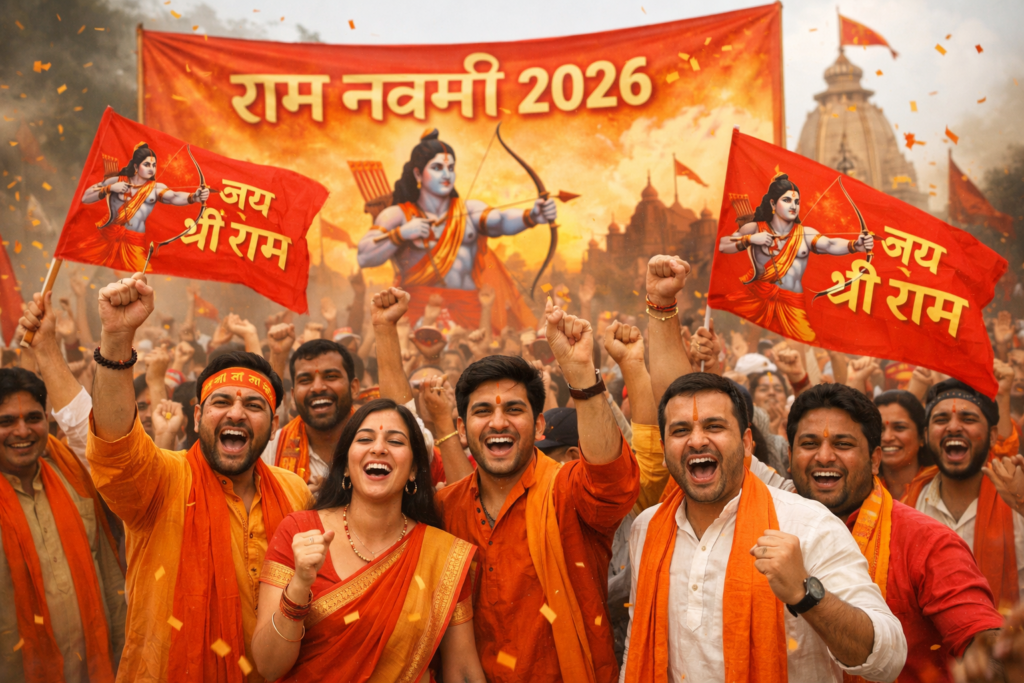
The Ram Mandir broadcasts the Surya Tilak live on giant screens throughout Ayodhya. Devotees who cannot enter the sanctum — and on Ram Navami, the crowds are measured in lakhs — stand in the streets, facing the screens, and watch the sun touch the god’s forehead together. The collective gasp and the subsequent roar of Jay Shri Ram is audible across the entire city.
The Full Day in Ayodhya
| Pre-dawn — 4:00 AM | Mangala Aarti at the Ram Mandir — the first aarti of the day, while the city is still dark. Devotees who have bathed in the Sarayu before dawn fill the temple complex. The fragrance of flowers and the sound of conch shells carry across the river. |
| Sunrise — 6:30 AM | Sarayu Snan — the sacred bath in the Sarayu river, Ayodhya’s own river. Thousands of devotees enter the water at the ghats. The river that carried Rama’s childhood — where he played as a boy under Vasishtha’s guidance — receives them with the same current it has always carried. |
| Morning — 8–11 AM | Abhishekam of Ram Lalla — the idol bathed with Panchamrit: milk, curd, honey, ghee, and sugar. Adorned with fresh flowers, new silk garments in yellow and saffron, and the ornaments of a royal child. The entire sanctum fills with the fragrance of sandalwood and the sound of Vedic mantras. |
| The Madhyahna — 12:27 PM | THE SURYA TILAK: four minutes of natural sunlight on Ram Lalla’s forehead. The Madhyahna aarti is performed simultaneously. The Ram Janmotsav cradle-rocking ceremony — Ram Lalla placed symbolically in a decorated cradle, rocked gently while bhajans are sung. The entire city vibrates with Jay Shri Ram. |
| Afternoon — 2–6 PM | Ram Katha and Ramayana recitations at multiple points across Ayodhya. Sadhus and scholars discourse on the Balakanda and the significance of the day. Community kitchens feed hundreds of thousands of pilgrims. Processions of decorated chariots carrying Rama, Sita, Lakshmana, and Hanuman through the streets. |
| Evening — 7–10 PM | The Sarayu Aarti — hundreds of lamps lit on the ghats, released on the river, the surface of the water turning into a moving constellation. Ram Leela performances across the city. The Shobha Yatra through the old streets of Ayodhya. The city does not sleep on Ram Navami. |
| VIP Darshan Note | The Ram Mandir suspends all VIP and Sugam Darshan passes during Ram Navami. All devotees — regardless of status — use the general queue. This is considered especially sacred: on the day of Maryada Purushottam’s birth, there is no precedence. The man who maintained equality before dharma receives devotees in equality. |
The Most Extraordinary Coincidence in the Hindu Calendar — Shakti Births Dharma
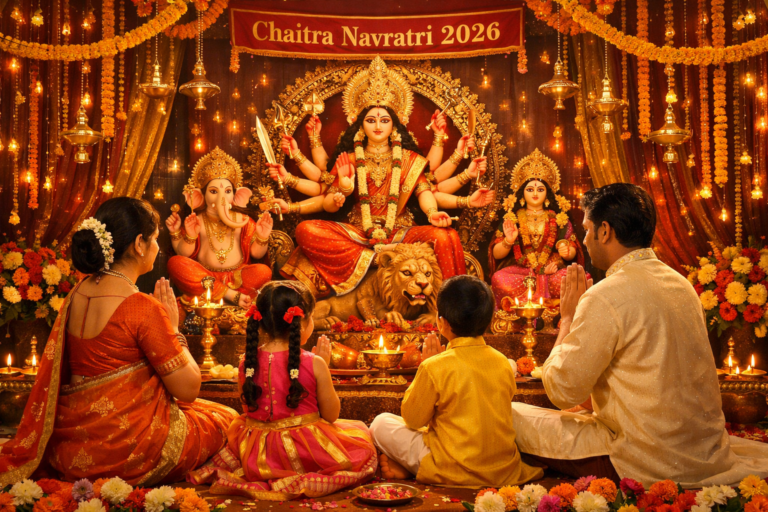
Of all the theological layers of Ram Navami, the one most rarely discussed is the most profound: Ram Navami always falls on the last day of Chaitra Navratri. Always. Without exception. The nine days of the Goddess end with the birth of the God of Dharma. Shakti hands the world to Rama.
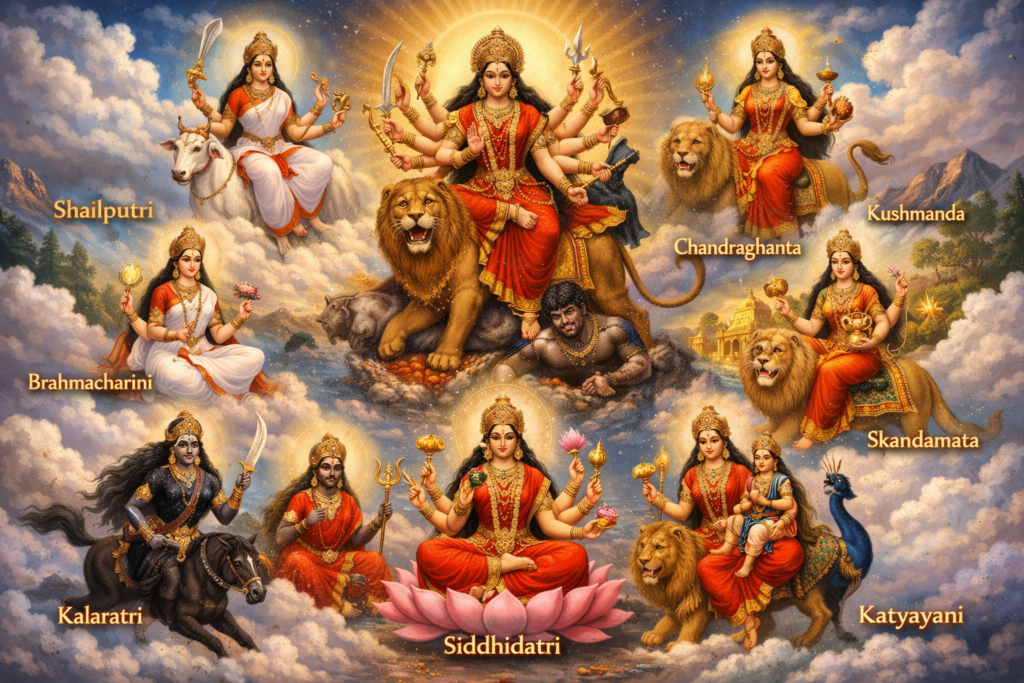
This is not coincidence. The Hindu calendar, which is built on a astronomical-theological framework of extraordinary sophistication, arranged this alignment deliberately. The nine nights of worshipping the divine feminine — the Navdurga, Adi Parashakti herself — culminate on the day that the masculine principle of Dharma, in its most complete human form, arrives in the world.
The theological statement is precise: without Shakti, Dharma cannot be born. Rama is the son of Kausalya — a devotee of the goddess — and he carries within him the blessing of the nine nights. The Aditya Hridayam that sage Agastya teaches Rama on the battlefield of Lanka — the hymn to the twelve forms of Surya that gives him the strength to defeat Ravana — is itself a form of Shakti worship. Rama does not win through the power he was born with. He wins through the power he receives from the goddess. From Shakti. From the source that Navratri has been invoking for nine days.
“The nine nights of Shakti end and the tenth morning begins with Dharma. This is what the Hindu calendar is saying on every Ram Navami: the feminine principle creates the conditions in which the masculine principle of righteousness can operate. One without the other is incomplete.”
— Whispering Bharat
In 2026, this connection carries a particular weight because Chaitra Navratri and Ram Navami share their dates in the Parabhava Nama Samvatsara — the year of transformation. The nine days of Shakti in a year of transformation, ending with the birth of Dharma in a year of transformation. The calendar’s intelligence is not abstract. It is speaking to the specific character of this specific year.
And there is one more layer: Maa Siddhidatri, the ninth Navdurga worshipped on Navami — the granter of all Siddhis — is the goddess who gave Lord Shiva his powers. She is the source. And on her day, Rama is born. Siddhidatri hands her blessing to the seventh avatar of Vishnu. The tradition moves forward. Shakti and Dharma, completing each other, on the same morning.
The Rituals — Ram Navami in Homes and Temples Across Bharat
Ram Navami is a festival of extraordinary uniformity across India’s astonishing regional diversity. The specific foods, the specific music, the specific prayers — these vary enormously from state to state and community to community. But the essential act is the same everywhere: the acknowledgement of the birth, the decoration of a cradle, the chanting of the name, and the breaking of the fast at the Madhyahna moment. Ram Navami is not confused about what it is.
The Home Puja — What Happens in Every Household
Rise before sunrise. Bathe. Wear clean, preferably yellow or saffron clothes. Place the idol or image of Lord Rama — ideally infant Rama, the child who was born on this day — on a clean wooden chowki draped in yellow or red cloth. Beside him, place Sita, Lakshmana, and Hanuman — because Rama is never worshipped alone. His family is his dharma in living form.
Perform Panchamrit abhishek: bathe the idol with milk, curd, honey, ghee, and sugar water successively, then with Gangajal. Dress the idol in fresh cloth, apply chandan and kumkum tilak, offer fresh yellow or orange flowers and Tulsi leaves. Light a ghee lamp. Light incense.
Chant the Ram Navami puja mantra. Then recite from the Ramcharitmanas — specifically the Balakanda, the book of Rama’s childhood and birth. Those who have been doing the Akhand Ramayan Path — the continuous non-stop recitation begun nine days earlier at Navratri’s start — complete it today.
At the Madhyahna Muhurat — 11:13 AM to 1:41 PM, specifically at 12:27 PM — perform the Ram Janmotsav: place infant Rama in a small decorated cradle (jhoola), rock it gently, and sing the birth celebration bhajans. Blow the shankh (conch). Ring bells. This moment — the rocking of the cradle at the Madhyahna — is the emotional centre of Ram Navami in every home, in every community, across all of Bharat.
The Mantras
ॐ श्री रामाय नमः
Om Shri Ramaya Namah
The fundamental salutation to Lord Rama — recite 108 times with a japa mala on Ram Navami
श्री रामचन्द्र कृपालु भजु मन
Shri Ramachandra Kripalu Bhaju Mana
Tulsidas’s opening verse of Ram Bhakti — the most beloved Rama bhajan in all of North India
रा-म
Rā — Ma · The Taraka Mantra
Ra from Om NaRāyaNa Namah · Ma from Om NaMaḥ Shivāya. The two-syllable bridge between Vishnu and Shiva. Shiva whispers it to departing souls in Kashi. Valmiki was liberated by it. Gandhi died with it.
The Fast — Navami Vrat
Ram Navami vrat is observed from sunrise to sunset on March 26, 2026. The permitted foods follow the same sattvic Navratri guidelines: fruits, sendha namak, kuttu, sama rice, makhana, milk, and curd. The fast is broken in the evening after the final aarti with the Ram Navami prasad: Panjiri (wheat flour, ghee, sugar, and dry fruits), Panchamrit, and fruits. Many families prepare Kheer — rice pudding — as the primary prasad, connecting to the Payasam offered at Dasharatha’s yajna from which Rama himself was born.
Ram Navami Across Bharat — Five Cities, One Dharma
| Region / Temple | Character | The Defining Ritual | What You Will Not Find Anywhere Else |
| Ayodhya Uttar Pradesh | The Birthplace · The Origin | Surya Tilak at 12:27 PM · Sarayu Snan · Grand Abhishekam · Shobha Yatra through the Peth · Sarayu Aarti at sunset | The Surya Tilak — sunlight channelled through precision optics to illuminate Ram Lalla’s forehead at the exact birth moment — is the most scientifically remarkable and spiritually charged single event in all of India’s festival calendar. There is no equivalent anywhere in the world. |
| Sitamarhi Bihar | Sita’s Birthplace · The Other Side of the Story | Janakpur-Sitamarhi Yatra · Sita-Rama Kalyanam ceremonies · Grand mela at Janaki Temple · Pilgrims walking barefoot from Mithila | Ram Navami in Sitamarhi is observed from Sita’s perspective — the day Rama was born is also the day destined to bring him to Sita. The pilgrimage between Sitamarhi and the Nepal border town of Janakpur — across two countries — is one of the most moving border-crossing devotional journeys in South Asia. |
| Bhadrachalam Telangana | Dakshina Ayodhya · The Southern Birthplace | Seeta Rama Kalyanam — the ceremonial marriage of Rama and Sita, sponsored officially by the Telangana government. River procession on the Godavari. Pushkara Pattabhishekam once in 12 years. | Bhadrachalam is called Dakshina Ayodhya — the Southern Ayodhya — and Sri Vaikunta Rama Kshetra. The Seeta Rama Kalyanam here is a state event: the Governor of Telangana presents pearl necklaces and silk to the deity on behalf of the government. The celestial wedding is the defining event of Ram Navami in the entire South. The Godavari river procession at sunset — boats carrying the married Rama and Sita on the sacred river — has no equivalent in the North. |
| Rameswaram Tamil Nadu | The Southernmost Point · Where Rama Stood Before Lanka | Abhishekam at the Ramanathaswamy temple — one of the twelve Jyotirlingas. Sacred bath in the 22 theerthams. Kalyanotsavam. Ram Navami procession along the famous corridor of 1,212 pillars. | Rameswaram is where Rama prayed to Shiva before crossing to Lanka — the southernmost sacred point of the Rama pilgrimage circuit. On Ram Navami, the Ramanathaswamy temple — whose 1,212-pillar corridor is the longest in any Hindu temple on earth — opens all 22 sacred theerthams for devotees to bathe in sequence. It is the only day all 22 are open simultaneously. |
| Hampi Karnataka | The Kishkinda of the Ramayana · Sugriva’s Kingdom | Celebrations at the Virupaksha temple and the Anjanadri hill (birthplace of Hanuman). Classical music performances — Carnatic concerts as offerings to Rama. Panaka (jaggery drink) distribution across the city. | Hampi is the site of Kishkinda — the kingdom of the Vanaras where Rama met Sugriva and Hanuman. Anjanadri Hill, visible from the ruins of the Vijayanagara empire, is believed to be the birthplace of Hanuman himself. Ram Navami at Hampi is the annual pilgrimage to the place where Rama first encountered the devotion that would ultimately win the war — Hanuman, who searched the world for Sita. Karnataka’s month-long classical music festival by the Sree Ramaseva Mandali culminates on this day. |
| Nashik Maharashtra | Panchavati · The Forest of Exile | Puja at Kalaram Temple and Sita Gumpha (the cave where Sita resided during exile). Ram Navami Rath Yatra along the Godavari ghats. Community Ramayana recitations. | Nashik’s Panchavati — the forest where Rama, Sita, and Lakshmana spent a part of their exile — is the site of both Sita’s abduction by Ravana and Lakshmana’s drawing of the Lakshmana Rekha. On Ram Navami, the Kalaram Temple (built in the black stone of the Deccan) is the most visited temple in Maharashtra outside of Mumbai. The Godavari ghats at Nashik on Ram Navami carry the specific sadness and beauty of the exile — celebrating the birth of one who would spend fourteen years in this forest. |
The Name That Remains
Of all the things that could be said about Ram Navami — the astronomical precision of the Surya Tilak, the triple sanctity of the Navami tithi, the Navdurga’s nine-day preparation for the birth of Dharma, the extraordinary regional tapestry of five cities each holding their own piece of the story — the thing that might matter most is the simplest.
The name.
Ra — Ma. Two syllables. The Taraka Mantra. The Sthala Purana of Kashi records that Lord Shiva — the great ascetic who has seen everything and renounced most of it — whispers this name into the ear of every soul departing from Kashi at the moment of death. Why this name? Why Rama — not Om, not Narayana, not Shivoham — but Rama, the human being, the king who accepted exile without bitterness, who kept every promise even when the promise cost him everything?
Because Shiva understood something about this name that the entire tradition has been trying to explain for thousands of years: Rama is what a human being looks like when they are completely themselves. Not transcendent, not superhuman, not beyond desire and grief and love and longing — but fully, deeply, completely themselves, with every human quality expressed in its highest form. When Shiva whispers Rama into the ear of the dying, he is giving them the one name that holds the highest possibility of what a human being can be.
Ram Navami is the day that possibility arrived. Dressed as a child, crying in a palace in Ayodhya, in a body that would eventually feel exile and grief and the unbearable loss of the person he loved most. Everything ahead of him was known to the cosmos and unknown to him. He arrived anyway. That is Dharma. That is why Ayodhya stops the world today.
And that is why, somewhere in every corner of Bharat — in temples and homes and roadsides and hearts — the name is being said right now. Has always been said. Will always be said.
जय श्री राम
Jai Shri Ram
रामं स्कन्दं हनूमन्तं वैनतेयं वृकोदरम्
शयने यः स्मरेन्नित्यं दुःस्वप्नस्तस्य नश्यति
Those who remember Rama, Skanda, Hanuman, Garuda, and Bhima before sleep — their nightmares are destroyed.
🙏 Will you be in Ayodhya for Ram Navami 2026 — or have you witnessed the Surya Tilak, or the Bhadrachalam Kalyanam, or the Sarayu Aarti at midnight? Or does your family have a Ram Navami tradition that has been in your home since your grandparents’ time — a specific cradle-rocking song, a specific way of preparing the prasad? Write to us. Every such story is a piece of Bharat that Whispering Bharat was made to carry.
| 🙏 If This Work Reached You — Consider Supporting It Whispering Bharat is a labour of love — built to carry the stories of real Bharat that stand nowhere in textbooks, nowhere in mainstream media, nowhere but in the living memory of the people who keep them alive. Every article is researched, written, and designed by hand. No sponsored content. No advertiser pressure. No algorithm telling us what to cover. Just the real Bharat — written with full devotion, offered freely. If our work has given you something — a story you did not know, a meaning behind a ritual you had always observed, a temple you now want to visit, a mantra whose purpose you now understand — we would be honoured if you supported us in continuing this work. |
| ☕ Buy Us a Chai — Support on Ko-fi Even the price of one chai keeps the stories coming. Every contribution goes directly into the research, writing, and building of Whispering Bharat. No subscription. No pressure. Just support when you feel it. 👉 ko-fi.com/rudraveda |
| 🌐 Start Your Own Blog with Hostinger Inspired to share your own slice of Bharat with the world? Whispering Bharat is built on Hostinger — affordable, fast, and genuinely easy to use. If you are thinking of starting a blog, a website, or an online presence for your story, Hostinger is where we would point you. 👉 hostinger.com/in?REFERRALCODE=1ANKUR227 (Use this link for a special discount — and you support Whispering Bharat at no extra cost to you.) |
| Thank you for reading. Thank you for caring about Bharat’s stories. The work continues because readers like you exist. 🙏 जय श्री राम |