Chaitra Navratri 2026: Complete Guide — Dates, Colours, Puja & Fasting Rules
March 19 – March 27, 2026 · Nine Nights · Nine Goddesses · One Sacred SpringComplete Guide — Dates, Colours, Puja & Fasting Rules
| Festival | Chaitra Navratri 2026 (also called Vasanta Navratri / Rama Navratri) |
| Start Date | Thursday, March 19, 2026 — Pratipada Tithi, Chaitra Shukla Paksha |
| End Date | Friday, March 27, 2026 — Navami Tithi (Ram Navami) |
| Ghatasthapana Muhurat | 6:52 AM – 7:43 AM · Alternate (Abhijit): 12:05 PM – 12:53 PM · March 19 |
| Sandhi Puja | 11:24 AM – 12:12 PM · March 26, 2026 (48-minute sacred window) |
| Navratri Parana | After 10:06 AM · March 27, 2026 (fast-breaking) |
| Hindu Year | Vikram Samvat 2083 begins on this day (Gudi Padwa / Hindu New Year) |
| Coincides With | Gudi Padwa (March 19) + Ram Navami (March 27) |
Nine times a year, by the calendar, the seasons shift. But only once does the entire civilisation of Bharat pause at the same moment to feel it. When Chaitra arrives — that first warm month after the cruelty of winter and the riot of Holi — the air carries something different. Not the loudness of celebration. Something quieter. A calling inward i.e., Chaitra Navratri.
Chaitra Navratri does not arrive with drums. It arrives the way dawn does — gradually, with the lit diya before sunrise, the smell of fresh flowers on a puja thali, the sound of a mantra recited half in sleep by someone who has done this every year of their life. Nine nights. Nine goddesses. One invitation to the whole of Bharat to stop, clean the house, clean the mind, and remember who they actually are.
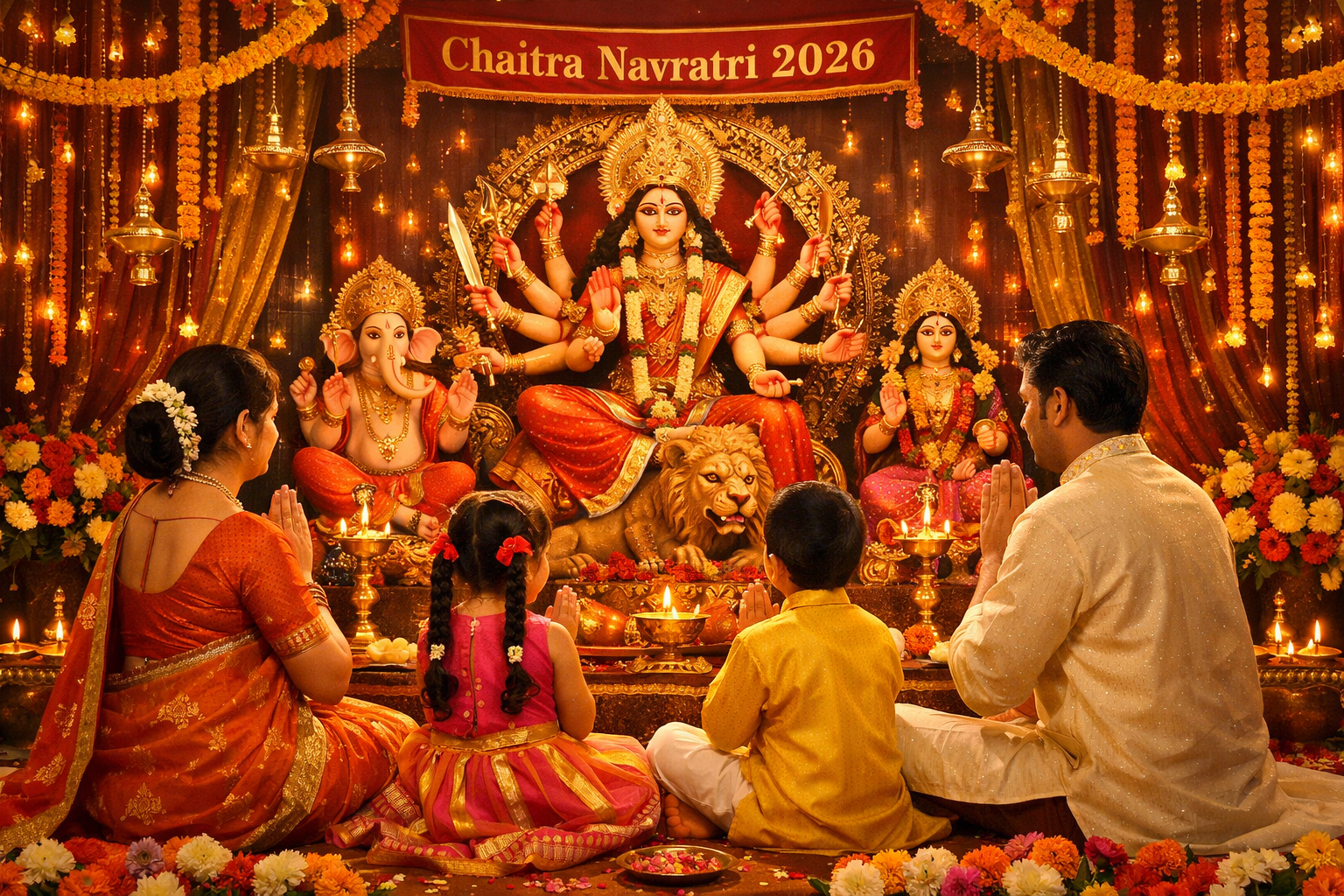
In 2026, Chaitra Navratri begins on Thursday, March 19 — the same morning that Gudi Padwa marks the Marathi New Year, the same day that the Hindu lunar calendar turns its first page of Vikram Samvat 2083. And it ends nine days later, on March 27, with Ram Navami — the birth of Lord Rama — joining the nine-day energy of Shakti with the divine grace of Dharma. This is not an ordinary Navratri. The stars have arranged it into something quite complete.
Here is everything you need to observe it with full understanding: the dates, the nine goddesses and their colours, the Ghatasthapana vidhi, the fasting rules, and — more than all of that — the meaning that holds all these rituals together.
What Is Chaitra Navratri — And Why Does It Matter
The word Navratri holds its meaning inside itself. Nav: nine. Ratri: nights. Nine sacred nights during which the universe’s feminine energy — called Shakti, called Adi Parashakti, called Durga in her ten thousand forms — is worshipped with total devotion across every corner of Bharat.
There are four Navratris in the Hindu calendar, but two are observed widely: Chaitra Navratri in spring, and Sharad Navratri in autumn before Dussehra. Of the two, Sharad Navratri is louder — it has garba, it has dandiya, it ends with Vijayadashami and the burning of Ravana. Chaitra Navratri is the quieter one. More inward. More personal. It does not ask for spectacle. It asks for sincerity.
Chaitra Navratri is also called Vasanta Navratri — Navratri of spring — because it falls when the earth itself is in renewal. The wheat fields are turning gold. The mango trees are in blossom. The days are warming but the mornings still carry the coolness of receding winter. In this threshold season, Bharat turns its attention to the Goddess — because it understands, in some ancient, wordless way, that every new beginning requires the blessing of the one who holds all beginnings inside her.
“The soul of Navratri is not in the rituals alone. It is in the intention behind the rituals — the nine-day decision to be a little more awake, a little more grateful, a little more devoted than you were the day before.”
— The Whispering Bharat Ethos
This year, Chaitra Navratri carries a three-layered significance that is rare in any single calendar year. First, it coincides with Gudi Padwa — the Marathi New Year — making March 19 a double dawn of beginnings. Second, it ends with Ram Navami, meaning the nine days of Shakti conclude with the birth of Lord Rama, joining the energies of the goddess and the god of dharma in a single sacred arc. Third, it falls in the Parabhava Nama Samvatsara — a year of transformation — making these nine days particularly potent for spiritual reset, healing, and new intention.
Nine Days at a Glance — Dates, Colours, Goddesses & Mantras
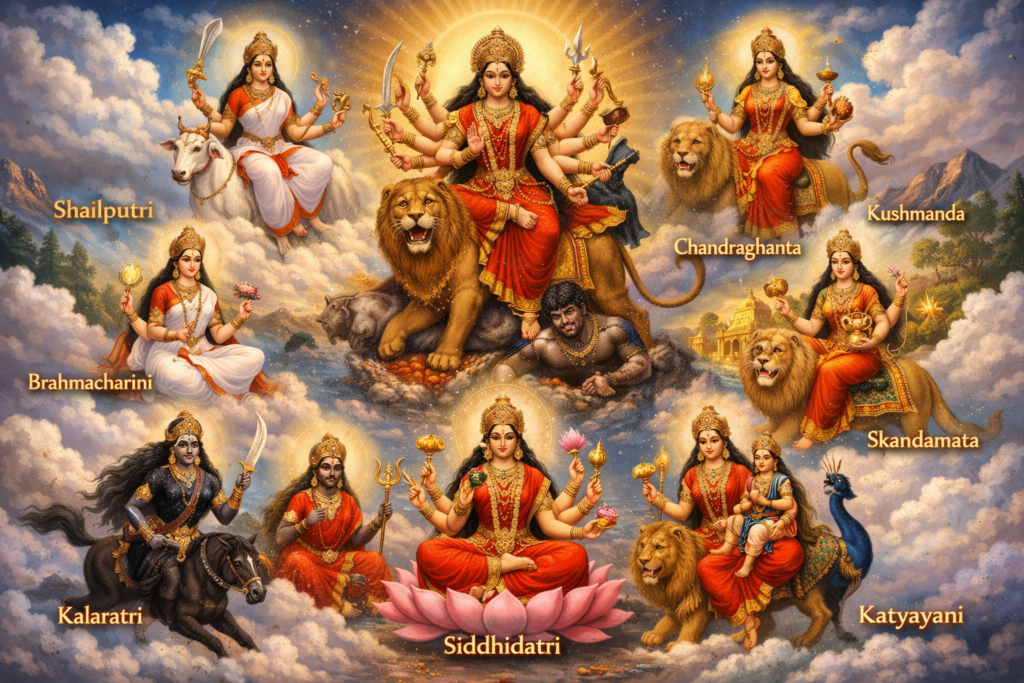
Each of the nine days of Navratri is dedicated to one form of Maa Durga — the Navdurga — and carries a specific colour that vibrates at the same frequency as that goddess’s energy. Wearing the colour of the day is not a trend or a fashion statement. It is a way of aligning your body and presence with the divine form being honoured.
| Day & Date | Colour | Goddess | Mantra | Bhog |
| Day 1 Mar 19 Thursday | 🟡 Yellow | Maa Shailputri Daughter of the Mountains | Om Shaam Sheem Shoom Shailputrayi Namah | Cow’s ghee and white sweets |
| Day 2 Mar 20 Friday | 🟢 Green | Maa Brahmacharini The Ascetic Goddess | Om Braam Breem Broom Brahmachariniyai Namah | Panchamrit and sugar |
| Day 3 Mar 21 Saturday | 🩶 Grey | Maa Chandraghanta The Bell-Bearer | Om Hreem Kleem Sheem Chandraghantayai Namah | Milk and kheer |
| Day 4 Mar 22 Sunday | 🟠 Orange | Maa Kushmanda Creator of the Universe | Om Hreem Kushmandayi Jagatprasootyai Namah | Malpua |
| Day 5 Mar 23 Monday | ⬜ White | Maa Skandamata Mother of Kartikeya | Om Hreem Saha Skandmatrayi Namah | Banana and fresh fruits |
| Day 6 & 7 Mar 24 Tuesday | 🔴 Red & 🔵 Royal Blue | Maa Katyayani & Maa Kalaratri (both worshipped today) | Om Hreem Katyayaniyai Namah / Om Aim Hreem Kalaratryai Namah | Honey and jaggery |
| Day 8 Mar 26 Thursday | 🩷 Pink | Maa Mahagauri The Pure White One | Om Shreem Hreem Kleem Mahagauryai Namah | Coconut and nariyal laddoo |
| Day 9 Mar 27 Friday | 🟣 Purple | Maa Siddhidatri Granter of All Siddhis | Om Hreem Kleem Aim Siddhidatryai Namah | Sesame seeds and halwa |
Note on Days 6 & 7: This year, due to the Panchang, Shashthi and Saptami tithis fall on the same calendar day — Tuesday, March 24. Both Maa Katyayani and Maa Kalaratri are worshipped together on this day. This is not unusual in Navratri; it happens regularly due to the movement of the lunar calendar.
The Nine Goddesses — Who They Are and What They Ask of You
To worship the Navdurga without understanding who they are is like singing a song in a language you do not know. Beautiful, perhaps, but incomplete. Each of the nine forms of Maa Durga represents a different quality of the divine feminine — and an invitation to cultivate that quality in your own life during these nine days.
Day 1 — Maa Shailputri · 🟡 Yellow
Shailputri is the daughter of Shail — the mountain. She is Parvati in her most grounded form: steady, powerful, unmovable. She rides Nandi the bull, holds a trishul in her right hand and a lotus in her left. She represents the root of all energy — the foundational strength without which nothing else in the spiritual life is possible. Ghatasthapana is performed on her day because she is the beginning, the earth itself.
What she asks of you: Begin this Navratri from a place of groundedness, not anxiety. The mountain does not hurry its rising.
Day 2 — Maa Brahmacharini · 🟢 Green
Brahmacharini is the penance form of Parvati — the one who sat through blistering summers and freezing winters for years to win the love of Shiva. She walks barefoot, carries a kamandal (water pot) and a jaap mala. Her face is luminous with the discipline of tapas. She represents that extraordinary Bharatiya understanding: that the greatest things in life are earned through sustained devotion, not quick desire.
What she asks of you: Where in your life are you giving up too quickly? What are you not willing to sit with for long enough?
Day 3 — Maa Chandraghanta · 🩶 Grey
Chandraghanta wears a half-moon on her forehead shaped like a bell — chandraghanta. She has ten arms and rides a tiger. She is the warrior form, the one who protects. Her name alone, it is said, is enough to destroy evil. She represents the courage required to face life’s difficulties without flinching — not the absence of fear, but the decision to move forward through it.
What she asks of you: What are you avoiding out of fear? Call on Chandraghanta to face it this Navratri.
Day 4 — Maa Kushmanda · 🟠 Orange
Kushmanda is the Creator. Before the universe existed — when there was only darkness — it is said that Maa Kushmanda smiled, and from that smile the cosmos was born. She holds the sun in one of her eight hands and wears a smile that is, literally, the light of creation. She represents the creative energy of the universe and the joy that is available to anyone who aligns with it.
What she asks of you: What are you here to create? What have you been waiting for permission to begin?
Day 5 — Maa Skandamata · ⬜ White
Skandamata is the mother of Skanda — Kartikeya, the commander of the gods. She holds the infant Skanda on her lap and rides a fierce lion. She is the mother in her most complete form: fierce in protection, infinite in love, simultaneously tender and terrifying. She represents the wisdom that love and strength are not opposites.
What she asks of you: Who or what needs your fiercest, most generous protection right now?
Days 6 & 7 — Maa Katyayani & Maa Kalaratri · 🔴 Red & 🔵 Royal Blue
Two goddesses, one day this year — and appropriately so, since they are two faces of the same fierce energy. Katyayani was born to sage Katyayan for the express purpose of slaying the demon Mahishasura. She has four arms, rides a lion, and fulfils the sincere wishes of her devotees — particularly those seeking a loving life partner. Kalaratri is the most fearsome form of Durga: dark as the night sky, with three eyes blazing, riding a donkey, wielding a scimitar. She destroys every form of darkness. Her name — Kala meaning darkness and time — reminds us that even the most terrifying aspects of existence are ultimately the goddess in disguise, working on our liberation.
What they ask of you: Face what frightens you. The goddess who looks most terrifying is the one working hardest on your behalf.
Day 8 — Maa Mahagauri · 🩷 Pink
Mahagauri — the Great White One — is radiant with purity. After years of tapas, Parvati’s body had darkened from sun and wind. Shiva bathed her with the waters of the Ganga and she emerged shining white, all impurity dissolved. She is the Goddess after the penance is complete — after the difficulty has done its work and what remains is pure. She is worshipped on Ashtami, the most powerful night of Navratri. Kanya Puja — the worship of nine young girls as living embodiments of the goddess — is performed on this day.
What she asks of you: What difficulty in your life is actually purifying you? Can you trust the process long enough to emerge as Mahagauri did?
Day 9 — Maa Siddhidatri · 🟣 Purple — Ram Navami
Siddhidatri is the granter of all eight supernatural powers — the Siddhis: Anima, Mahima, Garima, Laghima, Prapti, Prakamya, Ishitva, and Vashitva. She sits on a lotus, serene, surrounded by all celestial beings including Lord Shiva himself who received his Siddhis from her. She is the final destination of the Navratri journey — the realisation that when you have done the work of nine days with sincerity, you are different than when you began. Something in you has been given.
This year, her day also carries Ram Navami — the birth of Lord Rama at the auspicious Abhijit Muhurat (approximately 12:00 PM to 12:48 PM on March 27). In some traditions, the Navratri Parana is performed before Ram Navami puja; in others, it follows. Both are honoured on this one sacred day.
What she asks of you: Complete all nine days. Do not stop at eight. The ninth day is where the blessing lives.
Ghatasthapana — The Sacred Opening Ritual
Ghatasthapana — also called Kalash Sthapana — is the ritual that invites the Goddess into your home. It is the most important single act of the entire nine days, because everything that follows flows from this formal invitation. It must be performed during a specific Shubh Muhurat, never in the evening or night.
| Primary Muhurat | 6:52 AM to 7:43 AM on Thursday, March 19, 2026 |
| Alternative Muhurat | 12:05 PM to 12:53 PM on March 19 (Abhijit Muhurat — use if primary window is missed) |
| Direction | Face East or North. Place the Kalash in the Northeast corner of the puja space |
| Never perform | In the evening or after sunset. Morning is mandatory. |
Step-by-Step Ghatasthapana Vidhi
Prepare the space: Clean the puja room thoroughly. Sprinkle Gangajal for purification. Spread a red or yellow cloth on a wooden chowki (platform).
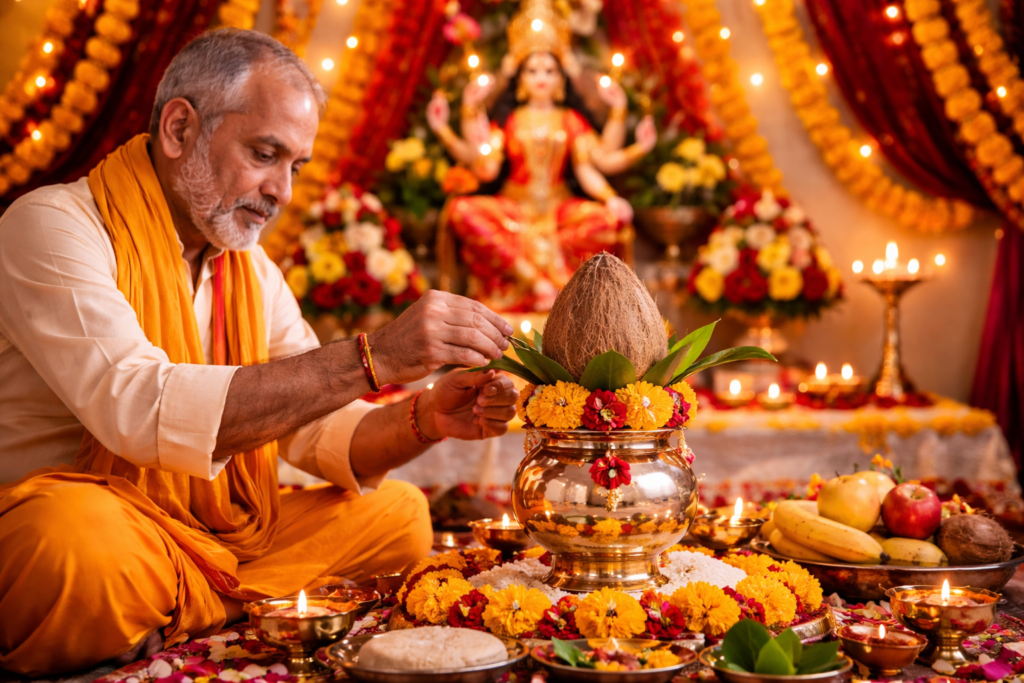
Create the soil bed: Place a clay pot or flat tray with clean soil on the cloth. Sow wheat or barley seeds — these become the Javara (wheatgrass) that grows throughout Navratri and is offered on the final day.
Prepare the Kalash: Take a copper or clay pot. Fill it with fresh water. Add coins, supari, whole rice, and a handful of turmeric. Place five mango leaves at the mouth of the pot in a fan arrangement.
Crown the Kalash: Place a coconut wrapped in red cloth on top of the mango leaves. This coconut represents the head of the goddess — the divine feminine presence entering your home.
Sankalp: Sit facing East or North. Take water in your right hand with rice and flowers. State your full name, gotra, the date, and your intention for Navratri. Release the water into a plate. The Goddess has heard you.
Light the Akhand Diya: A ghee lamp that burns continuously for all nine days. This is the Goddess’s constant presence in your home. Keep it attended — if it goes out, relight it with devotion, not anxiety.
First Puja: Offer red hibiscus flowers, kumkum, fresh fruits, and sweets to the idol or photo of Maa Shailputri. Chant her mantra 108 times with a japa mala. Perform Durga Aarti with camphor. Distribute prasad.
“The Kalash does not simply represent the Goddess. It becomes the Goddess. Treat it as such for all nine days — with the same care and reverence you would offer a beloved guest who has come to stay.”
— Puja tradition
Navratri Fasting Rules — The Vrat Vidhi
Fasting during Navratri is not a performance of deprivation. It is a conscious decision to lighten the body’s burden so that more of your energy can flow toward devotion. The Sanskrit word for this fast is Vrat — which does not only mean abstaining from food. It means a vow, an intention, a promise made to oneself and to the Goddess. The food that is allowed during Navratri vrat is called sattvic — pure, light, energising — food that supports clarity rather than heaviness.
| ✅ Allowed During Vrat | ❌ Strictly Avoid |
| Sabudana (sago/tapioca pearls) — khichdi or vada | All grains: wheat, rice, bajra, jowar, corn, maida |
| Kuttu ka atta (buckwheat flour) — puri or cheela | Pulses and legumes: dal, rajma, chana, moong |
| Singhara atta (water chestnut flour) | Onion and garlic — always avoided during Navratri |
| Samak rice (barnyard millet) | Non-vegetarian food of any kind |
| Sendha namak (rock salt) — not table salt | Regular table salt (iodised salt) |
| Fresh fruits — all kinds | Alcohol and intoxicants |
| Milk, curd, paneer, ghee, makhana | Packaged or processed foods |
| Nuts — cashews, almonds, walnuts, peanuts | Tea and coffee (for strict observers) |
| Sweet potato and potatoes | Smoking and tamasic (heavy, dulling) behaviour |
| Coconut, coconut water | Negative speech, anger, and ego — these break the vrat too |
Fasting Rules by Devotion Level
Complete fast (Nirjala Vrat): No food or water until the daily puja is complete. Observed by the most dedicated devotees, especially on Ashtami and Navami. Not recommended without prior experience or good health.
One meal a day (Ekahara Vrat): The most common form for married women and serious observers. One full sattvic meal per day, taken after the daily puja. The meal may include all allowed foods.
Partial fast (Phalahara): Fruits, milk, and nuts throughout the day with no grains. Suitable for working professionals, elders, and those with health conditions. The Goddess sees intention, not performance.
No fast but mindful observance: If health does not permit fasting, maintaining purity in thought and action — avoiding meat, alcohol, negativity, and participating in daily puja — is itself a complete form of Navratri observance.
Breaking the Fast — Navratri Parana
The nine-day fast is broken on March 27, 2026, after the Navami Tithi ends — specifically after 10:06 AM. Perform the final Siddhidatri Puja and havan (or a simple aarti if havan is not possible). Uproot the Javara barley sprouts that have been growing since Day 1 and offer them as prasad. Then break the fast gently — begin with fruits or light khichdi before returning to a full meal. The foods traditionally eaten after Navratri Parana are kheer, poori, halwa-chana, and churma.
Kanya Puja — When the Goddess Walks Through Your Door
Of all the rituals of Navratri, Kanya Puja is the one that carries the most direct theological statement: the Goddess is not only in the stone idol. She is alive, walking, breathing — and she lives in the form of young girls.
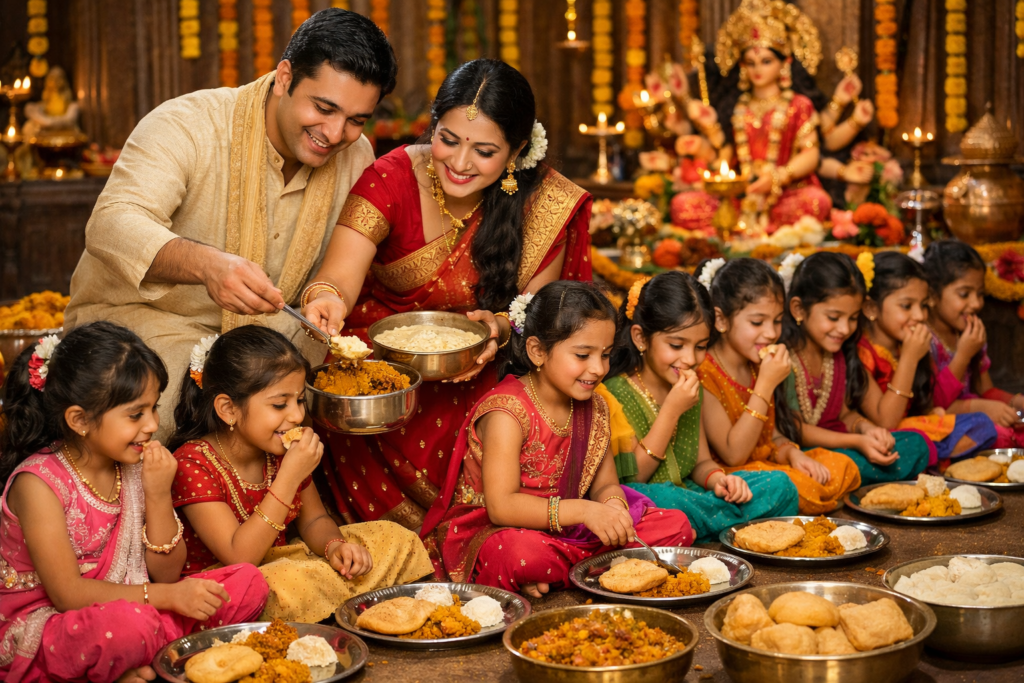
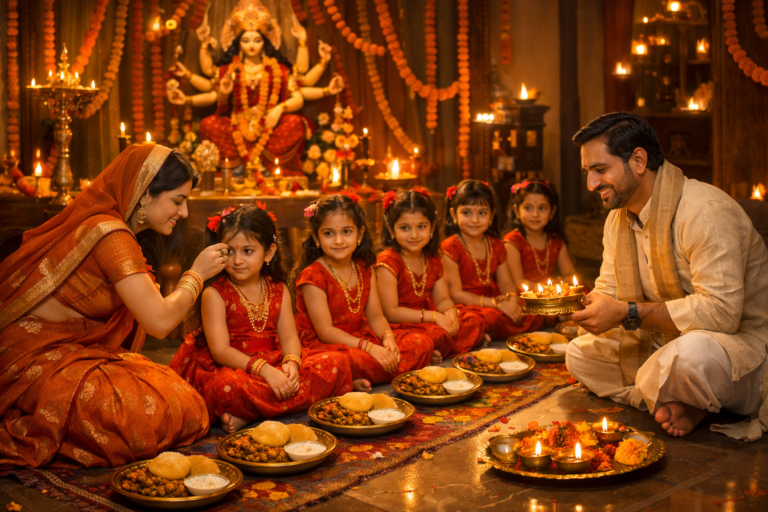
On Ashtami (March 26) or Navami (March 27), nine girls between the ages of two and ten are invited to the home. In some families, a young boy representing Bhairav (Shiva’s attendant) is also included — making it ten. The girls are washed with warm water, offered tilak on the forehead, draped with new dupattas, and seated on a clean asana. Their feet are washed by the host — not as a social gesture, but as an act of worship.
Food is offered to them first as prasad: traditionally halwa, poori, and chana — rich, warm, and plentiful. The girls eat as guests of the Goddess, which means they are the Goddess eating. Gifts are given: new clothes, small amounts of cash, bangles, sweets. Each girl is seen off with a namaskar and a prayer.
“To perform Kanya Puja is to look at a child and genuinely see the divine. This is the Navratri teaching in its most complete form — the sacred is not elsewhere. It is here, in front of you, eating halwa with both hands.”
— Whispering Bharat
Daily Puja Vidhi — What to Do Each Morning
The daily puja of Navratri is simple in structure. What matters is consistency and presence — the same acts, performed nine times with increasing devotion.
Rise before sunrise and bathe. Wear clean clothes in the colour of the day. Begin by lighting the Akhand Diya (re-light if it has gone out) and fresh incense.
Offer fresh flowers — ideally red hibiscus or marigold — at the feet of the idol or image of the day’s goddess. Add kumkum, haldi, and roli tilak. Place fresh fruits and the day’s specific bhog (see the nine-day table above).
Sankalp: Hold water and rice in your right hand, state your intention for the day, release into a plate.
Mantra chanting: Recite the daily Devi mantra 108 times with a japa mala. The universal Navratri mantra — Om Aim Hreem Kleem Chamundaye Vichche — may be chanted on any day.
Durga Saptashati: If you observe the full reading, follow the daily chapter schedule. If this is not possible, even reading five minutes of the Devi Mahatmya with full attention is accepted.
Aarti: Sing Jai Ambe Gauri with camphor and a diya, ringing a bell. Perform pradakshina (circumambulation) of the altar if space allows.
Prasad: Distribute among family members and, if possible, neighbours.
Evening puja: A shorter repetition of the morning puja — light the diya again, offer flowers, chant the mantra. Navratri is named after the nights. The evening ritual holds its own power.
Sandhi Puja — The 48 Most Sacred Minutes of Navratri
In the entire nine days of Navratri, there is one window of 48 minutes that stands above all others. It is called Sandhi Puja — the worship at the junction — and in 2026, it falls on Thursday, March 26, between 11:24 AM and 12:12 PM.
The Sandhi is the exact moment when the Ashtami Tithi (eighth lunar day) ends and the Navami Tithi (ninth lunar day) begins. It is the junction between two sacred tithis, and Hindu tradition holds that the divine energy at this junction is at its most intense — the moment, according to the Devi Mahatmya, when Goddess Durga destroyed the demons Chanda and Munda. The form worshipped at Sandhi Puja is Chamunda — fierce, victorious, draped in skulls, standing on the demon’s fallen form.
| Sandhi Puja Window | 11:24 AM to 12:12 PM on Thursday, March 26, 2026 |
| Duration | 48 minutes — do not begin late |
| Goddess | Chamunda (Chandi) — Durga’s most fierce form |
| Significance | The cosmic moment when Chanda and Munda were destroyed; divine energy at peak intensity |
| Offering | 108 blue lotus flowers (if available) or red hibiscus. Light 108 diyas. |
Missing Sandhi Puja is considered the most significant ritual loss of Navratri. Set a reminder. If you can perform only one specific puja in all nine days, make it this one.
Chaitra Navratri vs Sharad Navratri — What Is Different
Both Navratris worship the same Navdurga and follow the same essential structure. But they carry distinctly different energies, and understanding this difference is part of understanding Bharat’s relationship with time.
| Season | Chaitra: Spring — renewal, sowing, new beginning · Sharad: Autumn — harvest, fulfilment, culmination |
| Energy | Chaitra: Inward, quiet, meditative · Sharad: Outward, communal, celebratory |
| Concludes With | Chaitra: Ram Navami (dharma, righteousness) · Sharad: Vijayadashami / Dussehra (victory over evil) |
| Emphasis | Chaitra: Personal devotion and spiritual renewal · Sharad: Community celebration and cultural expression |
| Garba/Dandiya | Not traditionally part of Chaitra Navratri · Central to Sharad Navratri in Gujarat and beyond |
| Significance | Chaitra: Hindu New Year begins · Sharad: New harvest season begins |
Chaitra Navratri is the Navratri of the personal relationship between the devotee and the Goddess. It does not need an audience.
Chaitra Navratri Across Bharat — The Same Devotion, Nine Different Expressions
Bharat does not celebrate any festival the same way twice — not across regions, not across generations, not even across the street in some old cities. Chaitra Navratri is no exception. The goddess is the same. The devotion is the same. But the way Bharat expresses it is infinitely varied.
In Rajasthan, where we write from, Chaitra Navratri overlaps with the tail end of Gangaur — Rajasthan’s own festival of divine love. Many households are simultaneously observing both. The goddess Gauri and the Navdurga receive offerings in the same puja room, the same hands, the same early-morning devotion.
In Maharashtra, Chaitra Navratri begins on the day of Gudi Padwa — the Marathi New Year. The gudi (a decorated stick with an inverted pot on top) goes up on the same morning that the Kalash comes down for Ghatasthapana. Two symbols of new beginning, side by side.
In Andhra Pradesh and Telangana, it coincides with Ugadi — the Telugu New Year — and the same energy of spring renewal runs through both. In West Bengal, where Chaitra is called Basant, the temples resonate with Durga mantras a full six months before Durga Puja arrives in autumn.
In the temples of Vaishno Devi, Chamundeshwari, Nainital’s Naina Devi, and hundreds of Shakti Peethas across the subcontinent, queues begin forming three days before Pratipada. The goddess does not lack for devotees. She never has.
A Thought Before the Nine Days Begin
Every religion on this earth has its form of the sacred nine. Nine planets. Nine muses. The nine days of creation in various traditions. Something in the human being has always understood that nine is the number of completion — the last single digit, the number that, when multiplied by anything, always returns to itself.
Bharat understood this a long time ago. And it did what Bharat always does with ancient knowledge — it built a festival around it. Not a festival of spectacle, not a festival for the gods alone, but a festival for the person standing in their own kitchen at five in the morning, lighting a diya in the dark, saying a mantra they learned from their mother who learned it from her mother who learned it from hers.
This is what Chaitra Navratri 2026 actually is. Not a religious obligation. Not a cultural performance. A nine-day conversation between you and the oldest energy in the universe — the energy that holds all creation inside it and is willing, if you ask sincerely enough, to hold you too.
Begin on March 19. Light the Kalash before 7:43 AM. Wear yellow. Offer ghee to Shailputri. And for nine mornings and nine evenings, show up.
The Goddess will be there. She always is.
ॐ ऐं ह्रीं क्लीं चामुण्डायै विच्चे
Om Aim Hreem Kleem Chamundaye Vichche