Gangaur 2026 — The Festival Where Rajasthan Worships Love Itself
There are festivals that celebrate harvest. Festivals that celebrate victory. Festivals that celebrate the turning of seasons and the mercy of rain. And then, standing apart from all of them, there is Gangaur — the festival that celebrates love itself.
In Rajasthan, when spring breathes its first real warmth into the desert air and Holi's colours have barely dried on the walls of the old city, something extraordinary begins. Streets that belong to merchants and motorcycles become slow rivers of colour. Women who live their days in quiet devotion step forward and take the centre of everything. The air fills with folk songs older than any written record. And for eighteen unbroken days, the whole of Rajasthan pauses to worship not power, not wealth, not conquest — but the sacred, enduring force of love between a woman and her chosen.
Gangaur is Rajasthan's most intimate celebration. It is a conversation between women and their goddess, between wives and the divine, between young girls and the futures they are brave enough to wish for. It is rooted in the cosmic love story of Lord Shiva and Goddess Parvati — and it carries within it something quietly radical: the belief that a woman's love and devotion are among the most sacred forces in the universe, worthy of eighteen days of prayer, fasting, song, and ceremony.
In 2026, Gangaur runs from March 4 to March 21. If you are in Rajasthan during this window — or even if you are not — what follows is everything you need to understand, honour, and experience this extraordinary festival.
What is Gangaur? The Name, the Meaning, the Heart of It
The word Gangaur holds two divine names inside it. Gan — one of the sacred names of Lord Shiva, the great ascetic, the destroyer and renewer, the stillness at the centre of everything. And Gaur — short for Gauri, the golden one, the radiant form of Goddess Parvati, consort of Shiva, embodiment of feminine devotion, strength, and grace.
Held together, the word means the divine union of masculine and feminine — of cosmic stillness and vibrant life. To celebrate Gangaur is to celebrate this union. It is to say: the love that holds these two cosmic forces together is worth honouring with everything we have. Worth rising before dawn for. Worth eighteen days of fasting for. Worth every thread of embroidery on a festival ghagra and every petal placed at the feet of a clay idol.
"Gangaur is not a festival that happens to women — it is a festival that belongs to them, body and soul, from the first day of Chaitra to the final note of the farewell procession."
— A Jaipur elder, on sixty years of celebrating Gangaur
The festival holds different meanings for different women. For married women, Gangaur is an act of deep devotion — a prayer for the long life, good health, and prosperity of their husbands. For unmarried girls, it is an act of hope — a petition to Gauri herself to grant them a life partner as devoted and powerful as Lord Shiva. And for newlyweds, observing their first Gangaur is a rite of passage that marks their full entry into the rhythms of married life — traditionally, a new bride fasts for all eighteen days.
The Mythology: A Love Story That Moved the Universe
Every great festival has a story at its heart, and Gangaur's is as beautiful as any ever told on this land.
It is said that the Goddess Parvati — in a former life known as Sati — was reborn determined to win the love of Lord Shiva once more. But Shiva, deep in his ascetic meditation, was not easily moved. He had renounced desire, attachment, and the ordinary currents of the world. The gods grew anxious. The universe needed their union.
And so Parvati undertook the most severe penance. She sat through blistering summers under the open sky. She survived freezing winters without shelter. She fasted for years. She meditated with absolute concentration. She offered everything — comfort, beauty, ease — and asked for nothing in return except the love of the one she had chosen.
And Shiva, who had once seemed unmovable, was moved. He accepted her. He recognised in her devotion something that matched the depth of his own nature. Their union — celebrated across all Hindu mythology as one of the universe's great love stories — was sealed.
The story continues: after their marriage, Parvati returned to her maternal home for eighteen days. She spent this time blessing the women who gathered around her, bestowing upon them the gifts of marital happiness, prosperity, and long-lived husbands. It is these eighteen days that Gangaur commemorates — Gauri visiting her people, bestowing her love, and then returning to Shiva.
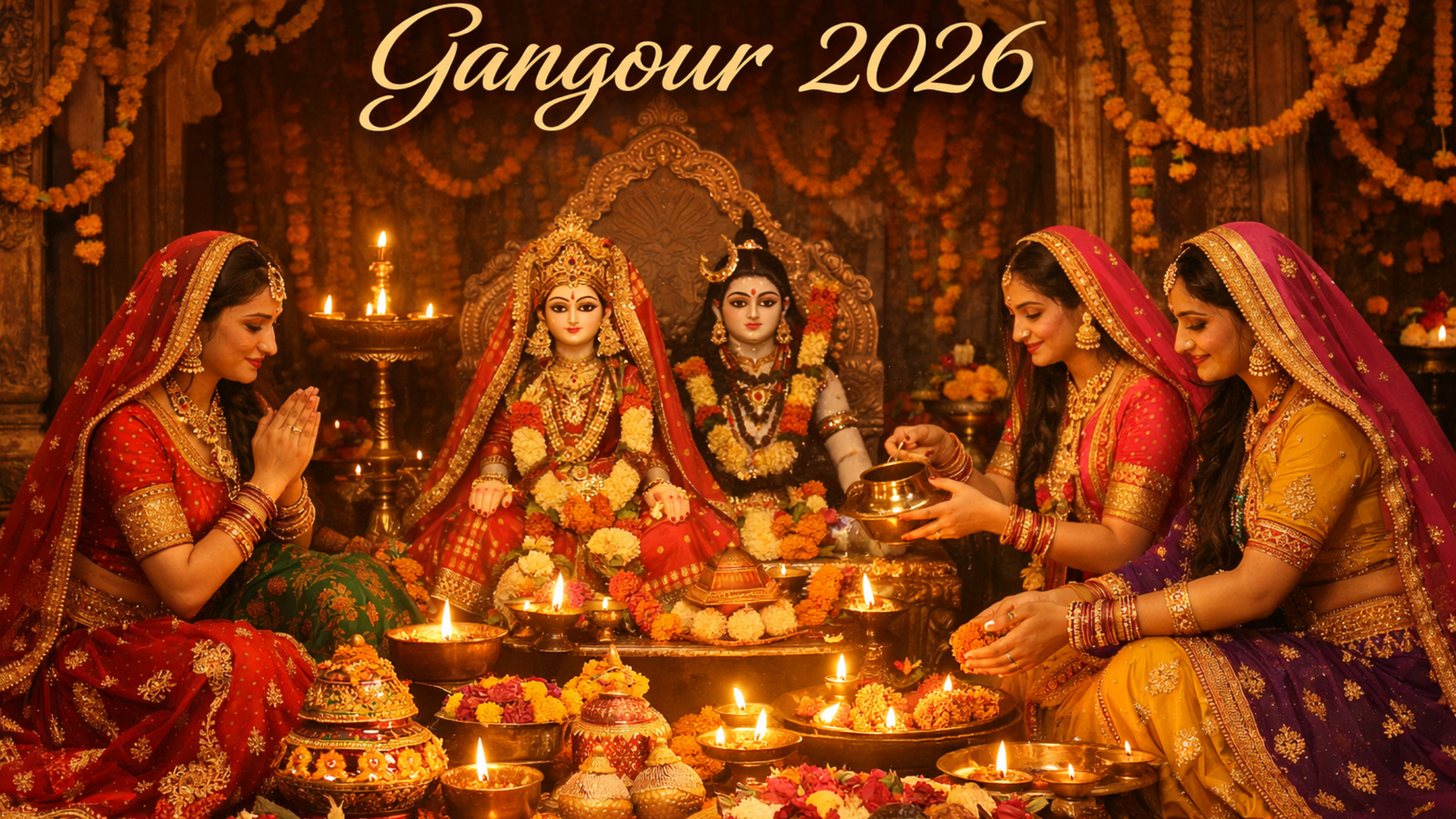
The Gauri and Isar idols — some families worship the same figures for generations.
Applying mehndi is an act of love and devotion — a prayer expressed through the body.
The Rituals: Eighteen Days of Living Devotion
To experience Gangaur from inside a Rajasthani household is to witness something that has barely changed in centuries. The rituals are precise, layered, and accumulated over generations — each gesture carrying the weight of every woman who performed it before.
Day 1 — The Sacred Ashes: Where Everything Begins
Before Holi's colours have even dried, on the morning after Holika Dahan, women rise early. They collect the sacred ashes from the holy fire — the same fire that burned Holika — in small earthen pots called kundas. Into these ashes, they sow seeds of wheat and barley. The pots are placed in a corner of the home and watered carefully each morning. As the festival progresses, the seeds sprout and grow — called jawara or wheatgrass — becoming a living symbol of fertility, prosperity, and spring's renewal. On the final day, this wheatgrass becomes part of the farewell offering to Gauri.
Days 2–7 — Making the Goddess
Over the first week, women make or purchase their clay idols. The idol of Gauri is crafted with care — her face painted with vermilion and kohl, her body draped in miniature fabric, her hands adorned with the tiniest bangles and mirrors. Beside her stands Isar — Lord Shiva — equally adorned with the miniature ornaments of a groom. In many families, these are not newly made each year. They are the same idols that a grandmother once worshipped, freshly painted and re-adorned for this season, carrying decades of accumulated prayer. Some of these family idols are painted by traditional artists called matherans — a craft that is itself slowly disappearing.
The Ghudlia — Ten Evenings of Lantern Light
On the seventh evening after Holi, something quietly magical happens. As dusk falls, unmarried girls take to the streets carrying ghudlias — earthen pots perforated all over with small holes, a burning lamp inside. The light escapes through every hole, scattering a constellation of tiny golden points across walls and lanes. The girls walk from house to house, singing the songs of Gangaur, and the neighbourhood receives them with sweets, jaggery, ghee, small gifts of currency, and oil. This continues every evening for the rest of the festival — a moving ceremony of light, song, and community. On the final day, the ghudlia pots are ceremonially broken.
Sinjara — The Day Before the Climax
The second-to-last day is called Sinjara, and it is one of the most tender moments in Rajasthani culture. On this day, the parents of married women send gifts to their daughters' homes — sweets, new clothes, bangles, cosmetics, and henna. It is a reminder, sent through colour and sugar, that no matter how far a daughter has gone into her married life, her parents' love follows her there without hesitation. The daughters dress in the gifted clothes, apply the richest mehndi to their hands and feet, and celebrate with the women of their new family. Both families — the one she was born into and the one she joined — become part of the same celebration.
The Final Day — Farewell to Gauri
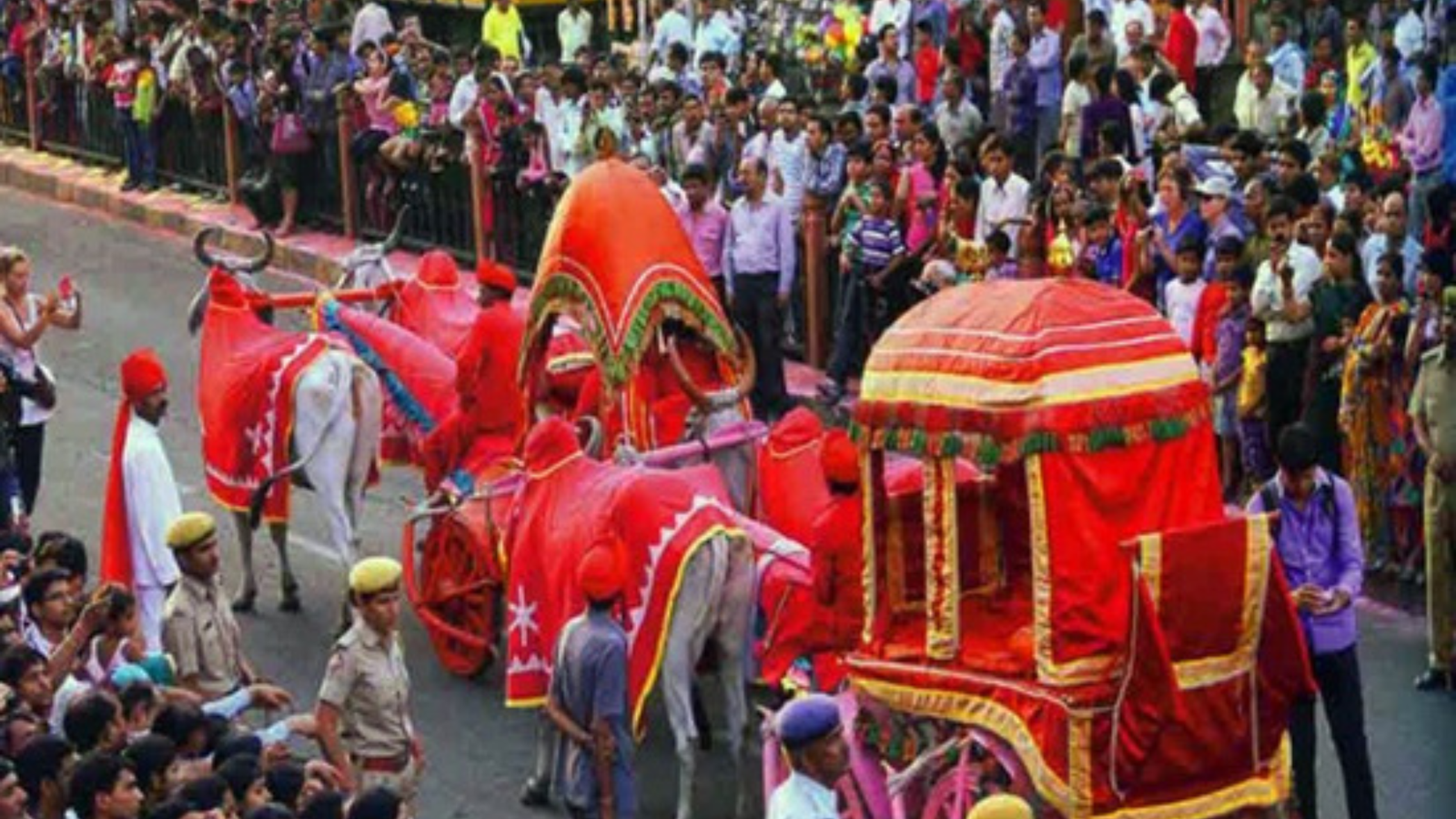
The last day is Gangaur's magnificent crescendo. The idols are dressed in fresh garments. Women gather in their finest attire — the most brilliant leheriya, the deepest red, the most elaborate jewellery. A grand procession forms. And then it moves — carrying the idols of Gauri and Isar on women's heads, accompanied by dhols, the sound of traditional folk instruments, and songs of farewell.
At the procession's end — at a lake, a river, or a well — the idols are immersed in water. Gauri returns to Kailash. She returns to Shiva. The women who watched over her, cared for her, decorated her, fasted for her — they bid her farewell with songs of vidaai. The festival ends as all the best stories end: with love persisting, devotion rewarded, and the promise that she will return again next year.
Where to Experience Gangaur 2026: City by City
Gangaur is celebrated across all of Rajasthan — and beyond, in parts of Gujarat, Madhya Pradesh, and Rajasthani communities in West Bengal. But each city brings its own character to the celebration. Here is where to go depending on what calls to you.
Jaipur — The Royal Procession
The most famous Gangaur celebration in the world. The procession starts from Zanani Deodhi of City Palace — the royal women's quarter — and moves through Tripolia Bazaar, Chhoti Chaupar, Gangauri Bazaar and Chaugan Stadium. Elephants, palanquins carrying adorned idols, folk musicians, hundreds of women balancing brass pitchers on their heads. Even the royal family participates. In Jaipur, Gangaur is a ceremony of state.
Udaipur — The Lake Procession
Perhaps the most visually stunning Gangaur on earth. The procession moves to Gangaur Ghat on Lake Pichola — a ghat built specifically for this occasion. The idols are placed in decorated boats and rowed across the lake at dusk, with the City Palace mirrored in the water and the Aravalli hills turning violet behind. Fireworks burst overhead. A thousand lamp-reflections dance on the surface of Pichola.
Jodhpur — Dhinga Gavar
Jodhpur's version is called Dhinga Gavar and it has no equal for sheer vitality. Idols are placed at major market spots in the old bazaar. Women patrol the streets carrying decorated sticks, with the traditional right to tap any young bachelor who crosses their path — and offer blessings in return. Loud, joyful, completely alive. The blue city at its most festive.
Bikaner & Jaisalmer — The Desert Intimacy
In the deep desert cities, Gangaur is smaller but more personal. You are likely to be invited into a home, seated on a charpai in a courtyard, and offered tea while a family shows you their ancestral idol — the same figure their great-grandmother once worshipped. This is where Gangaur feels most like what it truly is: a private conversation between a woman and her goddess.
The Puja: How Gangaur is Actually Worshipped
The daily puja ritual of Gangaur is simple in form but profound in meaning. Here is what happens in homes across Rajasthan every morning for eighteen days:
- Rising before dawn. Women wake before sunrise, bathe with ritual care, and dress cleanly before touching anything related to the puja.
- Preparing the altar. A clean wooden platform (paata) is set up, or the Gangaur chart is affixed to a wall. The clay idols of Gauri and Isar are placed with fresh flowers.
- The offerings. Haldi (turmeric), kumkum (vermilion), mehndi, bangles, fresh water in a brass kalash, flowers, green jawara grass, and sweets are offered to the goddess.
- The mantra. The principal Gangaur mantra is recited: ॐ ह्रीम गौरीपतये स्वाहा — Om Hreem Gauripataye Swaha — salutation to Goddess Gauri, the beloved of Lord Shiva, bestower of happiness and prosperity.
- The Gangaur Geet. Traditional folk songs are sung — sometimes from a printed geet book, sometimes entirely from memory — narrating Gauri's story and asking for her blessings.
- The Vrat Katha. The Gangaur vrat katha is listened to, either read aloud by an elder or recited from memory. Completing the festival without hearing the katha is considered ritually incomplete.
- The wheatgrass ritual (main day). On the final day, women form pairs, join their little fingers, take jawara grass in both hands, and dip it into water together sixteen times while chanting — a deeply bonding communal act.
The Look of Gangaur: Colour, Cloth & the Art of Dressing for the Divine
Gangaur is among India's most visually magnificent festivals, and this is no accident. In Rajasthani tradition, to dress beautifully for the goddess is itself an act of devotion. Every colour choice, every piece of jewellery, every stroke of mehndi is a prayer expressed through the body.
The central dress is the ghagra-choli-odhni — a full, deeply pleated skirt, fitted blouse, and flowing dupatta — in the vibrant prints that are Rajasthan's greatest textile gift to the world. Leheriya (the diagonal wave-dyed stripes unique to Rajasthan), bandhej (tie-dye circles), and gota work (gold ribbon embroidery) dominate. Red is Gauri's colour and the festival's dominant shade. But you will see every colour of Rajasthan here: saffron, turmeric gold, peacock green, rose, and sky blue.
The jewellery worn during Gangaur is considered part of the suhaag shringaar — the adornment of a married woman that honours the bond of marriage. Bangles, maang tikka, nathni, haath phool, and the distinctive Rajasthani borla (forehead ornament) are all worn together. The effect is spectacular.
The mehndi applied on Sinjara day covers hands and feet in intricate geometric and floral patterns — suns, moons, stars, peacocks, the lotus. In the colour language of Gangaur, a woman whose hands are deeply stained with henna on the day of the procession is a woman whose love runs deep.
The Food of Gangaur: Sweets That Are Prayers
No description of Gangaur is complete without its food, because Rajasthani festival cooking is itself an art form — and Gangaur brings out the finest of it.
Gangaur 2026: Your Complete Date-by-Date Guide
The Traveller's Honest Guide to Gangaur 2026
When to Arrive
If you can only give three days, arrive on March 19 and leave on March 22. You will catch Sinjara, the fever-pitch final preparations, and the magnificent finale on March 21. If you have a full week, arrive March 14 to absorb the building energy — the decorated markets, the nightly Ghudlia processions moving through dim lanes, the sweet shops stacking ghewar from floor to ceiling.
Where to Stay
In Jaipur, book a haveli or heritage hotel inside or close to the walled city — within walking distance of Tripolia Bazaar or Chaugan. The procession passes these lanes. The Alsisar Haveli or similar heritage properties in the old city put you in the heart of everything. In Udaipur, any property on the shores of Lake Pichola will give you front-row access to the boat procession at dusk. Book these by January — they fill completely by February for the Gangaur season.
How to Be Present Without Being Intrusive
Dress modestly and in colour — Gangaur welcomes colour from everyone. Remove your shoes before entering any home where puja is happening. Ask before photographing women in ritual dress — most will say yes, especially if you have shown genuine curiosity rather than tourist distance. Bring something small to offer if invited into a home: sweets from a local shop, or simply the gesture of sitting quietly and paying respectful attention. You will be treated with extraordinary warmth.
What to Eat and Buy
Ghewar is non-negotiable — buy it from a traditional halwai (sweet maker) in the old city, not from a chain bakery. In Jaipur's Johari Bazaar, the leheriya and bandhej textiles that women wear during Gangaur are sold at their most authentic and reasonable; this is the perfect time to invest in genuinely hand-crafted Rajasthani textiles. Miniature clay Gangaur idols are also available as souvenirs from craft shops — beautiful objects that carry the weight of the festival's meaning in their tiny painted hands.
What Gangaur Tells Us About Rajasthan — and About Love
We live in an age that is constantly trying to invent new rituals for love — new ceremonies, new ways to declare devotion publicly. And here, in the desert state of Rajasthan, is a festival that has been doing this, with far more depth and beauty than anything newly invented, for five centuries at minimum.
Gangaur does not celebrate easy love. It celebrates the love of Parvati — who sat through years of absolute penance for the one she chose. It celebrates the devotion of the wife who rises before dawn every morning for eighteen days to adorn a clay idol and ask the goddess to protect her husband. It honours the love of parents who, even after their daughter has gone to build her own life, send sweets to her door to say: we are still here. Your happiness still matters to us.
It is a festival built on the premise that dedication is not weakness. That love which endures is worthy of ceremony. That the things we choose to celebrate — and how we choose to celebrate them — define what we actually value.
In a world moving very fast and celebrating mostly surface, Gangaur asks us to slow down. To make something with our hands. To sing something our grandmother taught us. To stand in a street and let a procession of colour and devotion move through us — and remember that we are part of something far older, far more beautiful, and far more enduring than the present moment.
Gangaur 2026 runs from March 4 to March 21, with the main celebration on Saturday, March 21. Whether you witness it in person or from far away, may the blessings of Gauri — that golden, radiant goddess of love — reach your home this spring. May your love endure. May your devotion be seen. And may you, someday, hear Gangaur geet drifting from an old city lane at dusk, and understand in your bones what Rajasthan means when it says: love is worth worshipping.