Ghoomar : The Dance That Carries Rajasthan’s Soul in Every Twirl
Origin: Bhil Tribe, Marwar · Patron: Goddess Sarasvati · Adopted by: Rajput Royalty · Alive in: Every Lane of Rajasthan
| Name | Ghoomar — from ghoomna, the Hindi word for spinning or pirouetting. Also known as Ghumar or Jhumar. |
| Origin | Bhil tribe of the Marwar region (present-day Jodhpur district, Rajasthan) |
| Original Purpose | A ritual dance performed to worship Goddess Sarasvati — deity of wisdom, knowledge, and the arts |
| Adopted By | Rajput royalty, beginning with the Kachhwaha clan of Jaipur; eventually spread across all royal households of Rajputana |
| Performed By | Women exclusively — traditionally behind ghoonghat (veil). Men attend and sing but do not dance. |
| Occasions | Weddings (mandatory for new brides) · Gangaur · Teej · Holi · Diwali · arrival of monsoon · any auspicious celebration |
| Instruments | Dhol · Chang · Manjira (cymbals) · Metal plates · Harmonium. Music may be sung live by the dancers themselves. |
| Famous Songs | Gorband Nakhralo · Podina · Rumal · Mor Bole Re · Chirmi Mhari Chirmali · Aave Re Hichki |
| UNESCO Status | Part of India’s living intangible cultural heritage; ranked 4th in ‘Top 10 Local Dances Around the World’ |
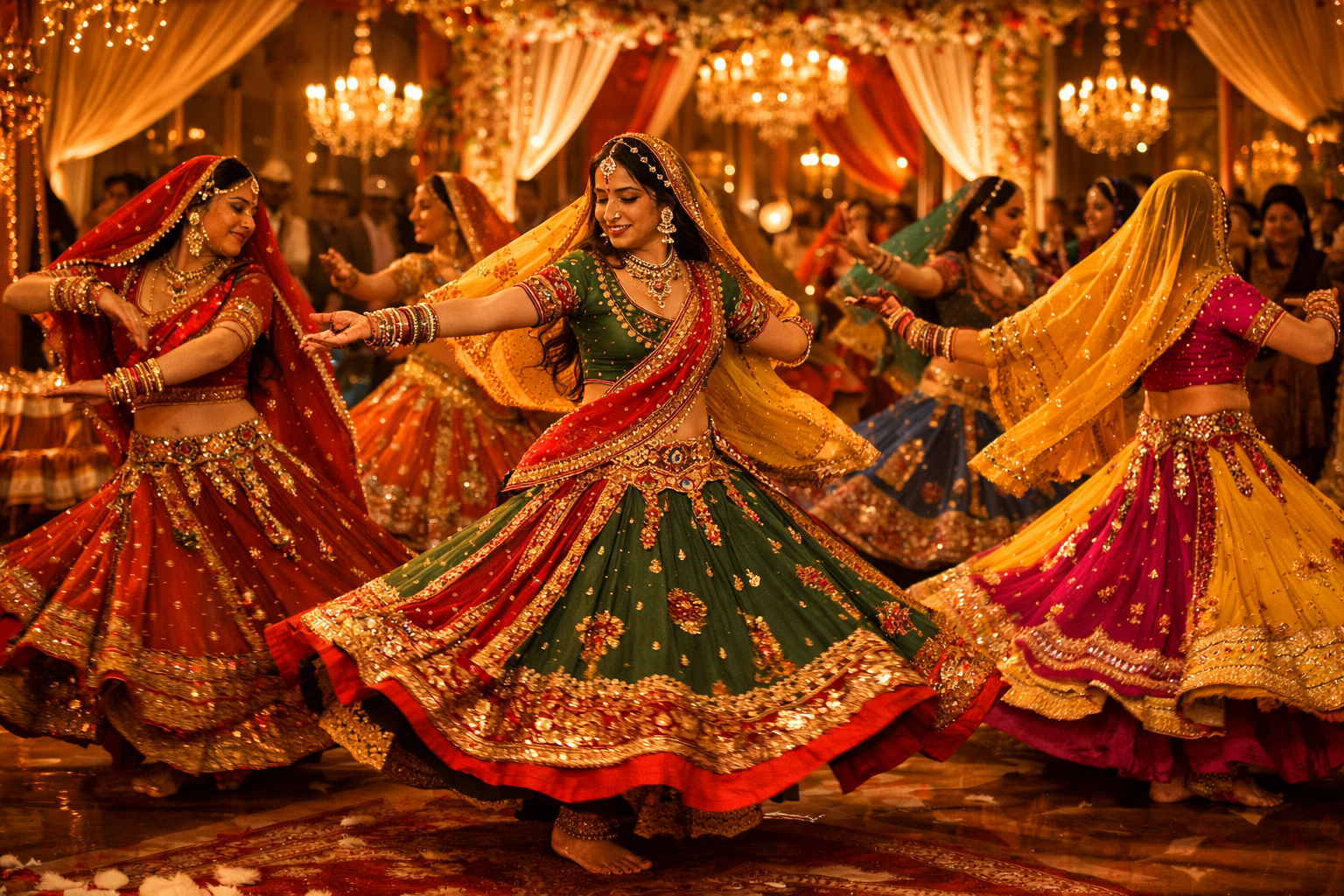
There is a moment in every Ghoomar performance — it arrives about twenty minutes in, when the music has found its full tempo and the dancers have forgotten the audience — when the ghagras stop being clothing and become something else entirely. They become wings. Or petals. Or the rings that form when a stone drops into still water. Twelve women spinning in a circle, their skirts rising and falling with each turn, their faces composed behind veils, their feet moving in a pattern their grandmothers taught them. And from above — if you could be above, looking down — it would look exactly like a flower opening and closing, opening and closing, in time with the desert wind.
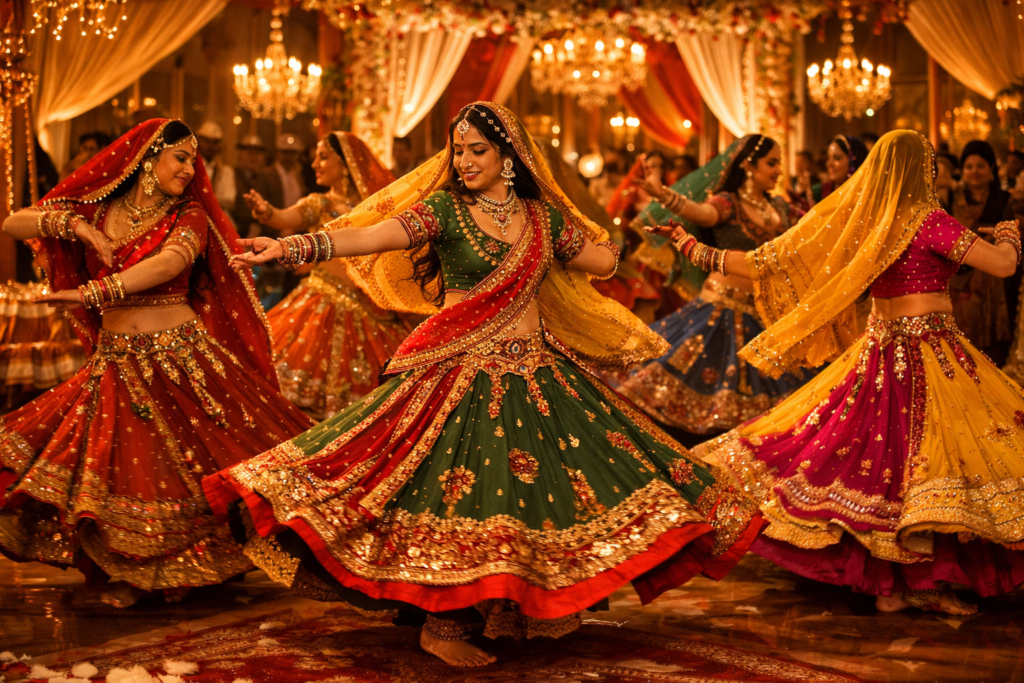
This is Ghoomar. Not the Bollywood version, though that has its own beauty. Not the stage performance, though that has its own precision. The real Ghoomar — the one that happens in a Rajasthani household courtyard at eleven at night during a wedding, with oil lamps guttering in the warm air and half the women singing while the other half dance, and the tempo climbing and climbing until the eldest woman in the room raises her hand and the whole thing stops at once in a burst of laughter and applause.
That Ghoomar is one of the oldest continuous art forms in Bharat. It was born in a Bhil tribal ritual for Goddess Sarasvati. It found its way into the zenanas of Rajput queens. It rode out of the palace gates into the streets, the villages, the middle-class drawing rooms, and eventually onto screens seen by hundreds of millions of people. And through all of it — through every conquest and adoption and popularisation — the original DNA of the dance has remained: women, a circle, a twirl, and the sound of fabric filling with air.
Here is the full story.
The History — From Bhil Ritual to Royal Zenana
The story of Ghoomar begins with the Bhil tribe — one of India’s oldest and largest indigenous communities, who inhabited the dense forests and rocky terrain of what is now Rajasthan long before any Rajput king set foot there. The Bhils were warrior people: indomitable, deeply rooted in the land, and possessed of a rich ceremonial culture that expressed itself through music, dance, and devotion to nature’s gods.
Their Ghoomar was not entertainment. It was a sacred act. Women of the tribe would gather at significant moments — the turn of seasons, the worship of Goddess Sarasvati, the passage of young girls into womanhood — and perform this circular dance as an offering. The spinning was itself the prayer: the body becoming a vessel, moving in the same eternal circles as the sun, the moon, the seasons. There was no audience. The dance was for the goddess.
“In the Bhil tradition, Ghoomar was not performed to be seen. It was performed to be heard — by Goddess Sarasvati herself, who received the spinning of her devotees as an act of complete surrender.”
— Whispering Bharat
The encounter between the Bhils and the Rajput Kachhwaha clan — who would go on to rule Jaipur — was not gentle. The two were in constant conflict over territory for generations. The Bhils had made large areas of the Aravalli hills effectively ungovernable; every time the Kachhwaha forces tried to subdue them, they simply melted back into the forest. Finally, both sides arrived at a form of peace that was as much recognition as agreement.
The Bhils were not absorbed into the Rajput order — they were acknowledged as its partners. The Kachhwaha kings made an extraordinary concession: no future coronation of a Kachhwaha ruler would be considered legitimate unless a Bhil chieftain first placed a tilak — the sacred mark of blessing — on the new king’s forehead. The tribal people became, by royal tradition, the spiritual authenticators of Rajput kingship.
And in this climate of acknowledged equality, the women of the Rajput zenana — the inner chambers of the palace where royal women lived — encountered Ghoomar. They were moved by it. They took it in. The Bhil ritual became the Rajput celebration. And in the hands of the palace women, it evolved — acquiring more elaborate costumes, more refined footwork, a new repertoire of songs celebrating Rajput valor and love — while never losing the essential motion that gave it its name. The ghoomna. The spinning.
From the Kachhwaha court, Ghoomar spread to every royal household in Rajputana — the Mewar rulers of Udaipur, the Rathore kings of Jodhpur, the rulers of Kota, Bundi, Bikaner, Jaisalmer. Each court adopted it and gave it its own flavour. By the time Rajputana gave way to the modern state of Rajasthan, Ghoomar had moved far beyond the palace walls into every community, every caste, every economic level — from royal households to farmer families — while remaining absolutely, identifiably itself.
Today, Ghoomar is also the dance that every new bride in a traditional Rajasthani household is expected to perform when she arrives at her marital home for the first time. It is her formal introduction to the women of the household — her announcement, through movement, that she has joined this circle. And in the Bhil community, it still marks the moment when a young girl steps into womanhood. The oldest meanings have not been lost. They have simply been carried, in the turning skirts, across centuries.
The Dance — What Ghoomar Actually Looks Like, From the Inside
A description of Ghoomar that focuses only on the spinning misses most of what makes it beautiful. The spin is the climax — the moment everyone waits for, when the ghagra rises and fills with air like a sail catching wind. But Ghoomar is a layered vocabulary of movement, and understanding each element reveals how much intelligence lives inside what looks, from the outside, like pure spontaneous joy.
| Movement | What It Looks Like | What It Means |
| Ghoomna (The Spin) | The dancer turns on her own axis in a full circle — both clockwise and anticlockwise — while simultaneously moving around the larger group circle. The ghagra rises with centrifugal force and creates a perfect disc of colour. | The spin is the prayer itself — the dancer becoming a spinning top, surrendering direction to the divine. It echoes the rotation of the cosmos, the turning of seasons, the cycle that everything lives inside. |
| Mandala (The Circle) | All dancers move together in a large circle, first clockwise, then anticlockwise. Within this outer circle, individual spins happen. The formation never breaks — even as tempo increases and spins multiply. | The mandala — the sacred circle — is the oldest symbol in Indian ritual. To dance in a circle is to participate in the universe’s own shape. No one leads, no one follows. The circle is the point. |
| Haath Mudras (Hand Gestures) | Between spins, the hands move in flowing, arced gestures: palms together and apart, fingers spread wide, arms sweeping overhead, hands drawing invisible circles. The gestures change with each section of the song. | The hand movements are the dance’s language — they narrate the song’s themes: valor, love, nature, devotion. A skilled Ghoomar dancer tells a story with her hands even while her feet do the technical work. |
| Taal (Clapping and Snapping) | Periodic sharp claps and finger-snaps punctuate the movement, always precisely on the beat. Sometimes the dancers clap each other’s hands as they pass in the circle — a moment of connection that happens and is gone. | The sound the body makes is part of the music. In the oldest performances, before instruments were added, the clapping and singing of the dancers was the only accompaniment. The hands are both dancer and drummer. |
| Ghoonghat (The Veil in Motion) | The odhni covering the head and face is managed throughout — pulled across the face at certain moments, released at others, occasionally caught and swept in a single fluid arc. The management of the veil is itself a skill. | The ghoonghat in motion is modesty and grace simultaneously. The dancer is present and absent — revealed and concealed — in the same gesture. In the royal zenana, where women were always veiled before anyone outside the household, the dance was one of the few places where even the management of concealment became an art. |
| Paon Ka Kaam (Footwork) | The feet move in small, precise steps — closer to a controlled shuffle than large strides — alternating weight with each beat. The feet are the foundation that allows the upper body to spin without losing balance. | The apparent effortlessness of Ghoomar is built entirely on invisible footwork. The dancer looks as though she is simply floating in a circle. In reality, her feet are doing constant, precise, high-stamina work. Ghoomar has no time limit — it can go on for hours. The feet make that possible. |
| Aaroha / Avaroha (Tempo Climbing) | As the performance progresses, the dhol tempo increases in stages. The dancers match it — the spins becoming faster, the circle tightening, the claps sharper and more frequent — until the music reaches a peak and cuts. The silence after is extraordinary. | The escalating tempo is Ghoomar’s dramatic arc. The first half is introduction and invitation. The second half is the full expression of energy, devotion, and joy building toward something that cannot be sustained but must be experienced. |
One detail that most descriptions of Ghoomar miss: the performance is not silent on the part of the dancers. The women sing while they dance — or some of them do, alternating with the men who accompany. The songs are called Ghoomar geet, and they are as much a part of the art form as the movement. To separate the music from the motion is to see only half of it.
The most traditional Ghoomar songs are old enough that nobody can trace their authors. Gorband Nakhralo — a playful song about a camel’s ornamental necklace — and Aave Re Hichki — a song about the hiccup a woman gets when the person she loves is thinking of her — have been sung in Rajasthani homes for so many generations that they have become a kind of aural landscape, as naturally part of the environment as the sound of temple bells or the call of the peacock.
The Costume — A Kaleidoscope Built from Centuries of Craft
The Ghoomar costume is not a backdrop for the dance. It is the dance’s most visible instrument. Every element — the weight of the ghagra, the length of the odhni, the sound of the jewellery — is designed not for the dancer’s appearance but for what the dance does to it. The costume is engineered for motion. What it looks like at rest is only a fraction of what it becomes when it spins.
| Garment / Ornament | Description | Why It Matters in Ghoomar |
| Ghagra (The Skirt) | An ankle-length fully flared skirt with enough volume — sometimes twelve to sixteen panels, sometimes more — that it creates a perfect horizontal disc when the dancer spins at full speed. Made in rich fabrics: silk, georgette, brocade. Colours are deep and vivid: red, saffron, deep rose, indigo, peacock green. The hem is heavily embellished. | The ghagra is the visual centrepiece of Ghoomar. When it lifts and spreads in the spin, it becomes the most powerful image in all of Rajasthani folk art: a ring of pure colour, suspended in air, controlled by a woman’s movement alone. The more volume in the skirt, the more spectacular the spin. |
| Gota Patti (Gold Ribbon) | Strips of real or imitation gold ribbon stitched in intricate patterns along the hem, the borders, and sometimes the entire surface of the ghagra. Gota is one of Rajasthan’s most ancient textile crafts — a speciality of Jaipur, where gota ka kaam masters have been working for centuries. | When the ghagra spins, the gota catches and throws light with every turn. The spinning dancer becomes a moving source of light — the gold tracing the circle in the air. In lamplight or firelight, this effect is extraordinary. Gota is not decoration. It is the dance’s relationship with light. |
| Leheriya / Bandhej (Print Technique) | Leheriya — the diagonal wave-dyed stripes unique to Rajasthan — and Bandhej — the tie-dye dot patterns — are the two most common print techniques on Ghoomar ghagras. Both techniques create patterns that are activated by motion: the waves of leheriya flow as the fabric moves; the dots of bandhej seem to multiply as the skirt lifts. | Both leheriya and bandhej were developed in Rajasthan specifically for clothes meant to be seen in motion — worn by women who danced, who rode, who moved through life with a physicality that European-influenced fashion never anticipated. They are prints designed for spinning. |
| Choli (The Blouse) | A fitted, short-sleeved or sleeveless blouse in a contrasting or complementary colour to the ghagra. Heavily embroidered with mirror work, zari, and often kachhi pati (coloured thread embroidery). The back of the choli is traditionally very low — a structural feature that allows the arms and upper body full range of motion. | The choli frames the upper body during Ghoomar — the hands, the mudras, the fluid arm movements are seen against the choli’s embroidered surface. The mirror work — shisha — catches light at different angles with every gesture, turning the upper body into its own source of shimmer. |
| Odhni (The Veil) | A long, sheer dupatta in fine fabric — traditionally Kota doria, a featherlight cotton-silk weave from Kota, Rajasthan — draped over the head and one or both shoulders. The traditional Ghoomar odhni has leheriya print with metallic foil work. It is secured at the head and left to move freely at the ends. | The odhni is the dance’s most dynamic element after the ghagra. It floats and shifts with every movement of the head and upper body. When the dancer turns, the ends of the odhni sweep outward. The management of the odhni — keeping it in place while the body spins — is one of Ghoomar’s most demanding technical skills. |
| Shisha (Mirror Work) | Small circular or geometric pieces of mirror glass stitched into the fabric of both ghagra and choli in dense patterns. A craft tradition of western Rajasthan and Gujarat, shisha work on Ghoomar costumes is both heavy — contributing to the skirt’s necessary weight — and reflective. | Mirror work on a spinning dancer creates an effect that no other textile embellishment can: the dancer becomes a source of moving light, throwing reflections in every direction. In the lamplight of a traditional courtyard performance, a shisha-covered ghagra spinning at full speed looks like a small contained firework. |
| Borla (Forehead Ornament) | The distinctive large spherical pendant worn at the centre of the forehead, suspended from the maang tikka (central hair parting ornament). The borla is the most recognisable piece of Rajasthani jewellery — almost always in gold or gold-plated metal with precious or semi-precious stones. | The borla frames the face and draws attention to the dancer’s composed expression during Ghoomar. Even as the body spins and the fabric swirls, the face — and the borla at its centre — remains still. This stillness in the face against all the motion in the body is one of Ghoomar’s most powerful qualities. |
| Nathni (Nose Ring) | A large, elaborate nose ring connected by a chain to the ear or hair. Traditionally made in gold with pearls, rubies, or emeralds. The royal version — as seen in paintings of Rajput queens and recreated famously for the Padmaavat film — is dramatically large. | The nathni sways with the dancer’s every movement — a small, perpetual pendulum that echoes the larger rhythm of the dance. It was worn by every Rajput woman on auspicious occasions and is considered part of the essential suhaag shringaar — the ornamental markers of married status. |
| Haath Phool (Hand Flower) | A piece of jewellery that connects a ring on one finger to a bracelet at the wrist via a decorative lattice of chains — effectively covering the back of the hand in gold and gems. One of the most distinctive pieces of Rajasthani bridal and festival jewellery. | During Ghoomar, the hands are constantly in motion — mudras, clapping, sweeping arcs through the air. The haath phool transforms every hand gesture into something seen from twenty feet away. The jewellery makes the hands legible as instruments of expression, not just bodies in motion. |
| Bangles (Kangan / Chura) | Glass bangles in multiple colours — red, green, and gold are traditional — stacked from wrist to near-elbow. In married women’s tradition, the red glass bangles (chura) are a marker of marital status worn for a specific period after the wedding. | The sound of bangles in Ghoomar is integral to the music — the ringing of glass against glass with every gesture and clap adds a layer of rhythm that no external instrument fully replaces. Before the dhol was added to Ghoomar’s accompaniment, the bangles were part of the percussion. |
“The Ghoomar ghagra at rest is beautiful. The Ghoomar ghagra in motion is something else — it becomes a moving argument for why Rajasthan’s textile makers spent centuries engineering fabric specifically for the body that dances.”
— Whispering Bharat
Ghoomar Across Rajasthan — One Name, Many Souls
Rajasthan is not one landscape. It is not one climate. It is not one cultural vocabulary. It is a vast state that contains the deep Thar Desert in the west, the Aravalli ranges through the centre, the fertile eastern plains near Braj, and everything in between. And Ghoomar — which is danced across all of it — carries the character of each of these places in its bones.
| Region | Character | What Makes It Distinct |
| Jaipur | Royal · Refined · Ceremonial | The most formalised Ghoomar — influenced by the long tradition of palace performance. The footwork is precise, the gestures are controlled, the costumes are the most elaborate. Jaipur’s Ghoomar is performed at Gangaur with full royal ceremony — the procession from Zanani Deodhi carries this tradition directly into the street. The Kachhwaha royal family’s adoption of Ghoomar is the reason it became Rajasthan’s signature dance at all. |
| Udaipur (Mewar) | Musical · Lyrical · Garba-adjacent | Udaipur’s Ghoomar is the most musical of all variations — the Mewar musical tradition, one of India’s richest, flows into the dance. The steps have absorbed something of the neighbouring Gujarat’s Garba: more weight-transfer, more fluid hip movement. In Mewar, Ghoomar and Garba are cousins who recognise each other. The lake city’s version feels like water — everything in it flows. |
| Jodhpur (Marwar) | Vigorous · Percussive · Desert-born | The birthplace of Ghoomar is also its most energetic interpreter. The Marwari Ghoomar has jerky, decisive limb movements — sharp accents that cut across the smooth spinning. The desert’s harshness lives in it. Songs like Gorband Nakhralo have their deepest roots here. The Jodhpur version is the most physically demanding — the most stamina-consuming — and in many ways the closest to the original Bhil energy. |
| Kota–Bundi (Hadaoti) | Lively · Fast · Most Popular Variant | Widely acknowledged as the most entertaining Ghoomar to watch. The tunes are faster and catchier, the tempo escalates more dramatically, and the energy of the dancers is infectious in a way that pulls the audience in. The Kota-Bundi Ghoomar is the one most likely to result in someone from the crowd spontaneously joining. The Hadaoti folk music tradition has given this version its irresistible rhythmic pull. |
| Bikaner & Jaisalmer | Intimate · Ancestral · Desert-quiet | In the deep desert cities, Ghoomar is smaller and more private. These are performances for households, not audiences — the ancestral idol in the corner, the oil lamp, a circle of women who have danced together since they were girls. The costumes here tend toward the older styles: more mirror work, more traditional embroidery, less of the theatrical length that came with modern variations. This is where Ghoomar looks most like what it began as. |
| Sirohi, Pali (Garasia tribe) | Tribal · Percussion-driven · Ancient | The Garasia tribe’s version — called the Walar — is considered the closest living prototype to the original Bhil Ghoomar. Performed to the beat of the mandal and chang drums rather than the dhol. The movements are less refined in the classical sense and more visceral — more tribal in the truest meaning. The Walar is Ghoomar before it went to the palace. Watching it is like looking through a window into the dance’s original life. |
Where to Witness Ghoomar — A Honest Guide
The honest truth about witnessing Ghoomar is this: the most magnificent version will never be in a hotel auditorium or a cultural evening package. The most magnificent version is in a household courtyard at a wedding, or in a lane during Gangaur, or in a village during Teej. To see Ghoomar as it is — not as it is performed for outsiders, but as it lives — requires a degree of patience, presence, and willingness to be in the right place at the right time.
That said, Rajasthan is a state that genuinely wants to share its culture. The hospitality is real. And there are places and moments where Ghoomar can be witnessed with full authenticity — if you know where to go.
| Where | When | What You Will See |
| Gangaur Procession Jaipur Old City | March 21, 2026 (and annually on Chaitra Shukla Tritiya) | The most spectacular public Ghoomar in Rajasthan. The procession moves from Zanani Deodhi of City Palace through Tripolia Bazaar and the narrow lanes of Badi Chaupar. Women in full festival dress perform Ghoomar at intervals along the route. The lane itself is so narrow that the swirling ghagras nearly touch both walls. This is the real thing — not a performance, a ceremony. |
| Teej Festival Jaipur & Udaipur | July–August (Sawan Shukla Tritiya) annually | The women’s festival of Teej is perhaps Ghoomar’s most natural home after Gangaur. Every lane of the old city has informal Ghoomar circles forming in the evening. In Jaipur, the Teej procession itself is a moving festival of dance and colour. No ticket, no stage — just women dancing in the street because it is Teej and Ghoomar belongs to Teej. |
| Traditional Weddings Any Town or Village | Wedding season: October–February and May (avoiding monsoon and harsh summer) | The most authentic access is the hardest to plan: a genuine invitation to a Rajasthani wedding. If you are travelling in Rajasthan during wedding season and encounter a procession, the local custom is to be extraordinarily welcoming to respectful strangers. Ask. You may be invited in. The Ghoomar at weddings happens late — after midnight sometimes — when the women have the courtyard to themselves. |
| Shilpgram Crafts Village Udaipur | Year-round, with the Shilpgram Utsav in December being the peak event | A living crafts museum on the outskirts of Udaipur where traditional artists and dancers from across Rajasthan perform and demonstrate their arts. The Ghoomar performances here are genuine — by dancers from communities where it is their living tradition — and the setting is intimate. The December Utsav brings the most accomplished performers together for ten days. |
| Khimsar, Rohet & Chhatra Sagar Forts | October–March (peak heritage tourism season) | Several heritage hotels in and around Jodhpur district — converted royal forts and havelis — host evening cultural performances that include authentic Ghoomar. These are arranged by the family members of the properties themselves, often performed by women from nearby villages whose families have danced for generations. The intimacy of a small audience in a lamplight fort courtyard is exactly the setting Ghoomar was born for. |
| Rajasthan International Folk Festival, Jodhpur | October annually, at Mehrangarh Fort | RIFF is one of the world’s finest folk music festivals and Ghoomar is always represented — not as a tourist-facing demonstration but as part of the full folk tradition that the festival celebrates. Mehrangarh Fort at night, under the desert stars, with Ghoomar dancers performing at full festival energy, is an experience with very few equivalents anywhere on earth. |
| Gangaur Ghat Lake Pichola, Udaipur | March 21, 2026 (Gangaur finale) | As the Gauri idol is rowed across Lake Pichola at dusk, groups of women on the ghats and in the surrounding lanes perform Ghoomar in the last light. The combination of the lake, the City Palace glowing behind, the boats on the water, and the sound of Ghoomar geet drifting from every direction is almost impossibly beautiful. Arrive by 5 PM to find a position on the ghat. |
A Note for the Respectful Visitor
Ghoomar at its most genuine is a women’s ceremony. The men who are present are there as singers and musicians, not as primary participants. When you witness a real Ghoomar — at a wedding, at a festival, at a village gathering — the correct way to be present is quietly, at the edge, with genuine curiosity rather than a camera thrust forward.
If you ask before photographing, most dancers will say yes. If you sit and watch with the attention the dance deserves, someone will almost always approach you afterward to explain what you just saw. The women of Rajasthan are proud of Ghoomar in the deepest sense — the pride that comes from knowing you carry something irreplaceable. They want it to be understood, not just photographed.
Ghoomar and the Question of Bollywood
No article about Ghoomar in 2026 can avoid the Padmaavat moment. In 2017, when Sanjay Leela Bhansali released the song Ghoomar from his film Padmaavat — with Deepika Padukone performing the dance in a costume so meticulously researched that the ghagra motifs were derived from 16th-century Pichwai paintings and the odhni fabric was hand-woven Kota cotton with leheriya print from a 16th-century textile sample found at the Victoria and Albert Museum in London — the dance reached an audience that had never heard of it before. The song received over ten million views in its first twenty-four hours. Deepika reportedly completed over sixty-two twirls during the shoot.
The response in Rajasthan was mixed in the way all such moments are mixed. There was pride that Ghoomar had been seen and celebrated at this scale. There was also a quietly held reservation: what people saw in Padmaavat was Ghoomar filtered through the aesthetic of one of Indian cinema’s most visually ambitious directors — magnificent, yes, but not the thing itself. The same way a painting of the ocean is not the ocean.
The right response to the Padmaavat Ghoomar is the one that the film’s Ghoomar consultant, Jyothi Naithani Tomar, articulated: it is an introduction, not a destination. If the song brings someone to Rajasthan looking for the real dance — which it has, in thousands of cases — then it has done something genuinely valuable. If it becomes what people think Ghoomar is, then something has been lost.
Whispering Bharat’s position is simple: watch the Padmaavat song and let it move you. Then come to Jaipur during Gangaur. Stand in a narrow lane of the old city. Watch twelve women spin in a circle under oil lamps at eleven at night, their ghagras rising, their faces composed behind veils, their feet tracing a pattern their grandmothers traced before them. And understand the difference.
The Dance That Will Not Stop
Every few years, someone announces that Ghoomar is dying. That the young women of Rajasthan are no longer learning it. That the old songs are being forgotten. That the dance is becoming a performance for tourists rather than a living tradition for families.
Every time this announcement is made, it is wrong.
Ghoomar is performed at approximately ten thousand weddings in Rajasthan every wedding season. It is taught in schools, revived in universities, carried by the Rajasthani diaspora to communities across India and beyond. The women who dance it have not forgotten where it came from — they know the name of the Bhil tribe that gave it to them, the name of the goddess it was first offered to, the name of the queen who first danced it in a palace courtyard in Amer. They know because they were told, and they will tell their daughters.
What Ghoomar survived — five centuries of conquest, the collapse of the Rajput kingdoms, Partition, modernisation, urbanisation, and now the perpetual threat of being reduced to a Bollywood reference — is not luck. It is the particular stubbornness of things that are genuinely essential. The Bhils created it because they needed it. The Rajput women took it because they needed it. Every new bride who dances it in her new home is continuing a need that has never been fully articulated but has never been in doubt.
The need to be seen in motion. The need to stand in a circle with other women and let the music do to the body what it does. The need to spin — the old, wordless, universal, completely specific act of spinning — and feel the fabric rise around you like wings, like petals, like the rings water makes when you drop a stone into it.
This is what Ghoomar carries. This is what it will not put down.
घूमर रे घूमर रे
Ghoomar re, Ghoomar re
Spin, keep spinning.
🏺 Have you witnessed Ghoomar — at a wedding, a festival, a village courtyard late at night? Or does your family have a Ghoomar tradition, a song, a specific step passed down through women who are no longer here to dance it themselves? Write to us. Every version of this dance that is remembered is a version that is not lost.