

Vasant Ritucharya: The Ayurvedic Spring Routine You Should Start Now
Mid-March to Mid-May · Vasant Ritu · Kapha Season · The King of Detox Seasons
| Ritu (Season) | Vasant Ritu — Spring (Mid-March to Mid-May; Chaitra & Vaishakha months) |
| Dosha to Watch | Kapha — the earth-and-water energy — accumulates in winter and melts in spring |
| The Core Problem | Melting Kapha floods digestion and respiratory system → sluggishness, congestion, allergies |
| The Core Solution | Light food · Warming spices · Daily movement · Detox herbs · Kapalabhati breathwork |
| Classical Source | Charaka Samhita, Sutrasthana Chapter 6 (Tasyashiteeya — Seasonal Regimen) |
| Ideal Wake Time | Before sunrise — before Kapha’s heaviest hour (6–10 AM) |
| Season Ends | Transitions into Grishma Ritu (summer) by mid-May |
There is a feeling most people recognise but cannot name. It arrives around the end of February or early March — a slight heaviness in the chest, a thickness in the sinuses, a strange tiredness that a full night’s sleep does not quite fix. The mornings feel sluggish. The body feels like it is carrying something. Motivation takes longer to arrive than usual.
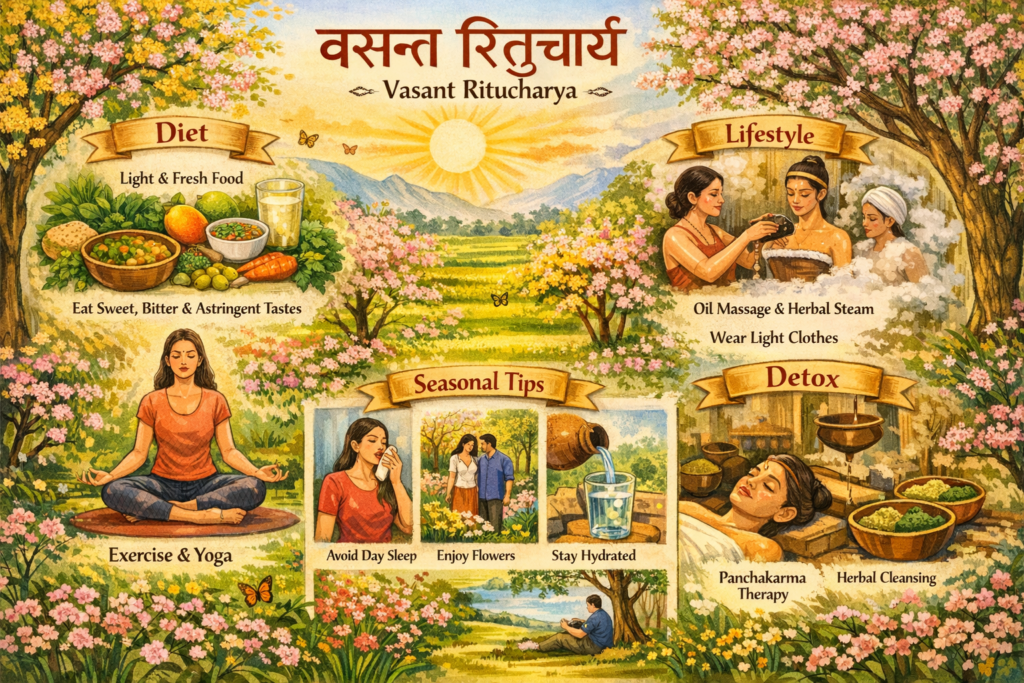
Modern medicine calls this seasonal transition. Ayurveda calls it Kapha prakopa — the awakening of accumulated heaviness — and it has had both a name and a solution for this feeling for at least three thousand years.
The solution is called Vasant Ritucharya. Vasant: spring. Ritu: season. Charya: regimen — the set of practices you follow. Together: the Ayurvedic routine for spring. And the reason you should start it now, if you have not already, is that this feeling in your body is not random. It is seasonal. And seasonal problems have seasonal answers.
This article is for anyone who has never studied Ayurveda but wants to understand what it actually says about spring — not in academic language, but in the language of daily life. What to eat. What to stop eating. Which herbs to take and how. How to move. How to breathe. And why all of it, when you understand the reasoning behind it, makes more sense than anything a diet chart has ever told you.
First, What Is Ritucharya? (And Why Should You Care)
The word Ritucharya comes from two Sanskrit roots: Ritu, meaning season, and Charya, meaning regimen or the way of living. Together, they mean the seasonal lifestyle — the specific adjustments Ayurveda recommends you make to your food, daily habits, sleep, movement, and self-care as each season changes.
Ayurveda divides the year not into four seasons but six. Each season brings a different energy, affects different aspects of the body, and requires a different response from you. The six seasons are Shishira (late winter), Vasanta (spring), Grishma (summer), Varsha (monsoon), Sharad (autumn), and Hemanta (early winter).
The Charaka Samhita — Ayurveda’s oldest and most authoritative classical text, written at least two thousand years ago — devotes an entire chapter to Ritucharya, called the Tasyashiteeya. Its central teaching is simple and profound: the person who understands what their body needs in each season and lives accordingly will have good health, good complexion, and good strength. The person who ignores the seasons will fall ill.
Tasya Shitadiya Ahaarbalam Varnascha Vardhate — the strength and complexion of the person who knows the suitable diet and regimen for every season and practises accordingly are enhanced.
— Charaka Samhita, Sutrasthana Chapter 6
This is not mysticism. It is observation — the accumulated wisdom of thousands of years of paying very close attention to what happens to the human body when the seasons shift. And it is as true now as it was when it was first written.
Understanding Kapha — The Key to Understanding Spring
Before we talk about what to do in spring, you need to understand one concept: Kapha dosha. This is the only piece of Ayurvedic theory you truly need to follow everything else in this article.
In Ayurveda, the entire universe — including your body — is made of five elements: earth, water, fire, air, and space. These five elements combine into three fundamental energies called doshas: Vata (air and space), Pitta (fire and water), and Kapha (earth and water). Every person has all three doshas, but in different proportions — and every season tends to increase one dosha more than the others.
Spring is Kapha season.
Here is why this matters in a way you can feel: during winter, the cold causes Kapha energy — the heavy, slow, cool, moist quality — to accumulate and freeze in the body, like water freezing into ice. This is actually good; winter is meant to be a time of rest and nourishment, and the body stores this heavy energy productively. But then spring arrives. The sun strengthens. The temperature rises. And all that frozen Kapha begins to melt — like ice becoming water.
This melting Kapha floods the system. It makes digestion sluggish. It fills the respiratory tract with mucus. It makes the body feel heavy and unmotivated. It is why spring is the season of colds, allergies, sinusitis, hay fever, heaviness, and a peculiar kind of tiredness. Not because spring is bad — spring is actually the season Ayurveda calls the King of Seasons — but because Kapha needs to be actively moved out of the body, and if you sit still and eat the same heavy winter foods, it will not leave on its own.
The entire Vasant Ritucharya — every food, every herb, every practice — is designed to do one thing: gently, intelligently help the body complete its spring detox. To move out the accumulated Kapha before it causes illness. To rekindle the digestive fire — called Agni — that winter and melting Kapha have dampened. And to emerge from spring lighter, clearer, and stronger, ready for the heat of summer.
The Spring Dinacharya — Your Day-by-Day Routine
Dinacharya means daily routine — the order of your day. Ayurveda is very specific about this, and the spring version of Dinacharya is different from your winter habits in several important ways.
🌅 Wake Up Before Sunrise
This is the single most important change you can make this spring. In Ayurveda, the hours of 6 AM to 10 AM are called Kapha time — the period when Kapha energy is at its heaviest in the natural world. If you sleep through Kapha time and wake up at 8 or 9 AM, you are waking up into the heaviest part of the day and the body carries that heaviness with it all morning.
The ideal wake time in Vasant Ritu is before sunrise — around 5:30 to 6 AM. The Sanskrit word for this time is Brahma Muhurta: the auspicious hour of Brahma. The air is clean, the mind is clear, and Vata energy (which is light and clear) is still dominant. Starting your day in Vata time rather than Kapha time makes an extraordinary difference to your energy, clarity, and motivation throughout the day.
If you cannot shift to 5:30 AM immediately, simply move your alarm back by fifteen minutes every few days. The body adapts quickly.
👅 Tongue Scraping — The First Act of the Day
Before you drink anything, before you brush your teeth, take a tongue scraper — ideally copper — and gently scrape the surface of your tongue from back to front, five to seven times. Rinse the scraper between each pass.
What you are removing is called Ama in Ayurveda — a Sanskrit word meaning undigested toxins. The body processes and detoxifies all night, and by morning, a coating builds up on the tongue that carries these toxins. If you swallow your saliva or drink water before scraping, you reabsorb a portion of what the body worked all night to eliminate. The tongue tells you a great deal: a thick white coating in spring means significant Kapha accumulation. As your Vasant Ritucharya progresses, the coating will reduce.
💧 Warm Water First — Always
The first thing you drink in spring should be warm water. Not cold. Not room temperature. Warm — the temperature of warm tea. A glass of warm water first thing in the morning gently activates the digestive fire that has been resting all night, helps flush the kidneys, and begins the movement of accumulated Kapha.
You can add one of the following to make it more therapeutic for spring: a squeeze of lemon and half a teaspoon of old honey (honey is Ayurveda’s greatest Kapha pacifier — but never add honey to hot water, only warm), or a thin slice of fresh ginger, or a pinch of turmeric. Any one of these takes your warm morning water from a simple good habit to an active spring medicine.
Note on honey: In Ayurveda, old honey — honey that has been stored for at least a year — is considered more therapeutic than fresh honey, which is heavier and more Kapha-forming. Spring is the one season when honey is actively prescribed.
🫒 Abhyanga or Udvartana — The Morning Body Practice
In winter, Abhyanga — the self-massage with warm sesame or mustard oil — is a deeply nourishing morning practice. In spring, Ayurveda recommends shifting away from heavy oil massage and toward Udvartana.
Udvartana is a dry powder massage — using a mixture of herbal powders (traditionally chickpea flour mixed with turmeric and a warming spice like dried ginger) massaged into the skin with firm, upward strokes. Unlike oil massage, which is nourishing and heavy, Udvartana is drying and stimulating. It activates the lymphatic system, reduces Kapha and water retention, improves circulation, and leaves the skin feeling genuinely alive. It takes only five minutes before your shower and the effect is noticeable from the first time you do it.
If Udvartana sounds too elaborate for a weekday morning, even dry brushing — using a natural bristle brush on dry skin before bathing, always brushing toward the heart — achieves a similar effect. The principle is the same: stimulate, move, energise. Do not let the skin sit in Kapha’s heaviness.
🛁 Bathing — With Warm (Never Hot) Water
Spring bath temperature is warm, not hot. Very hot showers feel wonderful in winter because the heat counters the cold. In spring, they dilate the blood vessels too rapidly when the body is already managing the liquefaction of Kapha, and can leave you feeling more fatigued than refreshed. Warm water is exactly right — warming enough to open the channels without overwhelming the system.
The classical texts also recommend occasional neem water baths in spring. Boil a handful of neem leaves in water, let it cool to warm, and add it to your bath. Neem is one of Ayurveda’s greatest spring medicines — bitter, antibacterial, and deeply purifying for both skin and respiratory system.
☀️ Sunlight — 20 to 30 Minutes Every Morning
Morning sunlight in spring is medicine. Not the harsh afternoon sun — the mild, golden morning light, ideally between 7 and 9 AM. Kapha is cold and heavy by nature, and sunlight is its direct antidote: warm, light, and energising. A twenty to thirty minute morning walk in sunlight — barefoot on grass if you have access — activates Vitamin D production, improves mood, stimulates circulation, and helps the body naturally burn through accumulated Kapha.
The Sanskrit for this practice is Suryasevana — the service of the sun. On a practical level, it simply means going outside every morning. The direction of the morning light, the warmth on the skin, the slight exertion of walking — all of these work together in a way that no supplement fully replicates.
😴 No Daytime Sleep — The Most Important Prohibition
Of all Vasant Ritucharya’s rules, this one is stated most firmly in the classical texts: no sleeping during the day. The Charaka Samhita specifically prohibits Divasvapna — daytime sleep — in spring.
Here is the reasoning: sleep increases Kapha. The body becomes heavier, cooler, and slower during sleep. During winter, this is appropriate and healing. During spring, when the body is already working to eliminate accumulated Kapha, adding more Kapha through daytime sleep counteracts the entire detox process. Even a twenty-minute afternoon nap will make you feel heavier rather than lighter, and will contribute to the very sluggishness you are trying to resolve.
If you genuinely cannot function without a daytime rest in spring, keep it to fifteen minutes maximum, sitting in a chair rather than lying down fully. The body rests without sinking fully into sleep.
What to Eat in Vasant Ritu — The Spring Food Guide
Spring asks something counterintuitive of the body: eat less, eat lighter, and eat warmer than you think you need. After winter’s richness — the ghee, the root vegetables, the heavy dals, the sweet warming foods — the spring table looks quite different. But once you understand why, the logic is completely clear.

The digestive fire — Agni — is naturally lower in spring because melting Kapha dampens it. Imagine trying to light a fire with wet wood. The fire exists, but it struggles. Your job in spring is to give it dry, light fuel — food that is easy to burn — while gradually bringing the fire back to its full strength. Heavy, oily, sweet, cold foods are wet wood. Light, warm, bitter, pungent foods are dry kindling.
✅ Eat More Of These
| ✅ Eat Freely in Spring | Why Ayurveda Recommends It |
| Old barley (jau) | The ideal spring grain — light, dry, easy to digest, reduces Kapha |
| Moong dal (green gram) | The lightest pulse — very easy on digestion, does not increase Kapha |
| Old rice (not fresh) | Lighter and drier than fresh rice; less Kapha-forming |
| Wheat (in moderation) | Acceptable if lightly prepared — roti better than heavy parathas |
| Bitter gourd (karela) | Bitter taste directly pacifies Kapha; one of the best spring vegetables |
| Drumstick (moringa) | Bitter, light, excellent for liver and respiratory system in spring |
| Fenugreek (methi) | Bitter and warming — both qualities needed in Vasant Ritu |
| Leafy greens (palak, sarson) | Light, bitter, easily digestible — perfect spring foods |
| Old honey | Ayurveda’s greatest Kapha pacifier — scrapes toxins, stimulates Agni |
| Ginger, black pepper, turmeric | Warming spices that rekindle digestive fire — use generously |
| Cinnamon, cardamom, cloves | All warming and Kapha-reducing — add to every cup of warm water |
| Pomegranate, apples, pears | Astringent and light fruits — appropriate for spring |
❌ Eat Much Less Of These
| ❌ Minimise in Spring | Why Ayurveda Cautions Against It |
| Dairy — curd, milk, paneer, cheese | Cold and heavy, increases Kapha directly; curd is especially problematic |
| Sweets — sugar, jaggery, mithai | Sweet taste is the most Kapha-forming of all six tastes |
| Fried foods — puri, pakora, samosa | Heavy and oily — wet wood for an already struggling digestive fire |
| Cold foods and drinks | Cold suppresses Agni and increases Kapha — avoid cold water entirely |
| Freshly harvested rice or new grain | Heavier and more Kapha-forming than old, stored grains |
| Heavy pulses — urad dal, rajma, chana | Dense and slow to digest — appropriate for winter, not spring |
| Excess salt | Salt is water-retaining and mildly Kapha-forming in excess |
| Sleeping immediately after eating | Suppresses Agni at exactly the moment it needs to work |
| Overeating — even light food | Amount matters as much as type; spring calls for 75% stomach, not full |
🫖 The Spring Morning Drink
Replace your morning chai — which is made with milk — with a simple herbal tea that does the opposite of what milk does. Boil a cup of water with a thin slice of fresh ginger, five to six fresh tulsi leaves, a small stick of cinnamon, and three to four black peppercorns. Simmer for five minutes. Strain. Add half a teaspoon of old honey once it has cooled to warm. Drink slowly.
This tea — ginger, tulsi, cinnamon, black pepper — is a spring pharmacy in a cup. Ginger kindles Agni. Tulsi clears the respiratory tract. Cinnamon warms and dries accumulated Kapha. Black pepper is one of the most powerful Kapha-dissolvers in Ayurvedic pharmacology. And honey scrapes ama from the tissues. Together, they do in thirty minutes what an antihistamine tries to do in six hours.
Herbs for Vasant Ritu — The Spring Pharmacy of Bharat
Ayurveda has always understood that food and herbs are not fundamentally different things. Both are medicines. The difference is that food works slowly, over seasons. Herbs work faster, and more specifically. During Vasant Ritu, certain herbs have been used for centuries to help the body complete its spring transition — to move Kapha, rekindle Agni, clear the respiratory tract, and restore lightness and energy. Here are the ones that matter most.
| 🌿 Herb | What It Does | How to Use It |
| Trikatu | The triple pungent formula: black pepper + long pepper (pippali) + dry ginger. Ayurveda’s most powerful digestive fire-kindler. Burns through accumulated Kapha like nothing else. | 1/4 tsp powder mixed in warm honey after meals · Or with warm water before meals · Available at Ayurvedic stores as Trikatu churna |
| Triphala | The three-fruit formula: amla + haritaki + bibhitaki. Gently cleanses the entire digestive tract, removes Ama (toxins), improves assimilation, and tones the gut. The most balanced detox herb in Ayurveda. | 1/2 tsp in warm water at bedtime · Do not take if you are fasting or pregnant · Takes 2–3 weeks to show full effect |
| Tulsi (Holy Basil) | Ayurveda’s greatest respiratory herb. Clears mucus from the bronchial passages, reduces allergic response, strengthens immunity, and has warming anti-Kapha properties. | 5–7 fresh leaves in morning tea · Or as tulsi tea throughout the day · Keep a tulsi plant at home if possible — the living plant itself purifies air |
| Ginger (Sunti / Shunthi) | The universal medicine of Ayurveda. Fresh ginger kindles Agni, dried ginger (shunthi) moves Kapha more powerfully. Both are essential in spring. | Fresh: thin slice in morning warm water · Dried: in herbal tea or as Trikatu · Ginger and honey: Ayurveda’s oldest cold and congestion remedy |
| Neem (Nimba) | Bitter, purifying, deeply anti-Kapha. One of the most important spring herbs for skin, blood, and respiratory health. Removes Ama from the blood and lymph. | 5–7 fresh neem leaves chewed on an empty stomach in spring (powerful but bitter — an acquired practice) · Neem leaf powder in warm water · Neem water bath weekly |
| Turmeric (Haridra) | Anti-inflammatory, blood-purifying, Agni-kindling. Turmeric reduces the inflammatory response that accompanies spring allergies and Kapha congestion. | 1/2 tsp in warm water or warm milk (golden milk) · Add to every cooked dish in spring · Turmeric + black pepper: the combination maximises absorption by up to 2000% |
| Pippali (Long Pepper) | Stronger than black pepper for Kapha. Classical Ayurvedic texts specifically recommend pippali for lung and respiratory conditions in spring. An extraordinary herb. | In Trikatu formula · Or 1–2 pippali fruit ground with honey · Available at Ayurvedic pharmacies |
The herbs of Vasant Ritu are not supplements to fill a nutritional gap. They are the seasonal intelligence of the plant kingdom — plants that evolved in the same ecosystem as the human body, and that the human body has been in conversation with for thousands of years.
— Whispering Bharat
Yoga & Breathwork for Vasant Ritu — Move the Kapha
Ayurveda and Yoga are sister sciences — both emerged from the same Vedic understanding of the body and both are more powerful together than separately. In Vasant Ritu, Yoga is not optional. The body’s accumulated Kapha does not move on its own. It needs to be moved. And nothing moves it quite like the combination of dynamic physical practice and specific pranayama (breathwork) that the spring season calls for.

The principle is simple: Kapha is heavy, slow, cold, and still. The antidote is light, fast, warm, and moving. Your spring Yoga practice should be more vigorous than your winter practice. More sun salutations, more standing poses, more inversions, more chest-openers. And the pranayama should be activating rather than calming.
| Asana / Pranayama | What It Does for Spring | Hold / Duration |
| Surya Namaskar (Sun Salutations) | Warms the entire body, activates circulation, burns through Kapha heaviness. The single most important spring practice. Ayurveda calls it agni-deepana — kindler of fire. | 12 rounds at a moderate pace · Build to 24 over the season · Best done at sunrise |
| Bhujangasana (Cobra Pose) | Opens the chest and lungs — exactly where spring Kapha accumulates. Stimulates the adrenal glands and increases energy. A fundamental spring pose. | Hold 30–60 seconds · 3 repetitions · Feel the chest fully open on each inhale |
| Ustrasana (Camel Pose) | A deep backbend that opens the entire front of the chest and respiratory tract. Particularly effective for spring congestion and heaviness. | Hold 20–30 seconds · 2–3 repetitions · Always follow with Child’s Pose |
| Virabhadrasana I & II (Warrior Poses) | Standing poses that build heat and strength. Counters Kapha’s tendency toward passivity and heaviness. The warrior’s grounded energy is exactly what spring calls for. | 30–60 seconds each side · 2 sets · The longer you hold, the more Kapha you move |
| Trikonasana (Triangle Pose) | Opens the side body and creates space in the lungs. Stimulates digestion and liver function — both sluggish in spring. A whole-body Kapha mover. | 30–45 seconds each side · 2 sets · Keep the chest open and lifted |
| Kapalabhati Pranayama (Skull Shining Breath) | The most powerful spring pranayama. Rapid, forceful exhales through the nose clear mucus from the sinuses and respiratory tract, rekindle Agni, and energise the entire nervous system. Called ‘skull shining’ because clarity follows practice. | 3 rounds of 30–50 breath cycles · Pause between rounds · Never force if congested — build gradually |
| Bhastrika (Bellows Breath) | Bellows-like rapid inhale and exhale. Generates intense heat, clears Kapha from the respiratory system, and dramatically increases Agni. More vigorous than Kapalabhati. | 2–3 rounds of 20 cycles · Only on an empty stomach · Avoid if you have high blood pressure |
| Anulom Vilom (Alternate Nostril Breathing) | Balances Vata and Pitta while clearing respiratory channels. Calms the mind after vigorous practice. Appropriate for ending the spring pranayama sequence. | 10 minutes after Kapalabhati or Bhastrika · Also excellent before meditation |
The Spring Morning Practice — What It Actually Looks Like
You do not need two hours. A complete spring morning Yoga practice can be done in thirty-five to forty minutes and covers everything the body needs. Here is a simple sequence:
Begin with five minutes of Kapalabhati — three rounds, with rest between. This clears the channels before the body moves. Follow with twelve rounds of Surya Namaskar at a pace that makes you mildly warm. Then move through five minutes each of Bhujangasana, Trikonasana, and Virabhadrasana. End with ten minutes of Anulom Vilom and five minutes of silent sitting or meditation. This sequence, done every morning — or even five mornings a week — will transform your spring experience within two weeks.
What to Expect — The Spring Transformation, Week by Week
Vasant Ritucharya does not work like a medicine that produces an instant result. It works the way seasons work — gradually, cumulatively, and completely. Here is an honest description of what most people notice as they follow the spring routine.
| Week 1 | The tongue coating may actually increase briefly — the body is releasing Ama more actively. Morning warmth drink helps. The early wake time feels difficult for 3–4 days then becomes natural. |
| Week 2 | Sinuses begin to clear. Morning heaviness reduces noticeably. Digestion starts to feel lighter after meals — the first sign that Agni is recovering. Energy in the morning improves. |
| Week 3 | Most people notice a genuine shift in energy levels — less afternoon slump, clearer thinking, lighter body. Skin often improves as blood and lymph clear. Old cravings for heavy foods reduce. |
| Week 4 | The spring body is here. Lighter, clearer, more motivated. The afternoon heaviness that was constant in weeks one and two has largely gone. Morning practice becomes something you want rather than something you do. |
| Whole Season | By mid-May, when spring transitions to summer, the body is ready for the heat: digestion is strong, respiratory tract is clear, and the winter’s accumulated weight — physical and energetic — has largely moved. |
A Last Thought — Why This Is Not Just a Health Tip
Every culture on earth has an intuition about spring as renewal. The urge to clean the house, to open the windows, to eat less and move more — this is not a modern wellness trend. It is an ancient human intelligence responding to an ancient seasonal signal.
What Ayurveda did, thousands of years ago, was take this intuition and make it precise. It looked at the patterns — the heaviness that arrives in spring, the respiratory congestion, the sluggish digestion — and traced them back to their cause. It understood that the body and the season are not separate systems. They are the same system, and when one shifts, the other must respond or suffer the consequences of not responding.
Vasant Ritucharya is what that response looks like. It is not deprivation. It is not a diet. It is not a detox in the modern sense of the word — a few days of green juice and discomfort. It is a seasonal reorientation of the way you live. Lighter food. Earlier mornings. More movement. Specific herbs taken with intention. Breathwork that clears what the body is trying to clear anyway. And the reward — if reward is even the right word — is simply feeling the way spring is supposed to feel. Light. Clear. Alive.
Start today. Not next Monday. Not when it is more convenient. The season has already begun. The body is already asking.
ॐ
May the wisdom of Vasant Ritu bring you lightness, health, and clarity.
🌿 Have you tried any Vasant Ritucharya practices? Or does your family follow a spring tradition passed down through generations that no Ayurveda textbook has ever recorded? Write to us — every kitchen and every grandmother holds a piece of this knowledge, and we are always listening.